Tag Archives: Revolutionary War

Yorktown: The Victory That Secured American Independence

In the summer of 1781, the Revolutionary War had dragged on for more than six years.
The British still held New York City. Their army remained one of the most powerful fighting forces in the world. Yet events set in motion during the Southern Campaign were about to converge on a small Virginia tobacco port called Yorktown.

As discussed in my previous article, British General Charles Cornwallis entered Virginia after a frustrating campaign in the Carolinas. Although he had won several tactical victories, British defeats at Kings Mountain and Cowpens, combined with General Nathanael Greene’s relentless strategy of attrition, steadily weakened Britain’s hold on the South.

Cornwallis hoped Virginia would provide a secure base for future operations. Instead, Yorktown became a trap.

A French Fleet Changes Everything

One of the greatest “what if” moments in American history occurred at sea.

In August 1781, a French fleet commanded by Admiral François Joseph Paul de Grasse sailed into the Chesapeake Bay. His arrival transformed the strategic situation.

The British navy, long considered invincible, attempted to regain control of the bay. The resulting Battle of the Chesapeake proved decisive. The French prevented British ships from reaching Yorktown and cut off Cornwallis’s most reliable escape route.

For the first time during the war, British forces found themselves vulnerable and isolated.
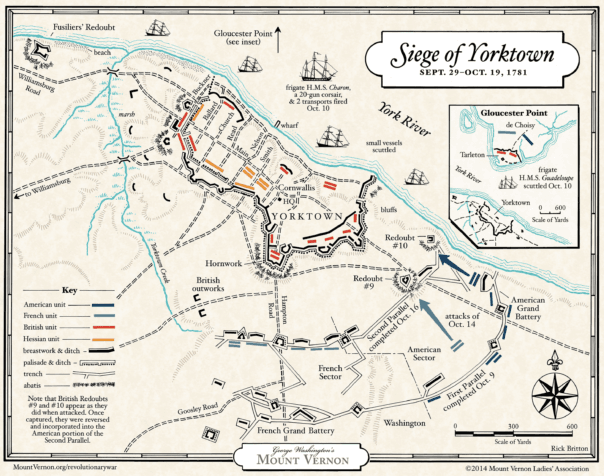
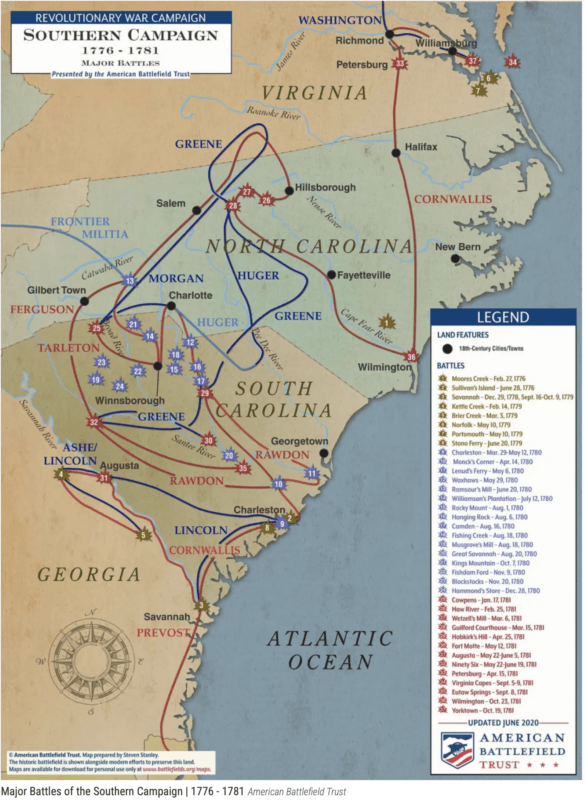
Seige of Yorktown Map, from Mount Vernon website.

Washington Sees His Opportunity

General George Washington had spent years watching British forces occupy New York City. Although he had hoped to recapture the location, circumstances rarely favored such an attack.

When news arrived that de Grasse would support operations in Virginia, Washington quickly changed plans.

Together with French General Jean-Baptiste Donatien de Vimeur, Comte de Rochambeau, Washington secretly moved thousands of American and French troops south. The march covered more than 400 miles and remains one of the most impressive military maneuvers of the war.

The British commander in New York did not fully realize Washington’s intentions until it was too late.

By late September, allied forces were converging on Yorktown.

The Siege Begins

Unlike many famous Revolutionary War battles, Yorktown was NOT decided in a single dramatic afternoon.

Instead, it became a carefully executed siege.

American and French troops surrounded the town while the French fleet blocked escape by sea. Cornwallis’s army found itself trapped between land and water.

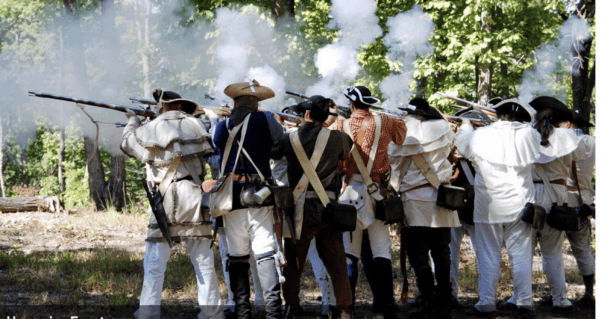
Engineers dug trenches closer and closer to British defenses. Artillery batteries bombarded the town day and night. The thunder of cannon fire echoed across the Virginia countryside.
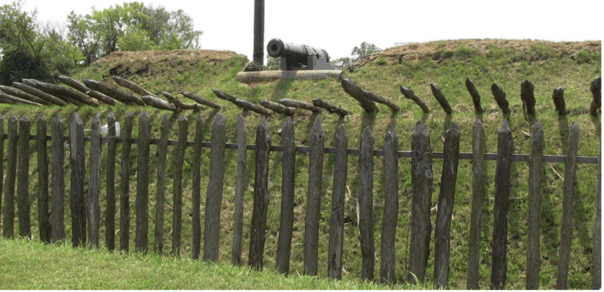
Yorktown Redoubt 10

As the siege tightened, British options dwindled.

Two key British defensive positions, Redoubts 9 and 10, became critical obstacles. In one of the most celebrated actions of the war, American troops led by Alexander Hamilton stormed Redoubt 10 with fixed bayonets during a nighttime assault. French forces simultaneously captured Redoubt 9.

The fall of the redoubts brought allied artillery within range of the British interior defenses and accelerated the collapse of Cornwallis’s position.
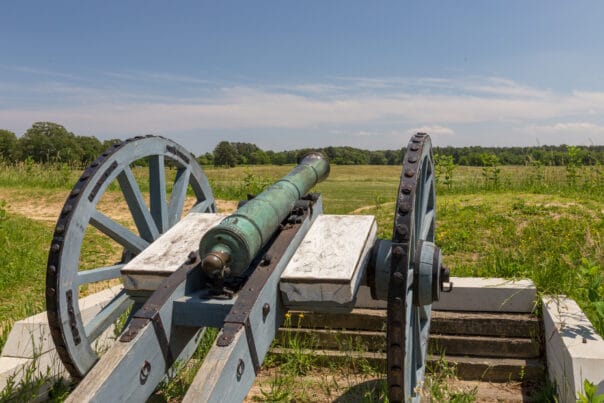
Canon at Yorktown Battlefield today. Photo ©Bylandersea

The Surrender

On October 19, 1781, Cornwallis surrendered.

Nearly 8,000 British soldiers laid down their arms.
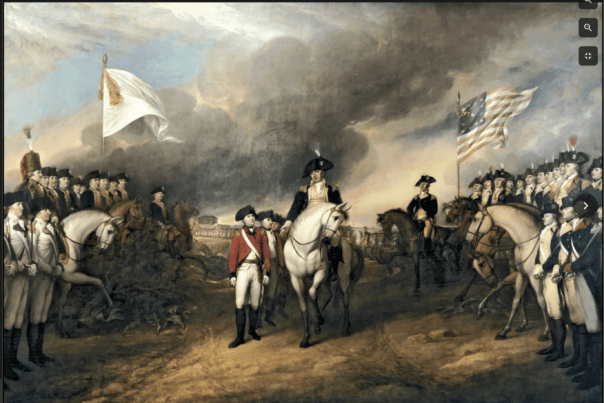
The Surrender of Lord Cornwallis
The Surrender of Lord Cornwallis (at Yorktown, Virginia, on October 19, 1781), oil on canvas by John Trumbull, completed in 1820; in the U.S. Capitol Rotunda, Washington, D.C. The painting captures the moment when major fighting during the American Revolution ended and the colonies achieved independence.

Legend holds that Cornwallis claimed illness and sent a subordinate to represent him at the surrender ceremony. Whether motivated by pride or genuine sickness, the gesture reflected the magnitude of Britain’s defeat.

The war did not officially end until the Treaty of Paris was signed in 1783, but Yorktown effectively ended major combat operations in North America.

Parliament soon recognized that continuing the war would be costly and increasingly unpopular. The American Revolution had been won.

Why Yorktown Matters

As America commemorates its 250th anniversary, Yorktown offers more than a history lesson. It is a place to reflect on the perseverance, sacrifice, and international cooperation that made independence possible. The victory achieved here on October 19, 1781, did not end the Revolutionary War overnight, but it marked the decisive turning point that led to the birth of the United States.

After following the Road to Revolution from Lexington and Concord through the battles of New England, the Middle Colonies, and the Carolinas, there is no more fitting place to conclude the journey than Yorktown—where the dream of independence became a reality.

Yorktown Travel Guide
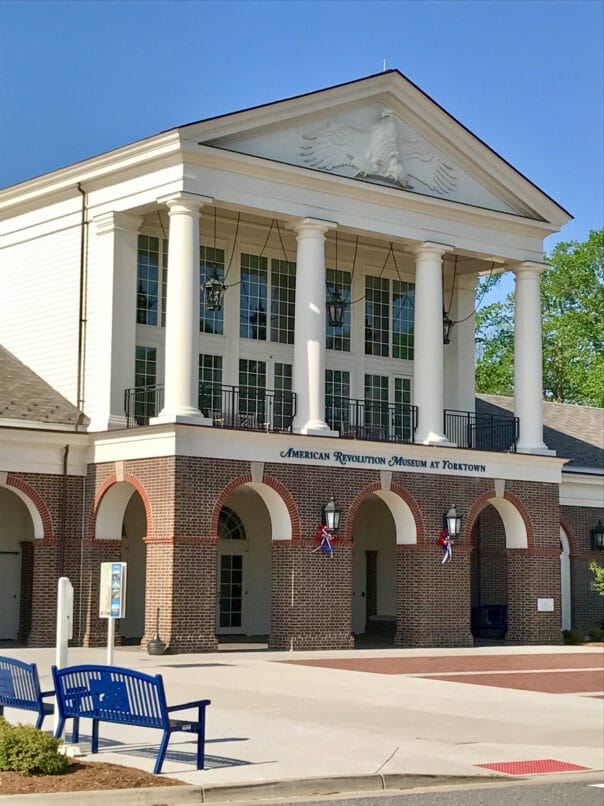
Start your visit at the multi-media American Revolution Museum of Yorktown. Photo ©Bylandersea

Few places bring the story of American independence to life more vividly than Yorktown.

The battlefield, riverfront village, and museums bring the final chapter of the Revolution vividly to life, while the quiet landscape encourages reflection on the extraordinary events that unfolded here in October 1781.

Although I first visited the former Yorktown Victory Center years ago, the experience today is dramatically different. The American Revolution Museum at Yorktown, which opened in 2017, brings the story of the Revolution to life through immersive exhibits, films, and engaging living- history experiences. It is wonderful for children, as well.

An interactive exhibit called The Liberty Tree in the American Revolution Museum at Yorktown. Photo ©Bylandersea

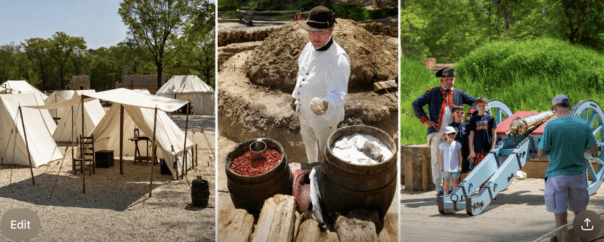
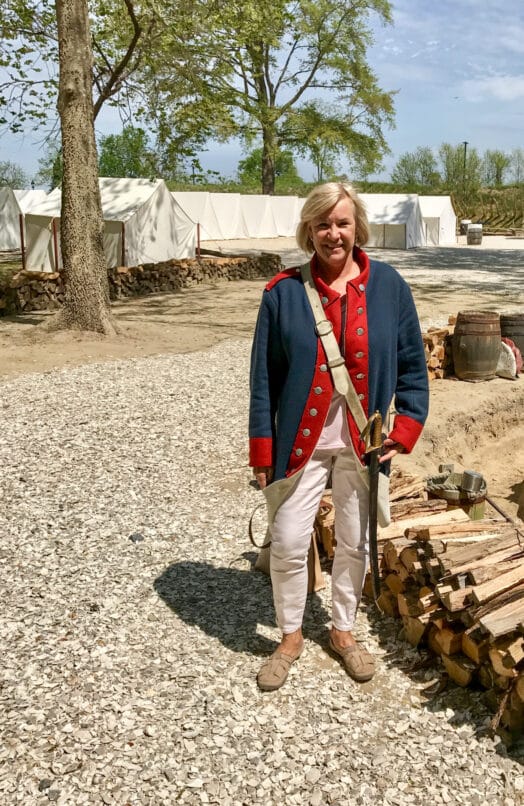
Stepping into history at the American Revolution Museum at Yorktown’s living-history area. Trying on the uniform of an eighteenth-century soldier offered a small glimpse into the lives of those who fought for independence in 1781.
Activities at the Encampment at the American Revolution Museum at Yorktown Photos ©Bylandersea

Afterward, continue to the  Colonial National Historical Park for the Yorktown Battlefield Visitor Center and follow the self-guided battlefield driving tour. Stop at the siege lines, Surrender Field, the Moore House where the surrender terms were negotiated, and the monuments commemorating the American and French victory. The visitor center and interpretive exhibits provide additional context for one of the most significant military campaigns in American history.
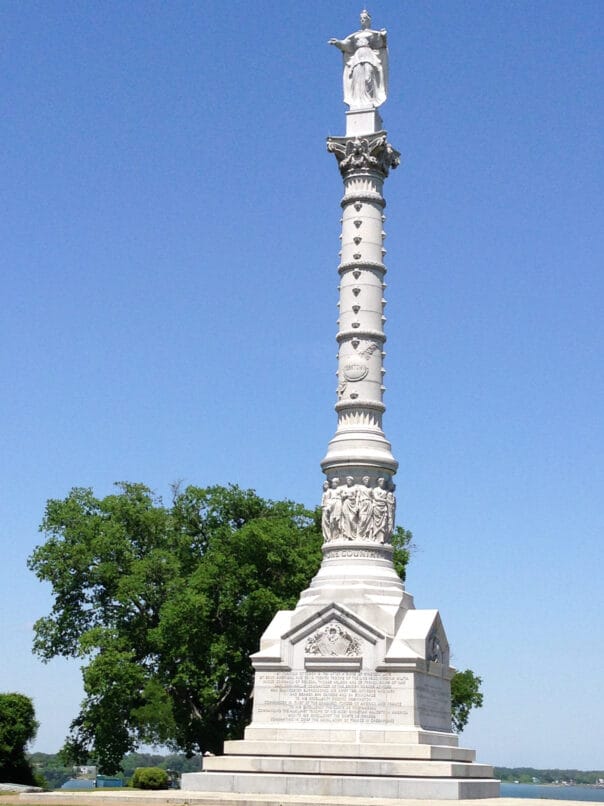
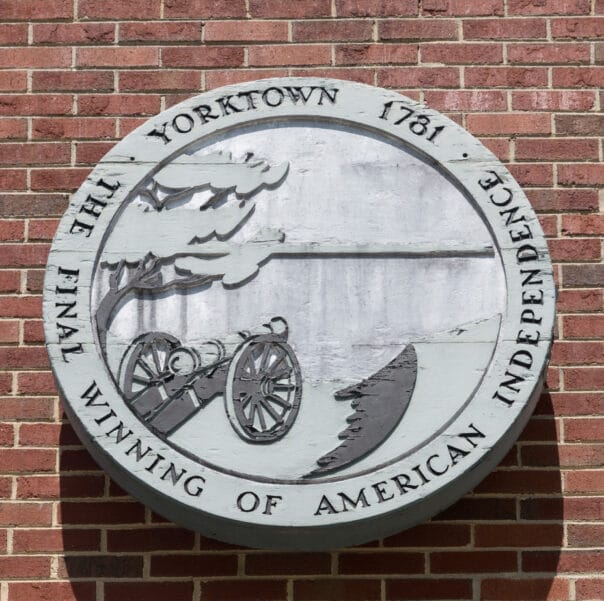
The Yorktown Victory Monument commemorates the decisive Allied victory that secured American independence. Authorized by the Continental Congress in 1781, the monument was not completed until 1884 and today stands overlooking the York River where history changed forever.

Allow time to stroll Historic Yorktown’s charming waterfront, browse its small museums and shops, and enjoy views of the York River that remind visitors why this peninsula became the setting for a world-changing victory. While you are in this area, known as the Virginia Historic Triangle, be sure to visit Colonial Williamsburg (my favorite) and Jamestown.  
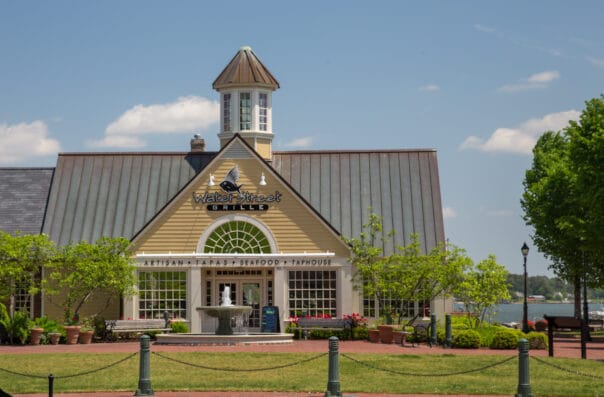
Yorktown’s Waterfront offers shops and restaurants. Photo ©Bylandersea

Did You Know?

Legend says the British army that surrendered at Yorktown marched out to the tune of “The World Turned Upside Down.” While historians still debate whether that tune was actually played, the phrase has become a lasting symbol of how the Revolutionary War transformed the world.

The stories of the Treaty of Paris and Washington’s resignation will follow soon.

The Road to Yorktown: How the Southern Campaign Won the Revolution

When Americans think of the Revolutionary War, they often picture Lexington and Concord, Valley Forge, or Washington crossing the Delaware, (all stories I have covered earlier in this series). Yet the road to independence did not end in New England. It ended hundreds of miles to the south at Yorktown, Virginia.

The final victory at Yorktown in October 1781 was not the result of a single battle. Instead, it was the culmination of a long and grueling Southern Campaign that slowly wore down British forces and changed the course of the war.

By 1778, Britain had shifted its focus to the southern colonies. British leaders believed they would find large numbers of Loyalists willing to support the Crown in Georgia and the Carolinas. Capturing the South, they hoped, would isolate the rebellious northern colonies and restore royal control.

Initially, the strategy seemed successful.

The British captured Savannah in 1778 and Charleston in 1780. Charleston’s surrender was one of the worst American defeats of the war. Thousands of Patriot soldiers were taken prisoner, and British General Charles Cornwallis appeared poised to restore British authority throughout the South. Then the tide began to turn.

Kings Mountain: The First Blow

In October 1780, Patriot militia from the frontier settlements gathered at what is now known as the Overmountain Victory National Historic Trail. These rugged backcountry fighters crossed the Appalachian Mountains and pursued Loyalist forces under Major Patrick Ferguson.

At Kings Mountain, on the border of North and South Carolina, the Patriots surrounded Ferguson’s force and won a decisive victory. Ferguson was killed, and more than 1,000 Loyalists were captured, killed, or wounded.

Thomas Jefferson later called Kings Mountain “the turn of the tide of success.” The victory shattered British hopes of raising large numbers of Loyalist supporters in the Carolina backcountry.

Cowpens: A Tactical Masterpiece

Three months later, another Patriot victory further weakened British control.

At Cowpens, South Carolina, General Daniel Morgan devised one of the most brilliant battle plans of the Revolution. He arranged his militia and Continental troops in successive lines, carefully anticipating how the British would attack.

The plan worked perfectly. British commander Banastre Tarleton’s forces were routed. More than 800 British soldiers were killed, wounded, or captured.

Cowpens not only damaged British military strength but also boosted Patriot morale throughout the South.

The Race to the Dan

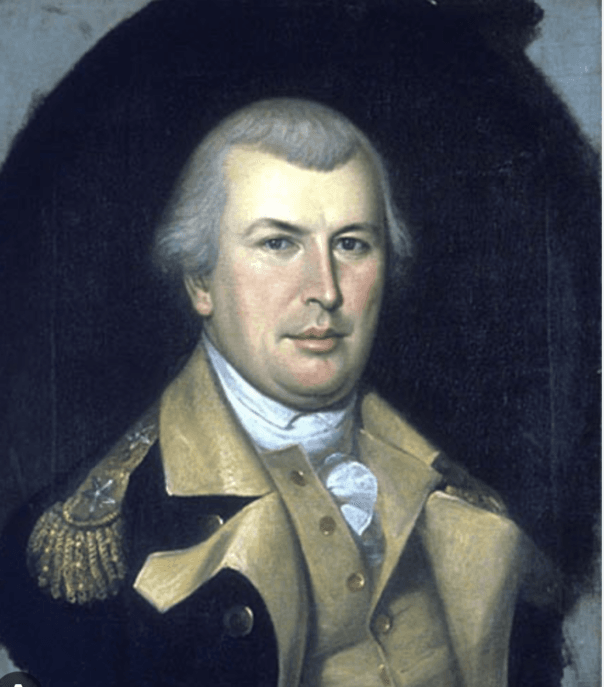
General Nathanael Greene

After Cowpens, General Nathanael Greene faced a difficult challenge. His army was smaller and less experienced than Cornwallis’s veteran troops. Rather than risk destruction in a major battle, Greene chose a strategy of movement and endurance.

For weeks, Patriot forces retreated across North Carolina while Cornwallis pursued them. The campaign became known as the Race to the Dan.

Greene successfully crossed Virginia’s Dan River and escaped. Cornwallis had failed to destroy the American army. Greene then turned and marched south again.

Guilford Courthouse: A Costly Victory

In March 1781, Greene confronted Cornwallis at Guilford Courthouse in present-day Greensboro, North Carolina. The British won the battle and held the field at day’s end. On paper, it appeared to be a British victory.

But the cost was enormous.More than a quarter of Cornwallis’s army became casualties. The British could not easily replace experienced soldiers operating far from their bases.

Greene’s army remained intact. The battle demonstrated a critical truth: Cornwallis could win battles and still lose the campaign.

The Long Fight for the South

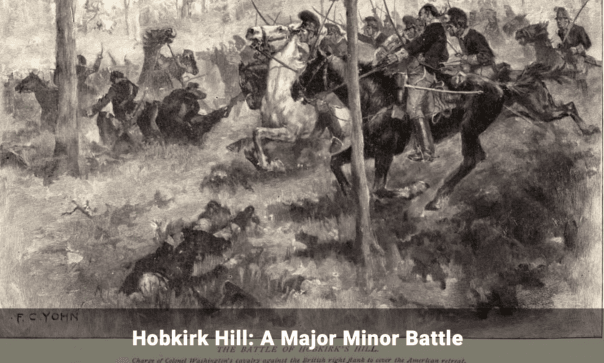
Photo from Journal of the American revolution

Greene continued to pressure British forces throughout the Carolinas.

At Hobkirk’s Hill, Ninety Six, and Eutaw Springs, Patriot troops repeatedly challenged British positions. Although Greene did not win every engagement, he forced the British to expend men, supplies, and energy simply to hold territory.

British forces gradually abandoned much of the interior South and retreated toward coastal strongholds.

The Southern Campaign became a war of attrition.Greene later summarized his strategy:

“We fight, get beat, rise, and fight again.”

His persistence slowly achieved what dramatic victories alone could not.

Cornwallis Moves North

Unable to secure the Carolinas, Cornwallis shifted his attention to Virginia.

The decision marked a turning point in the war. British forces had captured major southern cities and won several battles, yet they had failed to crush the Patriot cause. Nathanael Greene’s relentless campaign had steadily weakened British control of the countryside and forced Cornwallis to seek a new strategy.

By the summer of 1781, the war’s center of gravity was moving north.

Cornwallis marched into Virginia, believing he could establish a secure base and continue British operations. Instead, he was heading toward a place that would become synonymous with the end of the Revolutionary War.

The Southern Campaign had accomplished its purpose. Through persistence, sacrifice, and a series of hard-fought victories, Patriot forces had worn down one of Britain’s finest armies and pushed the war toward its final chapter.

The road to Yorktown had begun.

Next in the America 250 series: Yorktown – The Victory That Won Independence.

Hikers may enjoy the Overmountain Victory Trail: Stretching 330-miles through four states (Virginia, Tennessee, North and South Carolina) the Overmountain Victory National Historic Trail traces the route used by Patriot militia during the pivotal Kings Mountain campaign of 1780. Follow their campaign by utilizing a Commemorative Motor Route along existing state highways marked with the distinctive trail logo, or 80+ miles of walkable trail.

The Overmountain Men: Virginia Patriots and the Battle of Kings Mountain

If you are an Outlander fan like me, the Battle of Kings Mountain likely resonates deeply. In Diana Gabaldon’s story, Jamie Fraser knows that this rugged mountain fight in October 1780 will become a turning point in the American Revolution—and a moment that will shape the destiny of his family.

Long before Jamie’s fictional march, real frontiersmen gathered in what is now Abingdon, Virginia, to answer the call to arms.

T

A Quiet Place with a Powerful Story

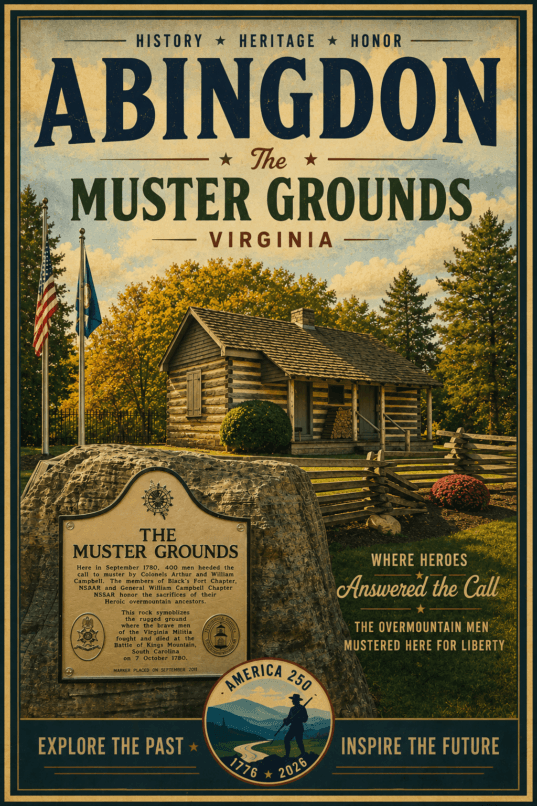
Today, visitors to Abingdon can stand at the historic The Muster Grounds, a site run by the National Park Service. . A simple marker and reconstructed log cabin commemorate the place where approximately 400 Virginia militia assembled in September 1780. It is part of the Overmountain Victory National Historic Trail.

These men responded to the leadership of Colonels Arthur Campbell and William Campbell, preparing to join the legendary Overmountain Men—backcountry settlers from Virginia, North Carolina, and what is now Tennessee.

Their mission was urgent: stop British Major Patrick Ferguson before he could crush Patriot resistance in the southern colonies.

Who Were the Overmountain Men?

The Overmountain Men were farmers, hunters, and Indian fighters living west of the Blue Ridge Mountains. They were fiercely independent and accustomed to hardship.

When Ferguson threatened to “lay waste” to their settlements, they chose to strike first.

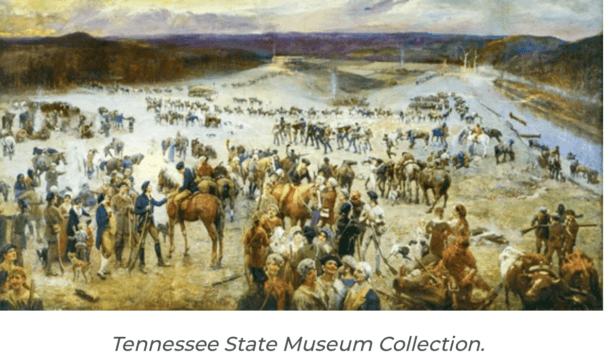
Gathering at places such as Abingdon and Sycamore Shoals State Historic Park, they crossed the Appalachian Mountains on horseback, carrying long rifles and enough determination to alter the course of the war.

The Gathering of the Overmountain Men at Sycamore Shoals, by Lloyd Branson in 1915

The March to Kings Mountain

The Patriots converged on the South Carolina frontier and caught Ferguson’s Loyalist force atop Kings Mountain National Military Park on October 7, 1780. The battle lasted little more than an hour.

Using frontier tactics and accurate rifle fire, the Americans surrounded the ridge and attacked from all sides. Ferguson was killed, and his army was destroyed.

Thomas Jefferson later called Kings Mountain “the joyful annunciation of that turn of the tide of success which terminated the Revolutionary War.”

Why Kings Mountain Mattered

Before Kings Mountain, the British appeared dominant in the South after victories at Charleston and Camden. You can read my earlier blog posts on those battles here: https://bylandersea.com/2026/04/from-savannah-to-kings-mountain-a-turning-point-in-the-southern-campaign/

For many historians, Kings Mountain was the beginning of the end for British hopes in the South.

The Outlander Connection

In Outlander, Jamie Fraser understands that Kings Mountain is one battle he cannot avoid.

Fans know the emotional weight of that realization. Jamie marches toward a fight where Frank records his death.

While I visited a few years ago, standing at the Muster Grounds in Abingdon brings that fictional journey vividly to life. The peaceful log cabin and memorial marker speak to the courage of the men who gathered here, leaving farms and families to defend the cause of liberty.

Visiting the Muster Grounds

The Muster Grounds are located near downtown Abingdon and are an ideal stop for travelers exploring Virginia’s Revolutionary War history. Nearby lies the Sinking Spring Cemetery.

Sinking Spring Cemetery

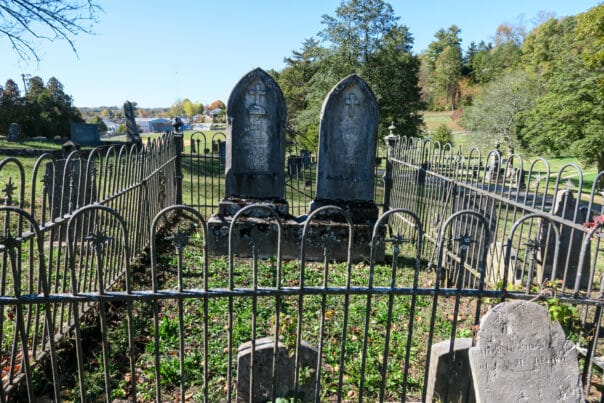
The Sinking Spring Cemetery is one of the oldest burial grounds in Southwest Virginia. Established in the late 18th century, the cemetery contains the graves of frontier families, Revolutionary War veterans, and generations of settlers who built this rugged corner of Virginia.


As I wandered among the weathered headstones and iron-fenced family plots, I could not help but wonder whether some of the men who answered the call to arms in September 1780 now rest here. These were farmers, hunters, and fathers who left their homes to join the Overmountain campaign and march toward the Battle of Kings Mountain.


The worn stones, softened by time and lichen, offer a poignant reminder that history is not just found in monuments and battlefields. It also lives in the quiet places where those who shaped our nation were laid to rest.

Weathered gravestones at Sinking Spring Cemetery in Abingdon, Virginia, stand as enduring reminders of the frontier families who lived, fought, and died in the era of the American Revolution.

Final Thoughts

The Overmountain Men were not professional soldiers. They were neighbors, fathers, and farmers who rose when liberty was threatened. Their victory at Kings Mountain changed the Revolution.

And for Outlander fans, this quiet Virginia site offers a moving connection between historical truth and beloved fiction.

Where to Stay

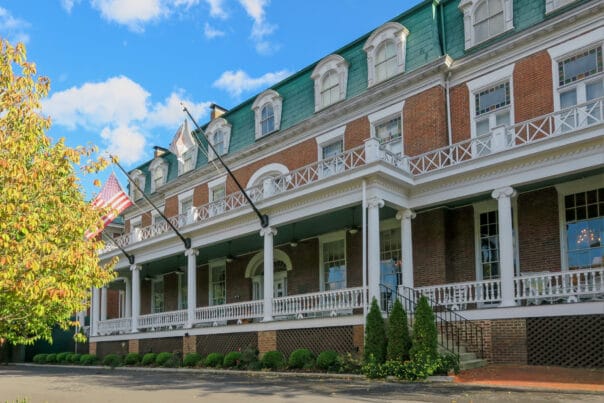
Martha Washington Inn and Spa is the place to stay in Abingdon. Photo ©Bylandersea

The Martha Washington Inn & Spa is one of Virginia’s most storied hotels and an ideal place to stay while exploring Abingdon’s Revolutionary War sites, including the Muster Grounds and Sinking Spring Cemetery.


The building was constructed in 1832 as a private residence for General Francis Preston, a prominent attorney, politician, and member of one of Southwest Virginia’s leading families. The mansion reflected the elegance and prosperity of early 19th-century Abingdon, with wide porches, gracious rooms, and a commanding location on Main Street.


A Women’s College
In 1858, the property became Martha Washington College, named for George Washington’s wife, Martha Washington. The school educated young women for more than seven decades and gained a reputation as one of the South’s respected female academies. Students studied literature, music, languages, and the social graces expected of the era.


Civil War Hospital
During the Civil War, the college served as a Confederate hospital. Wounded soldiers were treated in the classrooms and dormitories, and local lore speaks of lingering spirits from this turbulent period.


Reinvented as a Hote
l
The school closed in 1932, and in 1935 the building reopened as the Martha Washington Inn. Over time, it became one of Virginia’s best-known historic hotels. Today, the inn blends period charm with modern comforts, including a spa, elegant guest rooms, and welcoming common areas. I loved my stay there.


Ghost Stories and Legends
The hotel is widely considered one of Virginia’s most haunted inns. Guests and staff have reported mysterious footsteps, unexplained voices, and other paranormal encounters, particularly in the older sections of the building. I did not encounter any and loved my stay in the Inn.