Tag Archives: American Independence

The Treaty of Paris: Winning the Peace That Created a Nation

Part of the ByLanderSea America 250: Road to Revolution Series

The War Was Won—But Peace Had Yet to Be Secured

The surrender of British General Charles Cornwallis at Yorktown on October 19, 1781, marked the decisive military victory of the American Revolution. For many, the war seemed over.
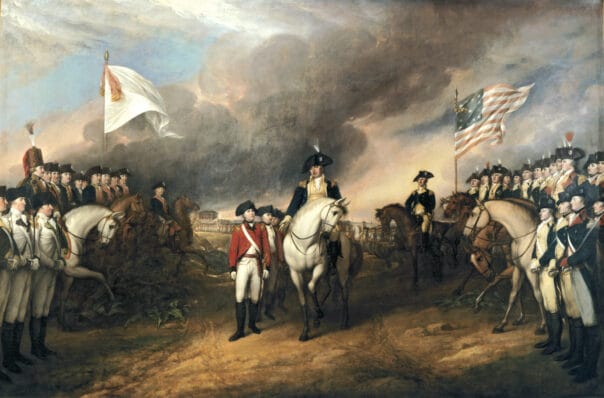
Surrender of Cornwallis By John Trumbull
– http://www.aoc.gov/cc/photo-gallery/ptgs_rotunda.cfm, Public Domain, https://commons.wikimedia.org/w/index.php?curid=1379717

It wasn’t.

Although the guns had fallen silent in Virginia, Great Britain had not yet recognized the independence of its former colonies. British troops still occupied New York City, Charleston, and Savannah, and no treaty had been signed. Winning the war on the battlefield was only the beginning. Now came the equally challenging task of winning the peace.

For nearly two years, diplomats worked across the Atlantic to transform military victory into an internationally recognized nation. (I think most of us forget this piece of history.)

Diplomacy in Paris

Peace negotiations began in Paris in the spring of 1782. Representing the United States were four remarkable men: Benjamin Franklin, already admired throughout France for his scientific achievements and diplomatic skill; John Adams of Massachusetts; John Jay of New York; and later Henry Laurens of South Carolina.
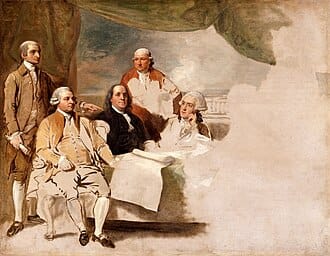
Benjamin West, Public domain, via Wikimedia Commons Unfinished Treaty of Paris: It shows, from left, John Jay, John Adams, Benjamin Franklin, Henry Laurens, and William Temple Franklin; the British refused to pose.

Franklin had spent years cultivating France’s friendship, securing the financial aid, military assistance, and naval support that proved essential to victory at Yorktown. Now he faced an equally difficult assignment—helping negotiate favorable terms for the new nation.

The negotiations were far from simple. Although France had been America’s indispensable ally during the war, French interests did not always align perfectly with those of the United States. John Jay became convinced the Americans would secure better terms by negotiating directly with Britain. John Adams agreed. Franklin, recognizing the importance of maintaining unity among the American commissioners, eventually supported the decision. The negotiations were delicate, sometimes tense, but ultimately successful.

A Remarkably Favorable Peace

On September 3, 1783, representatives of the United States and Great Britain signed the Treaty of Paris. Its terms exceeded nearly everyone’s expectations.

Great Britain formally recognized the independence of the United States. The new nation gained territory stretching from the Atlantic Ocean west to the Mississippi River and from Canada south to Spanish Florida. Americans retained valuable fishing rights off Newfoundland and agreed that pre-war debts would be honored. The treaty also recommended restitution for Loyalists whose property had been confiscated during the war, although enforcement varied from state to state.

Historians have often described the agreement as one of the most favorable peace treaties ever granted to a victorious former colony. The United States emerged not only independent but with abundant land and extraordinary opportunities for growth.

Yorktown had won the war. Paris secured the peace.

Following the Story Today

One of the pleasures of writing this Road to Revolution series has been visiting many of the places where history unfolded. You can see the actual document at the National Archives in Washington, D.C.

Although the treaty bears the name “Treaty of Paris,” surprisingly little marks the exact site where negotiations took place. The American commissioners met at the Hôtel d’York on Rue Jacob, where the building still stands as a private residence. During my upcoming visit to Paris, I hope to stand outside that historic address and imagine Franklin, Adams, and Jay negotiating the future of a new nation.
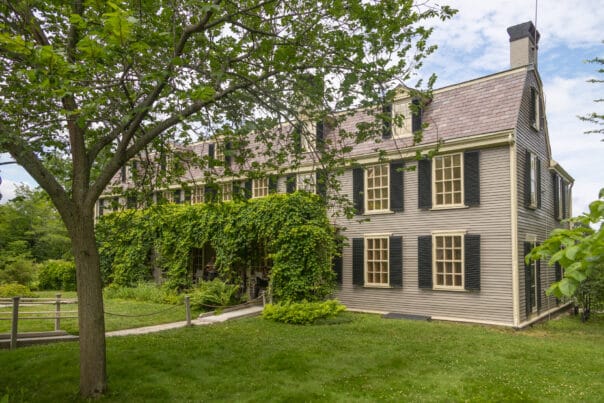
Peacefield in Quincy, Massachusetts, as I saw it in July 2025. Photo ©Bylandersea

Last summer, I visited the Adams National Historical Park in Quincy, Massachusetts, where John and Abigail Adams eventually retired after decades of public service. Their beloved home, Peacefield, reflected the quieter life Adams longed for after years spent helping build a nation through both war and diplomacy. Walking through its rooms, it was easy to forget that this peaceful gentleman had once helped negotiate one of the most significant treaties in American history.
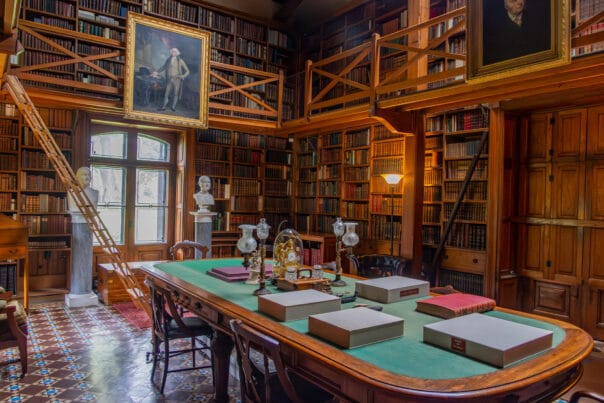
The library at Peacefield, the historic home of John Adams and his family in Quincy, Massachusetts, was built in 1870 (after his death) at the request of his son, Charles Francis Adams. The Stone Library houses thousands of volumes collected by generations of the Adams family—a remarkable reflection of one of America’s most influential political and intellectual dynasties.

History has a way of connecting places separated by hundreds of miles. I love that.

Did You Know?

Although the Treaty of Paris was signed on September 3, 1783, British troops did not evacuate New York City until November 25, 1783. Known today as Evacuation Day, the British departure marked the final withdrawal of British forces from the United States.

Looking Ahead

The Treaty of Paris formally ended the Revolutionary War and secured America’s independence. Yet one final chapter remained before the Revolution truly came to a close.

George Washington had led the Continental Army through eight long years of war. Like John Adams, he desired nothing more than to return home and resume the quiet life he had left behind. Many expected him to remain at the head of the army—or even seize political power. Instead, he performed an act that astonished the world.

He voluntarily resigned his commission, surrendered his military authority to Congress, and returned to Mount Vernon. His greatest victory did not come on the battlefield. It would come in walking away from power.
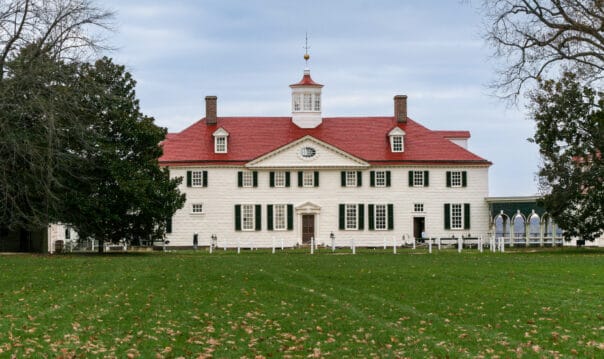
Mount Vernon, the home of George and Martha Washington in Alexandria, Virginia. Photo ©Bylandersea

In my next post,  I will take you on a tour of George and Martha Washington’s home, Mount Vernon in Alexandria, Virginia. It holds many memories as I grew up near there and have visited many times. 

The Road to Yorktown: How the Southern Campaign Won the Revolution

When Americans think of the Revolutionary War, they often picture Lexington and Concord, Valley Forge, or Washington crossing the Delaware, (all stories I have covered earlier in this series). Yet the road to independence did not end in New England. It ended hundreds of miles to the south at Yorktown, Virginia.

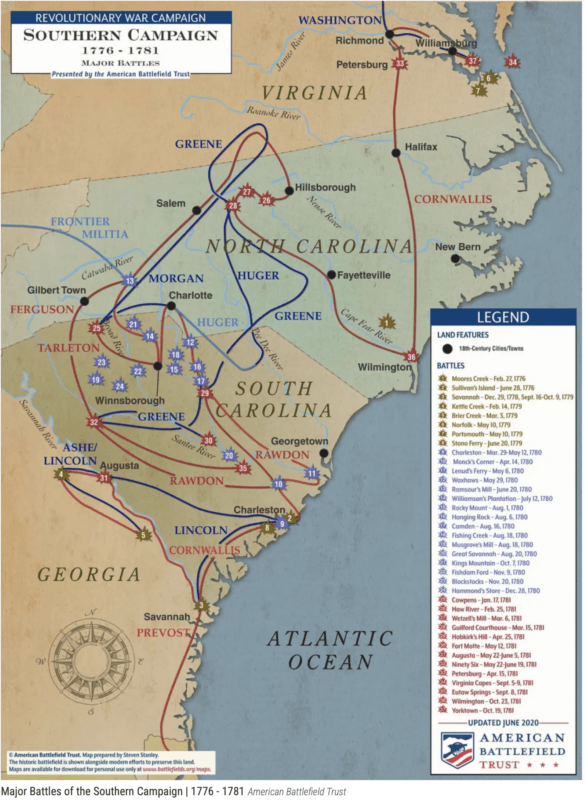
The final victory at Yorktown in October 1781 was not the result of a single battle. Instead, it was the culmination of a long and grueling Southern Campaign that slowly wore down British forces and changed the course of the war.

By 1778, Britain had shifted its focus to the southern colonies. British leaders believed they would find large numbers of Loyalists willing to support the Crown in Georgia and the Carolinas. Capturing the South, they hoped, would isolate the rebellious northern colonies and restore royal control.

Initially, the strategy seemed successful.

The British captured Savannah in 1778 and Charleston in 1780. Charleston’s surrender was one of the worst American defeats of the war. Thousands of Patriot soldiers were taken prisoner, and British General Charles Cornwallis appeared poised to restore British authority throughout the South. Then the tide began to turn.

Kings Mountain: The First Blow

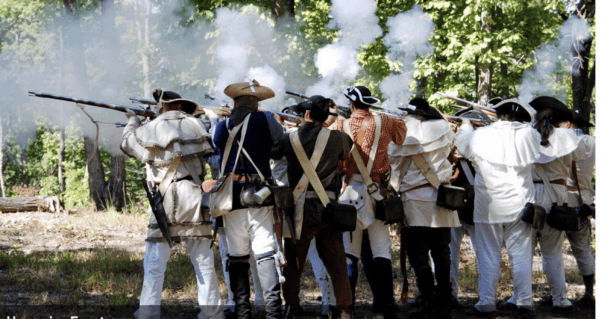
In October 1780, Patriot militia from the frontier settlements gathered at what is now known as the Overmountain Victory National Historic Trail. These rugged backcountry fighters crossed the Appalachian Mountains and pursued Loyalist forces under Major Patrick Ferguson.

At Kings Mountain, on the border of North and South Carolina, the Patriots surrounded Ferguson’s force and won a decisive victory. Ferguson was killed, and more than 1,000 Loyalists were captured, killed, or wounded.

Thomas Jefferson later called Kings Mountain “the turn of the tide of success.” The victory shattered British hopes of raising large numbers of Loyalist supporters in the Carolina backcountry.

Cowpens: A Tactical Masterpiece

Three months later, another Patriot victory further weakened British control.

At Cowpens, South Carolina, General Daniel Morgan devised one of the most brilliant battle plans of the Revolution. He arranged his militia and Continental troops in successive lines, carefully anticipating how the British would attack.

The plan worked perfectly. British commander Banastre Tarleton’s forces were routed. More than 800 British soldiers were killed, wounded, or captured.

Cowpens not only damaged British military strength but also boosted Patriot morale throughout the South.

The Race to the Dan

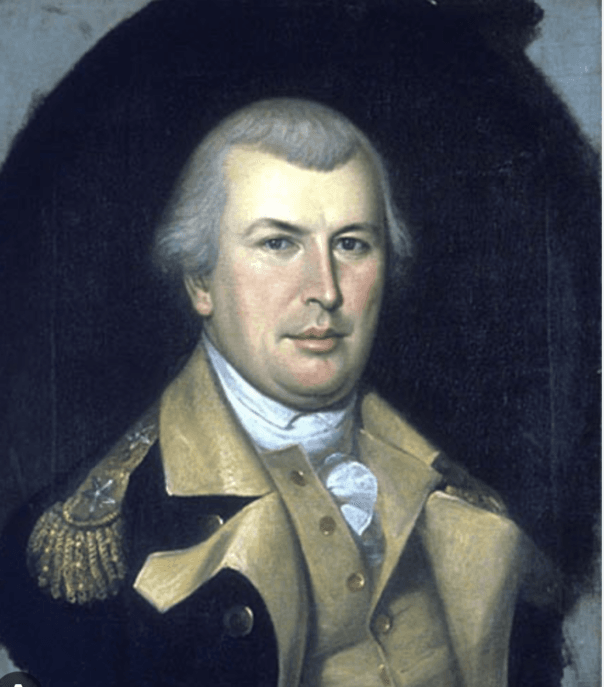
General Nathanael Greene

After Cowpens, General Nathanael Greene faced a difficult challenge. His army was smaller and less experienced than Cornwallis’s veteran troops. Rather than risk destruction in a major battle, Greene chose a strategy of movement and endurance.

For weeks, Patriot forces retreated across North Carolina while Cornwallis pursued them. The campaign became known as the Race to the Dan.

Greene successfully crossed Virginia’s Dan River and escaped. Cornwallis had failed to destroy the American army. Greene then turned and marched south again.

Guilford Courthouse: A Costly Victory

In March 1781, Greene confronted Cornwallis at Guilford Courthouse in present-day Greensboro, North Carolina. The British won the battle and held the field at day’s end. On paper, it appeared to be a British victory.

But the cost was enormous.More than a quarter of Cornwallis’s army became casualties. The British could not easily replace experienced soldiers operating far from their bases.

Greene’s army remained intact. The battle demonstrated a critical truth: Cornwallis could win battles and still lose the campaign.

The Long Fight for the South

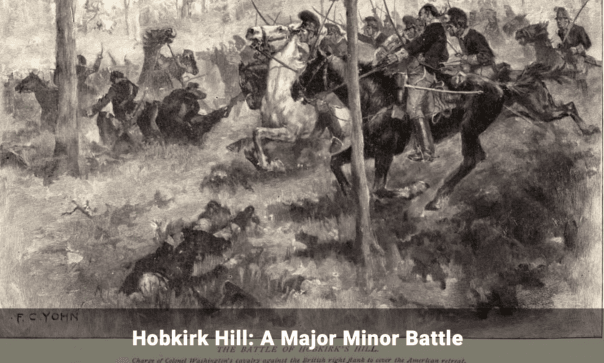
Photo from Journal of the American revolution

Greene continued to pressure British forces throughout the Carolinas.

At Hobkirk’s Hill, Ninety Six, and Eutaw Springs, Patriot troops repeatedly challenged British positions. Although Greene did not win every engagement, he forced the British to expend men, supplies, and energy simply to hold territory.

British forces gradually abandoned much of the interior South and retreated toward coastal strongholds.

The Southern Campaign became a war of attrition.Greene later summarized his strategy:

“We fight, get beat, rise, and fight again.”

His persistence slowly achieved what dramatic victories alone could not.

Cornwallis Moves North

Unable to secure the Carolinas, Cornwallis shifted his attention to Virginia.

The decision marked a turning point in the war. British forces had captured major southern cities and won several battles, yet they had failed to crush the Patriot cause. Nathanael Greene’s relentless campaign had steadily weakened British control of the countryside and forced Cornwallis to seek a new strategy.

By the summer of 1781, the war’s center of gravity was moving north.

Cornwallis marched into Virginia, believing he could establish a secure base and continue British operations. Instead, he was heading toward a place that would become synonymous with the end of the Revolutionary War.

The Southern Campaign had accomplished its purpose. Through persistence, sacrifice, and a series of hard-fought victories, Patriot forces had worn down one of Britain’s finest armies and pushed the war toward its final chapter.

The road to Yorktown had begun.

Next in the America 250 series: Yorktown – The Victory That Won Independence.

Hikers may enjoy the Overmountain Victory Trail: Stretching 330-miles through four states (Virginia, Tennessee, North and South Carolina) the Overmountain Victory National Historic Trail traces the route used by Patriot militia during the pivotal Kings Mountain campaign of 1780. Follow their campaign by utilizing a Commemorative Motor Route along existing state highways marked with the distinctive trail logo, or 80+ miles of walkable trail.