I love when my years of travel suddenly connect like pieces of a puzzle, creating a deeper understanding of a place or moment in history. Such was the case when I was invited to experience Titanic: An Immersive Voyage in Tampa.
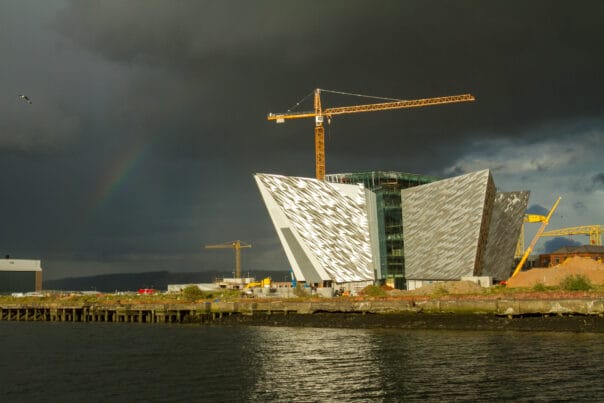
More than a century after RMS Titanic slipped beneath the icy North Atlantic, the ship still exerts a powerful pull on travelers. Over the years, I found myself following Titanic’s story across several countries and experiences, from the shipyards of Northern Ireland to the iceberg-filled waters off Newfoundland.
During my visit to southern Spain last spring, I arrived just as Seville was entering one of its most powerful and emotional traditions, Semana Santa. For seven days leading up to Easter, the historic streets transform into a stage for deeply rooted religious rituals that date back centuries. What unfolds is not simply a celebration but a profound cultural expression where faith, art, and community come together.
A Tradition Centuries in the Making
The roots of Seville’s Holy Week stretch back to the 16th century, when the Catholic Church encouraged public displays of devotion during the Counter-Reformation. Religious brotherhoods known as hermandades began organizing solemn processions through the city. Today, more than sixty of these brotherhoods participate, each maintaining traditions passed down through generations.
Their processions begin at neighborhood churches and wind through Seville’s labyrinth of streets toward the magnificent cathedral before returning home, often in the early hours of the morning.
The Processions: Art in Motion
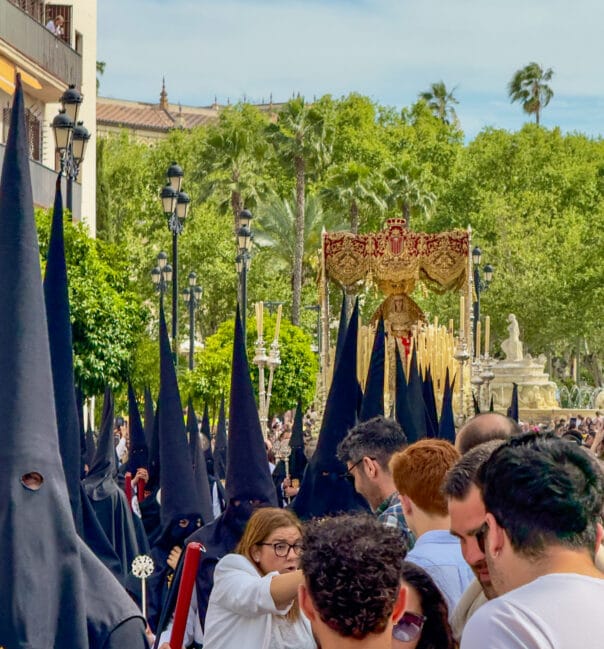
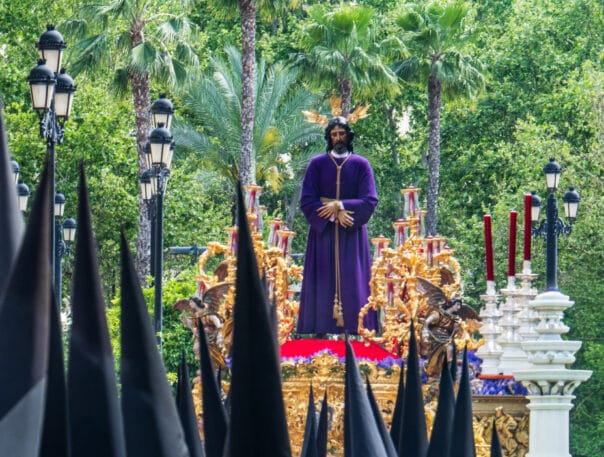
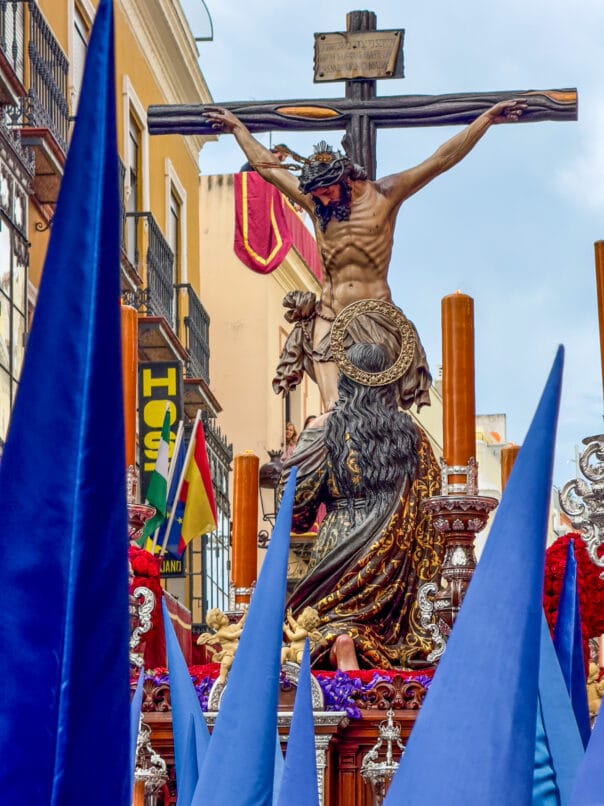
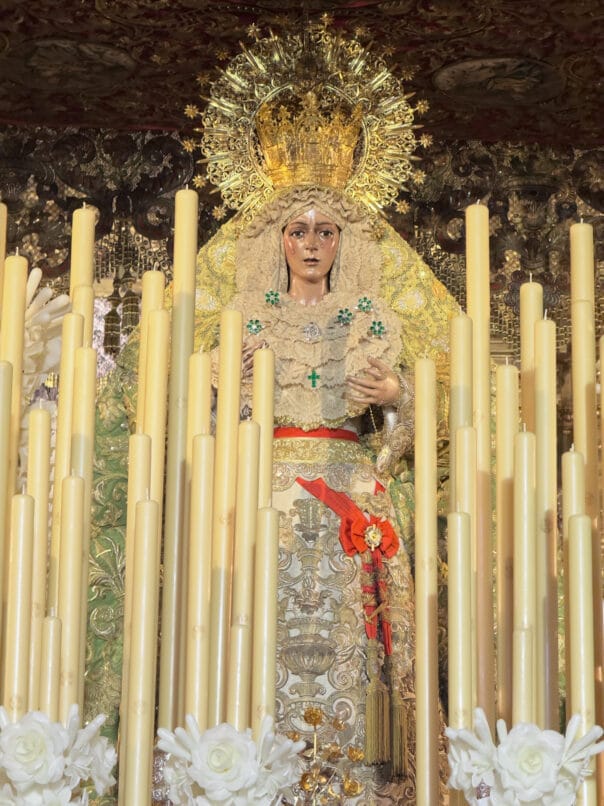
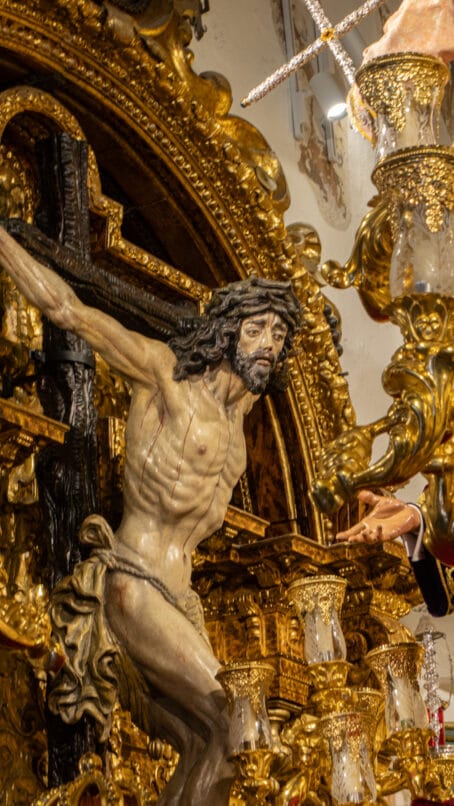
Each procession centers around massive religious floats calledpasos. These elaborate and very heavy platforms (some weigh up to 10,000 pounds) carry life-sized sculptures depicting scenes from the Passion of Christ or images of the Virgin Mary. Many date back hundreds of years and are revered as priceless works of sacred art.
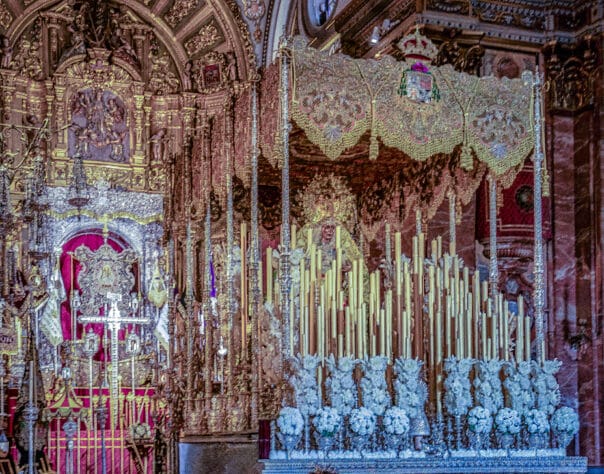
During the day, I joined locals visiting several churches to see the pasos up close. The sculptures are emotionally charged, and the most famous , La Macarena, is sorrowfully beautiful. She is deeply adored and the churched was crowded with admirers wanting a look. It is not uncommon to see grown men moved to tears as they stand in awe.
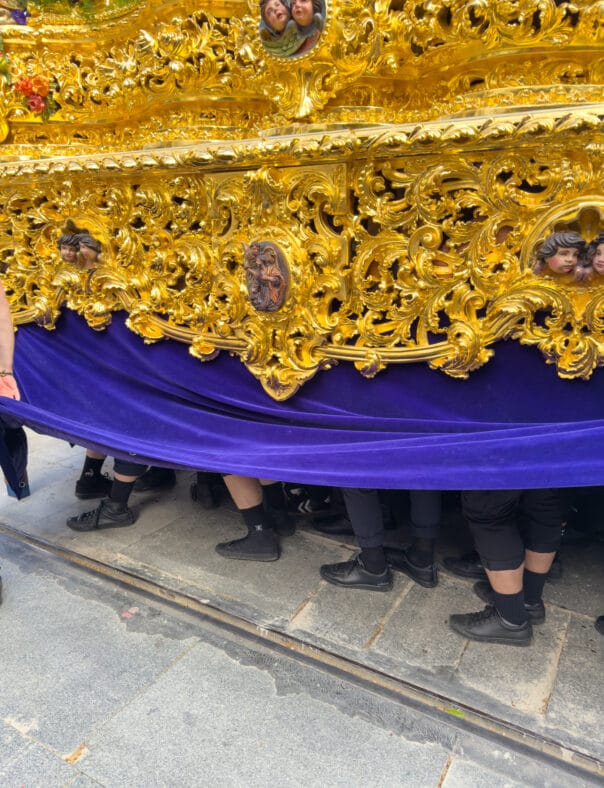
My biggest surprise came when I learned that dozens of men, known ascostaleros, carry the floats hidden beneath the structure, moving slowly and rhythmically through the streets. They can’t see where they are going and rely on the direction of someone to the side. Their dedication, strength and endurance are remarkable. Some processions last as long as twelve hours.
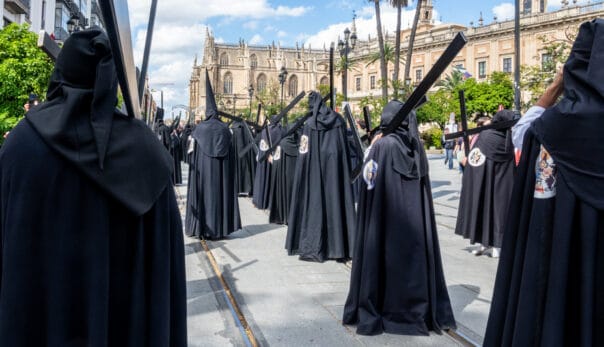
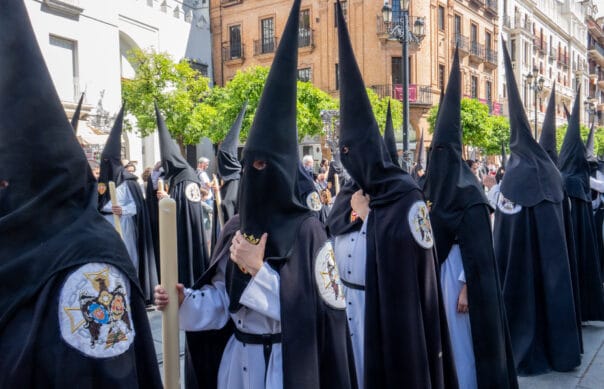
Leading the way are rows of penitents called nazarenos. Wearing long robes and tall pointed hoods to hide their identity, they carry candles or wooden crosses while walking in silence. Their appearance can surprise first-time visitors. While some Americans may initially associate the pointed hoods with imagery from our own racial history, these garments have a very different origin and meaning in Spain. They symbolize anonymity, humility, and penance before God. Some penitents even walk barefoot for miles.
Music, Silence, and Emotion
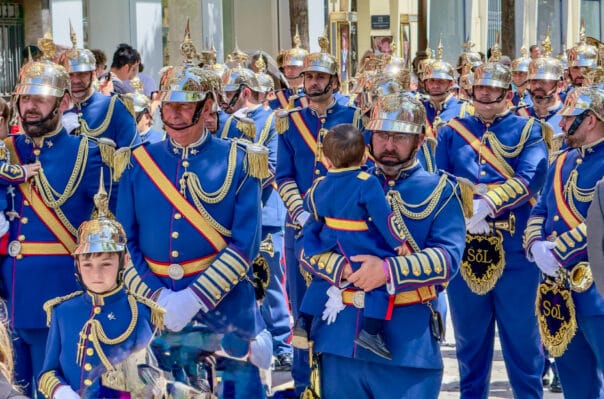
One of the most powerful elements of Semana Santa is the contrast between sound and silence. At times, the only noise comes from the soft shuffle of feet and flickering candles. Suddenly, a brass band begins a mournful march that echoes through the narrow streets.
Occasionally, a voice rises from a balcony in a spontaneous saeta, a haunting flamenco-style prayer sung directly to the passing Virgin or Christ figure. The crowd falls completely silent to listen.
These moments create an atmosphere that feels both sacred and deeply human. Though the streets are packed, the crowd remains respectful.
While watching on Palm Sunday, one of the pasos stopped directly in front of me. I watched as the costaleros crawled out from beneath the float while a fresh group moved in, lowering themselves on hands and knees into position. With a sharp command and the pounding of a drum, the structure rose as if lifted by magic, and the procession continued forward. It is a moment I will never forget. I captured part of it in this 30-second video below:
The Most Famous Night: La Madrugá
The peak of Seville’s Holy Week occurs late Thursday night into Good Friday during La Madrugá, meaning “the dawn.” Some of the city’s most revered brotherhoods process through the streets, including the beloved images from the Basílica de la Macarena. (I had left the city by the time, unfortunately.)
Hundreds of thousands of spectators line the streets throughout the night. Candles glow against the dark sky while church bells toll in the distance. For locals, this night represents the spiritual heart of the entire week.
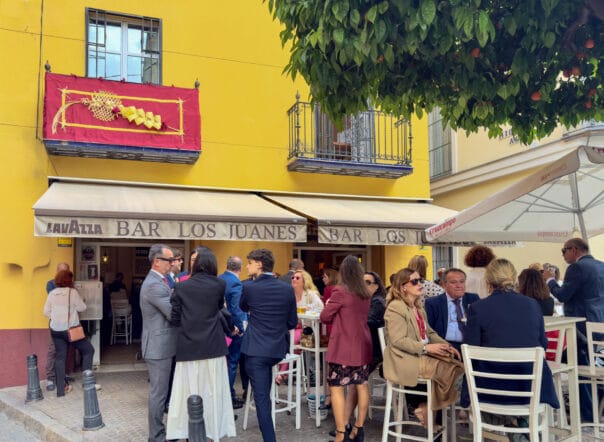
What struck me most was how deeply this tradition remains woven into everyday life in Seville. Families arrive early to claim viewing spots. Children sit on their parents’ shoulders to watch the floats pass. Cafés remain open late as neighbors gather and talk quietly while waiting for the next procession.
Even visitors who are not religious cannot help but be moved by the dedication, artistry, and emotion on display.
Experiencing Semana Santa in Seville is not simply watching an event. It is stepping into a centuries-old story that continues to unfold each spring.
Long after I left Seville, the sound of distant drums and swaying floats stayed with me.
Don’t Miss Seville’s Treasures
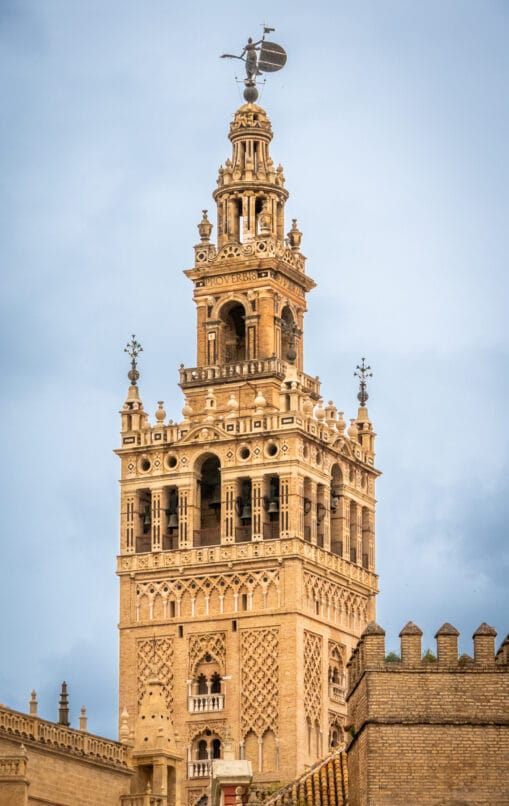
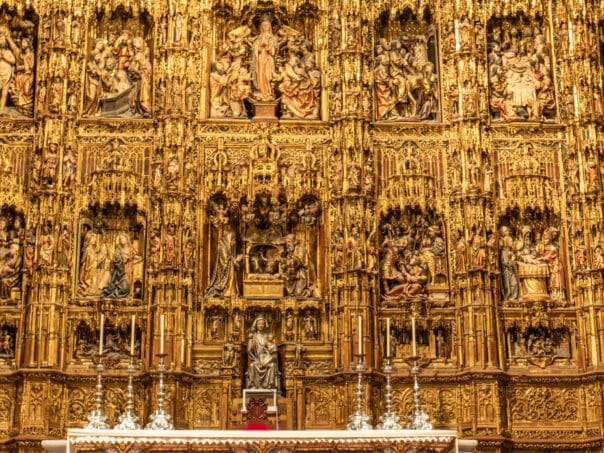
If you visit Seville, be sure to tour the immense Seville Cathedral and admire its golden altarpiece, then climb the Giralda tower for panoramic views across the city. Just steps away, the Royal Alcázar invites you into a world of intricate Moorish design and tranquil gardens. Leave time to wander the narrow lanes of the Santa Cruz quarter, where Seville’s history and charm come alive around every corner.
Some places ask to be understood. Bomarzo Park refuses.
Hidden in the forested hills of northern Lazio, the Parco dei Mostri or Monster Park, is not a garden in the traditional sense. It is a fantasy carved from stone. A labyrinth of towering monsters, reclining gods, mythic beasts, and unsettling faces created in the 16th century not to please, but to provoke.
Bomarzo Park was not created by a king or a pope, but by a grieving nobleman.
In 1552, Prince Pier Francesco “Vicino” Orsini, lord of Bomarzo, began commissioning this strange woodland after the death of his beloved wife, Giulia Farnese. Rather than building a formal Renaissance garden of symmetry and order, Orsini imagined something radically different. He envisioned a place of disorientation, emotion, and philosophical reflection.
He hired the famed Mannerist architect Pirro Ligorio to bring his vision to life. Instead of reshaping nature into geometric perfection, they carved the sculptures directly from existing volcanic rock outcroppings, allowing the forest itself to dictate form.
It was meant to be felt more than understood. For me, it was a place where imagination quietly returned. Time slowed. Edges softened. The practical world faded, replaced by a sense of childlike wonder I hadn’t realized I missed.
Reaching Bomarzo requires intention. Hidden in the countryside near Viterbo, it is not a place you find by chance. My taxi drove through peaceful villages and wooded hills, the road curving gently until the forest finally opened before us.
A modest visitor center greeted me. Then, I walked out the back door, and the stone giants began.
Proteo Glauco: Guardian of the Wood
One of the first figures visitors encounter is the formidable Proteo Glauco, a massive stone head emerging from the earth, crowned by a sculpted sphere. His expression is both watchful and ambiguous. Moss gathers in the creases of his face. Leaves settle in the folds of his carved hair.
He feels ancient, as if he has always belonged to the forest.
Deeper into the woodland sits the great Tartaruga. A giant turtle supports a figure balanced above, an allegory open to interpretation. Slow and steady. Power? Patience?
The entire sculpture is softened by greenery, as if nature itself is reclaiming the fantasy.
The Panca Etrusca, often called the Etruscan Elephant, is one of Bomarzo’s most iconic sculptures. The enormous stone elephant carries a small tower on its back while grasping a fallen soldier in its trunk. This elephant is a blend of fantasy with classical symbolism. It feels both whimsical and imposing.
Even in stone, it suggests motion, as though the beast might step forward at any moment.
I gasped when I stumbled upon the dramatic scene depicting Ercole defeating Caco, better known as Hercules and the thief. Here, a raw, muscular moment of violence is frozen in stone. The monumental scale reminds you that these sculptures were meant to overwhelm.
Up and around a bend, I found Neptune, known in Italian as Nettuno or the god of the sea, nestled behind the overhanging tree limbs.
He reconnects the garden to classical antiquity. Moss softens his features, yet his authority remains. He rests with quiet strength, weathered but dignified. Compared to the monsters, he feels almost serene.
I found myself lingering here. The balance between myth and nature felt seamless, as though Neptune had always belonged to the forest rather than the sea.
The crooked house tilts deliberately, disorienting visitors before you even step inside. It plays with gravity and expectation, reminding you that this is not a place of rational thought.
It is a garden of sensation, and it’s fun.
Entering the crooked house is fun but disorienting. Children love it.
The Herms and Silent Faces
A line of carved herms rises from the earth in silent procession, their expressions solemn and unblinking. Beyond them, reclining figures and nymph-like forms lounge amid urns and lichen-covered stone, letting time gently settle over them.
Here, the Sacred Wood moves from menace to meditation in a single turn of the path.
A line of faces near the Leaning House.
Orcus: Where Every Thought Flies
The path bends, the light dims beneath the thick canopy, and then it appears — not gradually, but all at once. A colossal stone face emerges from the earth, its mouth stretched wide in a silent, eternal cry.
This is Orcus – the most famous sculpture of all within the park.
His gaping jaws form a doorway, an invitation and a warning at once. Carved above the lip are the words Ogni pensiero vola — “Every thought flies.” It is less a caption than a challenge.
Standing before him, I hesitated. The darkness inside felt cool and cavernous, a space meant not simply to be viewed but experienced. It was playful and unsettling at the same time. You enter the monster, and somehow emerge lighter, proof that even darkness can be transformative.
Me standing in the mouth of Orcus.
Echidna: Mother of Monsters
One of the final and more surprising figures is Echidna, the mythological Mother of Monsters. Part woman, part serpent, she is said to have birthed many of the most fearsome creatures of Greek legend.
Learning her name changed the way I saw the forest. The sculptures no longer felt isolated or eccentric; they felt connected, part of an ancient mythic lineage. I even thought of Game of Thrones, where dragons and hybrid beings dominate modern storytelling. These archetypes endure. The Sacred Wood is not random fantasy. It draws deeply from classical mythology.
The Orsini family crest appears in the form of a powerful stone bear holding a shield. It brings personal history to the Sacred Wood, a statement of identity and legacy.
A Glimpse Into the Past
Returning to the visitor center, I noticed one of the displays held a vintage black and white photograph of shepherds guiding sheep through the Sacred Wood. You see livestock grazing before the Orcus mouth and the elephant. This photo showed me that Bomarzo was once even more rustic and untamed.
The monsters were not always surrounded by ticket booths and cameras. They stood quietly in a wilder landscape.
A vintage photo of Bormarzo when it wasn’t a tourist attraction.
Why Bomarzo Matters
Bomarzo is not polished. It is not symmetrical. It does not flatter the eye in the way formal gardens might.
It unsettles yet delights. It invites curiosity. It allows imagination to roam.
In a world that often demands clarity and order, the Sacred Wood offers something rarer.
Mystery.
And like all great journeys, Bomarzo stays with you long after you leave.
A closer look at Neptune.
Location: Bomarzo, Lazio, Italy Closest major cities: Rome and Viterbo Time needed: Allow at least two hours to wander slowly and let the forest reveal itself. Best season: Spring or autumn for softer light and fewer crowds. Family Friendly: Older children usually love it, unless they are easily frightened by oversized monsters and shadowy stone faces.
I hired a taxi driver in Viterbo who agreed to take me and return two hours later, making the visit simple and stress-free.