Category Archives: National Parks

The Overmountain Men: Virginia Patriots and the Battle of Kings Mountain

If you are an Outlander fan like me, the Battle of Kings Mountain likely resonates deeply. In Diana Gabaldon’s story, Jamie Fraser knows that this rugged mountain fight in October 1780 will become a turning point in the American Revolution—and a moment that will shape the destiny of his family.

Long before Jamie’s fictional march, real frontiersmen gathered in what is now Abingdon, Virginia, to answer the call to arms.

T

A Quiet Place with a Powerful Story

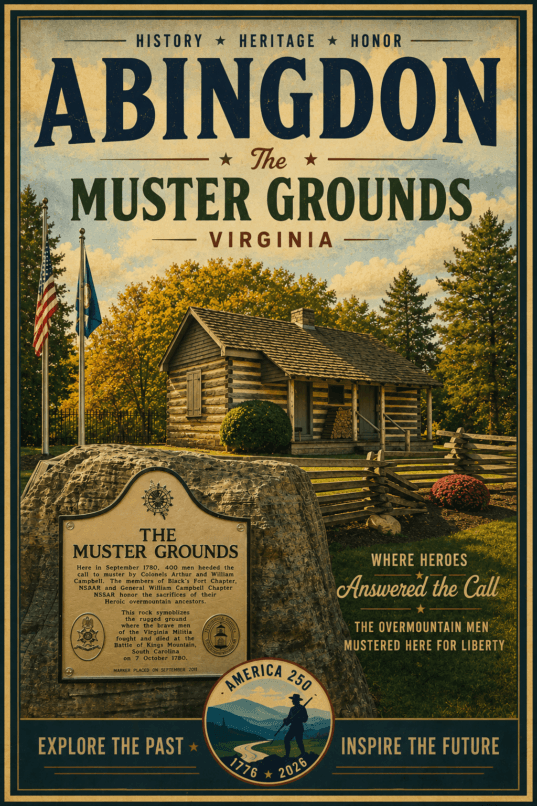
Today, visitors to Abingdon can stand at the historic The Muster Grounds, a site run by the National Park Service. . A simple marker and reconstructed log cabin commemorate the place where approximately 400 Virginia militia assembled in September 1780. It is part of the Overmountain Victory National Historic Trail.

These men responded to the leadership of Colonels Arthur Campbell and William Campbell, preparing to join the legendary Overmountain Men—backcountry settlers from Virginia, North Carolina, and what is now Tennessee.

Their mission was urgent: stop British Major Patrick Ferguson before he could crush Patriot resistance in the southern colonies.

Who Were the Overmountain Men?

The Overmountain Men were farmers, hunters, and Indian fighters living west of the Blue Ridge Mountains. They were fiercely independent and accustomed to hardship.

When Ferguson threatened to “lay waste” to their settlements, they chose to strike first.

Gathering at places such as Abingdon and Sycamore Shoals State Historic Park, they crossed the Appalachian Mountains on horseback, carrying long rifles and enough determination to alter the course of the war.

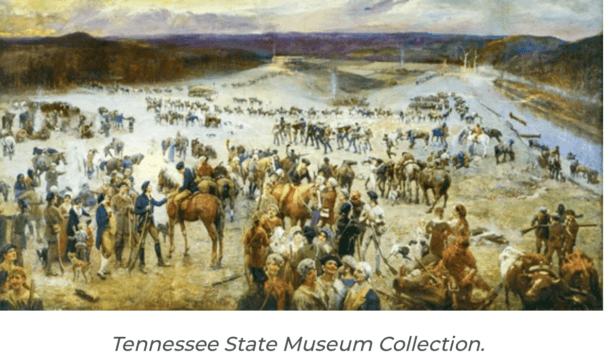
The Gathering of the Overmountain Men at Sycamore Shoals, by Lloyd Branson in 1915

The March to Kings Mountain

The Patriots converged on the South Carolina frontier and caught Ferguson’s Loyalist force atop Kings Mountain National Military Park on October 7, 1780. The battle lasted little more than an hour.

Using frontier tactics and accurate rifle fire, the Americans surrounded the ridge and attacked from all sides. Ferguson was killed, and his army was destroyed.

Thomas Jefferson later called Kings Mountain “the joyful annunciation of that turn of the tide of success which terminated the Revolutionary War.”

Why Kings Mountain Mattered

Before Kings Mountain, the British appeared dominant in the South after victories at Charleston and Camden. You can read my earlier blog posts on those battles here: https://bylandersea.com/2026/04/from-savannah-to-kings-mountain-a-turning-point-in-the-southern-campaign/

For many historians, Kings Mountain was the beginning of the end for British hopes in the South.

The Outlander Connection

In Outlander, Jamie Fraser understands that Kings Mountain is one battle he cannot avoid.

Fans know the emotional weight of that realization. Jamie marches toward a fight where Frank records his death.

While I visited a few years ago, standing at the Muster Grounds in Abingdon brings that fictional journey vividly to life. The peaceful log cabin and memorial marker speak to the courage of the men who gathered here, leaving farms and families to defend the cause of liberty.

Visiting the Muster Grounds

The Muster Grounds are located near downtown Abingdon and are an ideal stop for travelers exploring Virginia’s Revolutionary War history. Nearby lies the Sinking Spring Cemetery.

Sinking Spring Cemetery

The Sinking Spring Cemetery is one of the oldest burial grounds in Southwest Virginia. Established in the late 18th century, the cemetery contains the graves of frontier families, Revolutionary War veterans, and generations of settlers who built this rugged corner of Virginia.


As I wandered among the weathered headstones and iron-fenced family plots, I could not help but wonder whether some of the men who answered the call to arms in September 1780 now rest here. These were farmers, hunters, and fathers who left their homes to join the Overmountain campaign and march toward the Battle of Kings Mountain.


The worn stones, softened by time and lichen, offer a poignant reminder that history is not just found in monuments and battlefields. It also lives in the quiet places where those who shaped our nation were laid to rest.

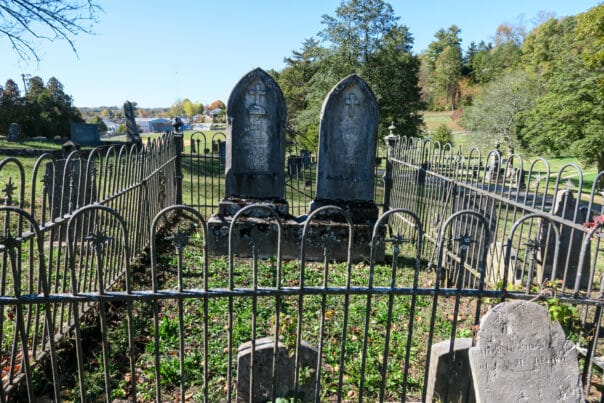
Weathered gravestones at Sinking Spring Cemetery in Abingdon, Virginia, stand as enduring reminders of the frontier families who lived, fought, and died in the era of the American Revolution.

Final Thoughts

The Overmountain Men were not professional soldiers. They were neighbors, fathers, and farmers who rose when liberty was threatened. Their victory at Kings Mountain changed the Revolution.

And for Outlander fans, this quiet Virginia site offers a moving connection between historical truth and beloved fiction.

Where to Stay

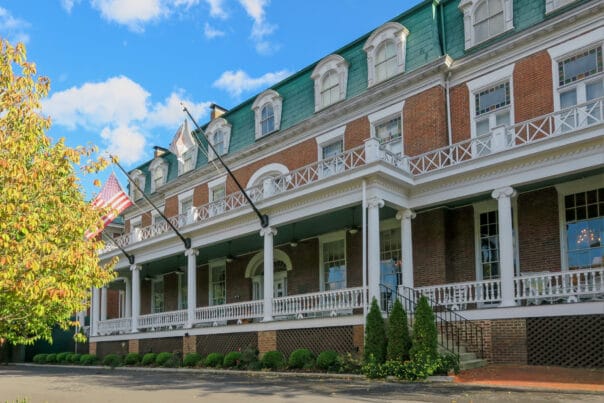
Martha Washington Inn and Spa is the place to stay in Abingdon. Photo ©Bylandersea

The Martha Washington Inn & Spa is one of Virginia’s most storied hotels and an ideal place to stay while exploring Abingdon’s Revolutionary War sites, including the Muster Grounds and Sinking Spring Cemetery.


The building was constructed in 1832 as a private residence for General Francis Preston, a prominent attorney, politician, and member of one of Southwest Virginia’s leading families. The mansion reflected the elegance and prosperity of early 19th-century Abingdon, with wide porches, gracious rooms, and a commanding location on Main Street.


A Women’s College
In 1858, the property became Martha Washington College, named for George Washington’s wife, Martha Washington. The school educated young women for more than seven decades and gained a reputation as one of the South’s respected female academies. Students studied literature, music, languages, and the social graces expected of the era.


Civil War Hospital
During the Civil War, the college served as a Confederate hospital. Wounded soldiers were treated in the classrooms and dormitories, and local lore speaks of lingering spirits from this turbulent period.


Reinvented as a Hote
l
The school closed in 1932, and in 1935 the building reopened as the Martha Washington Inn. Over time, it became one of Virginia’s best-known historic hotels. Today, the inn blends period charm with modern comforts, including a spa, elegant guest rooms, and welcoming common areas. I loved my stay there.


Ghost Stories and Legends
The hotel is widely considered one of Virginia’s most haunted inns. Guests and staff have reported mysterious footsteps, unexplained voices, and other paranormal encounters, particularly in the older sections of the building. I did not encounter any and loved my stay in the Inn.

From Triumph to Trial: Winter at Valley Forge

By Debi Lander
Bylandersea America 250 Series


From Saratoga to Survival

Washington leading the way to Valley Forge, Pennsylvania.

After the stunning victory at Saratoga in October 1777, the American cause finally gained international credibility. France would soon become an ally. Yet victory did not bring relief.

In December, General George Washington led nearly 12,000 weary soldiers into winter quarters at Valley Forge, only eighteen miles from British-occupied Philadelphia. The camp would test not only the army, but Washington himself.

He faced shortages, desertion, political rivals in Congress, and whispers that he should be replaced. Letters from the time reveal a leader weighed down by doubt yet anchored by resolve. Valley Forge became Washington’s greatest test.

A Cabin at Valley Forge National Historical Park
Continue reading From Triumph to Trial: Winter at Valley Forge

From Siege to Stronghold: Boston, Ticonderoga, and the Road to Revolution

By Debi Lander | Bylandersea America 250

By early 1775, the American Revolution was no longer a series of angry protests and tense standoffs. It was war.

After the battles of Lexington and Concord in April, thousands of New England militia poured into the countryside surrounding Boston. Farmers became soldiers. Taverns became headquarters. Hillsides bristled with makeshift encampments. The British Army, commanded by General Thomas Gage, suddenly found itself trapped inside the city it had once confidently occupied.

Thus began the Siege of Boston.

The Siege That Changed Everything

For eleven long months, colonial forces encircled the city, cutting off supplies and steadily tightening the noose. The pivotal moment came in June at the Battle of Bunker Hill, where inexperienced colonial troops proved they could stand toe-to-toe with British regulars. Though the British technically claimed the field, their staggering losses sent a clear message. This rebellion would not be easily crushed.

This monument sits at the to of Bunker Hill, part of the Freedom Trail in Boston.

George Washington arrived in Cambridge soon after and assumed command of the newly formed Continental Army. What he lacked, however, were the tools of victory, especially heavy artillery.

The solution lay more than 300 miles away at a remote stone fortress on the edge of Lake Champlain.


Fort Ticonderoga: The Key That Turned the War

Perched between Lake George and Lake Champlain, Fort Ticonderoga had guarded this vital water corridor since the French and Indian War. When Ethan Allen and Benedict Arnold captured the fort in May 1775, they seized far more than a strategic outpost. They captured cannons, the very weapons Washington desperately needed.

That winter, in one of the most remarkable logistical feats of the Revolution, Colonel Henry Knox led an epic expedition to haul more than sixty tons of artillery across frozen rivers, snow-choked forests, and rugged mountain passes. Oxen strained. Men froze. Wagons broke. Yet by March 1776, the guns arrived outside Boston.

Oxen pulled the cannons across the snow.

Washington positioned them atop Dorchester Heights, overlooking the harbor.

When the British awoke to see American cannons aimed squarely at their fleet, the siege was over. On March 17, 1776, British forces evacuated Boston. It was the first great victory of the American Revolution.

The road from Lexington had led, improbably and magnificently, through Ticonderoga.


Walking Where Jamie and Claire Might Have Stood

As a fan of Outlander, Fort Ticonderoga carries a special resonance. Diana Gabaldon’s time-traveling saga places Jamie and Claire Fraser deep within the political and military drama of the American Revolution, and standing on Ticonderoga’s stone ramparts makes it easy to imagine their presence here.

At sunset, as Lake Champlain glows and mist curls across the water, the fort feels suspended between centuries. The wind moves through the grasses. Cannons still point toward the horizon. The world of 1776 feels close enough to touch.

It is precisely the kind of place where Jamie might have surveyed the valley for British movement, and where Claire might have gathered medicinal plants in the shadow of history’s turning point.


Why This Journey Still Matters

The Siege of Boston and the capture of Fort Ticonderoga were not isolated events. Together, they formed the hinge on which the war first turned. Without Ticonderoga’s cannons, Boston might still have fallen, but not in 1776 and not in the way that unified the colonies and electrified the world.

For modern travelers, following this path is more than sightseeing. It is walking the opening chapters of the American story.

Fort Ticonderoga Travel Guide

Overlooking Fort Ticonderoga.

Ticonderoga • New York • On the Shores of Lake Champlain

I visited Fort Ticonderoga many years ago and recall it fondly. It’s location is one of the most evocative historical sites in North America — a restored 18th-century fort that played a pivotal role in both the French & Indian War and the American Revolution. Its star-shaped walls overlook Lake Champlain and Lake George, bringing to life the strategic struggles that shaped the long road to independence.

Location & Basic Info

Address: 102 Fort Ti Road, Ticonderoga, NY 12883
Hours (2026 Season): Tues–Sun, 9:30 a.m.–5:00 p.m., May 2–Oct. 25 (last ticket 4:30) Fort Ticonderoga
Website: fortticonderoga.org


What to See & Do

See cannon firing daily.

Explore the Historic Fort

Walk the ramparts and bastions that once guarded the gateway between Canada and the Hudson Valley. Interpretive signs and staff bring the battles and daily life of soldiers into vivid focus, from muskets and cannons to uniforms and fort defenses.

Living History Programs

Fort Ticonderoga offers North America’s premier living history experiences with daily interpretive activities that immerse you in 18th-century military life, trades, and tactics — perfect for history lovers and families alike. 

Expect:

  • Weapons demonstrations
  • Historic trades (cooking, tailoring, blacksmithing)
  • Interpretive talks and hands-on experiences

REAL TIME REVOLUTION® — Living History & Reenactments

Fort Ticonderoga’s signature living history series, REAL TIME REVOLUTION®, animates pivotal moments from 1775–1777 through immersive events that unfold much the way they did 250 years ago. 

Featured Events (2026 Highlights)

January–March Living History

  • Supplying Our Army in Canada — winter supply life (Jan. 17)
  • Precarious Garrison of Ticonderoga — soldiers wintering (Feb. 7)
  • Proceed to Canada — logistics & reenactors (Mar. 28) 

Spring & Summer Signature Reenactments

  • Return of an Army — Continental Army retreat reenactment (July 3–5)
  • Fleet & Fortification: The Science of Defense — defensive works & lake vessels (Aug. 29–30)
  • Hold the Line for Liberty — battle reenactment (Oct. 24–25)

Seasonal Living History Days

  • Scots Day (June) — Scottish troops and musket demos
  • Memorial Day Weekend — tribute & Fifes & Drums ceremonies
  • Heritage, Harvest, & Horse Festival (Oct.)

These events go far beyond static displays — you experience camp life, battle drills, supply movements, and civilian roles that connect you with the lived reality of the Revolution.


America 250 at Fort Ticonderoga

Fort Ticonderoga is a key site in America 250, the nationwide commemoration of the 250th anniversary of the American Revolution and the founding of the United States. 

  • May 10, 2025 marked 250 years since the capture of Fort Ticonderoga — one of the Revolution’s first major American victories. 
  • Throughout 2025–2027, Fort Ticonderoga’s programs explore the people, alliances, and pivotal decisions that shaped the fight for independence. 
  • Events include immersive reenactments, scholarly panels (e.g., Revolutionary anniversaries), and community celebrations tied into the broader semiquincentennial.

Whether you visit during a signature weekend or join everyday living history demonstrations, you’ll be walking ground that played a formative role in the birth of a nation.


Fort Defiance: A Companion Legacy Site

Just a short walk from Fort Ticonderoga you’ll find Fort Defiance, the defensive earthwork erected by the Continental Army after the fort’s capture in May 1775. Whereas Fort Ticonderoga’s reconstruction focuses on the earlier French and British phases of the fort’s history, Fort Defiance offers a window into the American Revolution’s very beginnings. Outlander fans will recall Jamie’s interest in Fort Defiance. too.

🎖 Why Visit Fort Defiance

  • Historical significance: Fort Defiance was built under the command of Ethan Allen and Benedict Arnold immediately following their surprise capture of Fort Ticonderoga on May 10, 1775 — an action that helped spark the Revolutionary War.
  • Strategic location: Positioned to overlook the southern approach to Fort Ticonderoga, Fort Defiance complemented the main fort’s defenses and helped secure American control of the area.
  • Interpretive experience: While not as architecturally elaborate as the main fort, Fort Defiance’s earthworks, trails, and interpretive signage help visitors understand how quickly Americans fortified the region and illustrate the evolving nature of warfare and logistics in the 1770s.

📷 Photo & Walk Tips

  • There is a scenic trail between Fort Ticonderoga and Fort Defiance that is perfect for photography — forested paths, historic earthworks, and dramatic lake views.
  • Visiting Fort Defiance adds depth to your understanding of the events of 1775 and enhances your overall Revolutionary War context.

🎺 Living History & Programs

Fort Ticonderoga offers North America’s premier living history experiences — hands-on demonstrations and immersive programs that bring the past to life.


📌 Tips for Visiting

Plan Ahead: Events and reenactments can sell out — especially in summer. Early booking is recommended.
Best Time: May–October for full fort access and living history.
Nearby Attractions: Lake Champlain cruises, historic Ticonderoga town, hiking and outdoor recreation.