Bylandersea America 250: Exploring the Road to Revolution
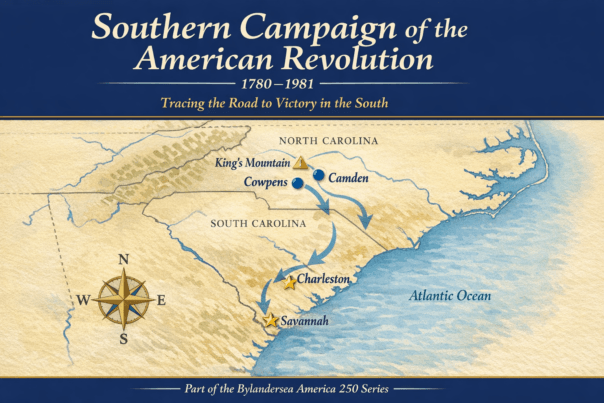
After the failed Siege of Savannah in 1779, the American cause in the South appeared to falter. The British tightened their grip on Georgia and turned their attention northward, convinced they could rally Loyalist support and end the rebellion from below.
Instead, the Southern Campaign became a proving ground for resilience.
Camden: A Crushing Blow
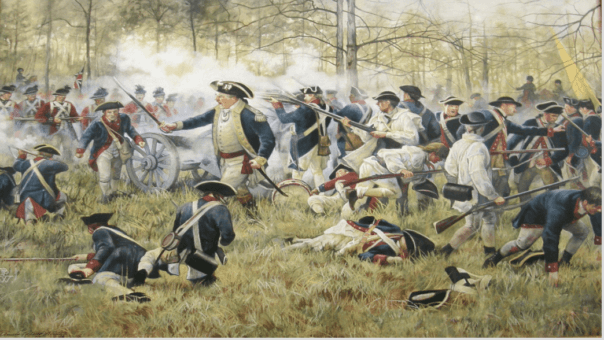
In August 1780, American forces met the British near Camden, South Carolina. The result was devastating. At the Battle of Camden, inexperienced militia broke under pressure, and the Continental Army suffered one of its worst defeats of the war.
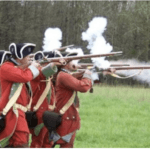
Photo from The Delaware Society of the Sons of the American Revolution
Walking the Camden battlefield today, the landscape feels deceptively peaceful. Pine forests and open fields give little hint of the confusion and panic that once unfolded here. Yet this loss would serve an unexpected purpose. It exposed weaknesses, forced new leadership, and hardened American resolve.
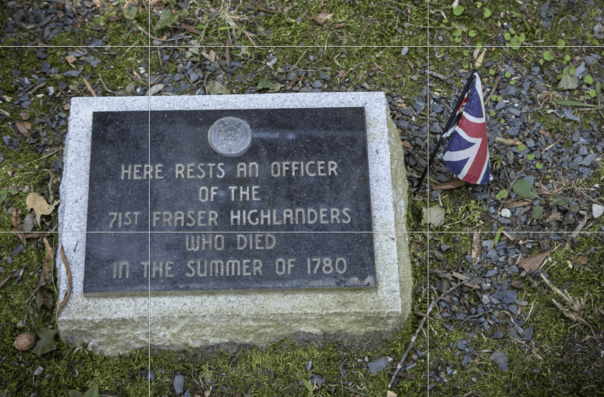
Near a quiet churchyard in Camden, beside a tall steeple rising above the trees, I came upon a simple stone marking the grave of an officer of the 71st Fraser Highlanders. Seeing the name ‘Fraser’ etched in stone brought an unexpected connection to mind. These were the same Highlanders woven into the world of Outlander. In that moment, fiction and history felt remarkably close.”
For those following the series Outlander, Kings Mountain carries an added sense of drama. In the current final season, Jamie Fraser reflects on a prophecy that he may die at this very battle.
That storyline brings emotional weight to a real moment in history. It reminds us that for the men who fought here, the outcome was uncertain and survival was never guaranteed.
Image via official Outlander Instagram. Jamie Fraser’s story unfolds in colonial North Carolina as the Revolutionary War approaches, adding a compelling layer to the real history of the Southern Campaign.
Just weeks later, the tide of the war began to turn. Patriot militia forces, many from the rugged frontier, gathered and marched toward a rocky, wooded ridge along the Carolina border. At Kings Mountain, they surrounded a Loyalist force and launched a fierce, close-range battle fought from tree to tree.
Unlike traditional European warfare, this was a fight shaped by terrain and determination. The Patriots knew the land, and they used it to their advantage. When the battle ended in October 1780, the victory sent a clear message. The British strategy in the South was far from secure.
Today, visitors to Kings Mountain National Military Park can walk the ridge trail and trace the path of the battle. The forested slopes still echo with the story of a turning point that helped revive the American cause.
A Turning Point Begins
The Southern Campaign did not turn on a single victory, but Kings Mountain marked the beginning of a shift. What followed would continue to weaken British control and set the stage for the final push toward independence.
Those next steps would unfold across the Carolina countryside, where strategy, leadership, and perseverance would carry the Revolution forward.