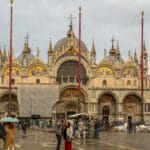
Welcome to St. Mark’s Basilica—the crown jewel of Venice and one of the most iconic churches in all of Italy, and really the entire world. This magnificent structure has stood watch over Piazza San Marco since the 11th century, blending Byzantine, Romanesque, and Gothic influences into a dazzling architectural statement.

The original church was built in 828 to house the relics of St. Mark the Evangelist, but the current version was constructed beginning in 1063, reflecting Venice’s growing power as a maritime empire. Inspired by the Church of the Holy Apostles in Constantinople, it became a powerful symbol of the Republic’s wealth, diplomacy, and spiritual devotion.
Exterior view of St. Mark’s Basilica

The Horses of St. Mark, above the main entrance
Above the central portal stand the famous bronze horses of St. Mark. While these are replicas, the originals—now preserved inside the basilica—have a storied past. They were looted from Constantinople in 1204 during the Fourth Crusade, when Venetian forces played a major role in the city’s sack. The horses symbolize both the glory and controversy of Venice’s reach. In 1797, Napoleon seized them and took them to Paris, but they were returned after his defeat.
Interior dome covered in golden mosaics
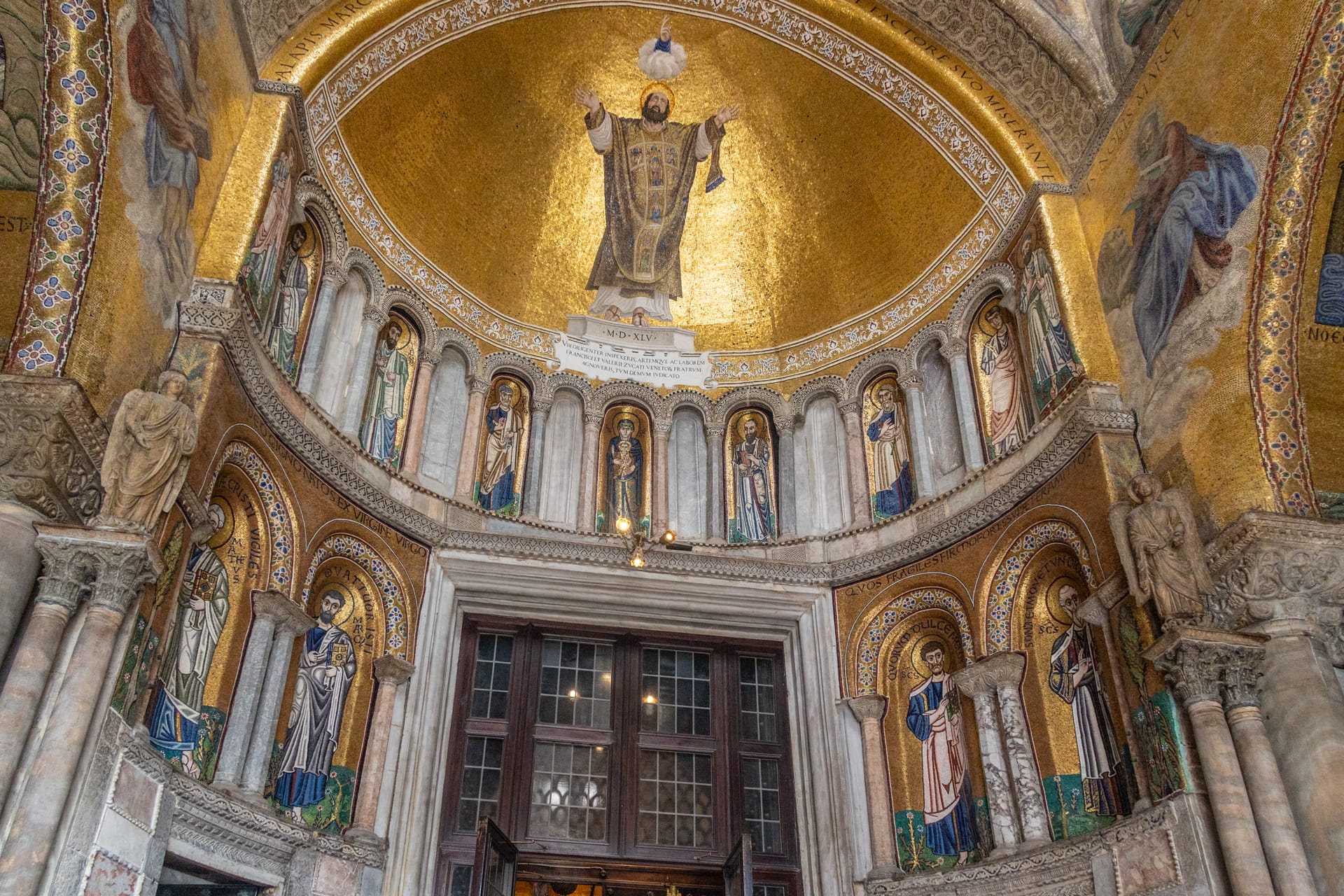
Step inside, and you’re enveloped in a shimmering world of over 9,570 square yards of mosaics—that’s about two acres, most of them in radiant gold. These mosaics were created between the 11th and 17th centuries, layer upon layer, portraying stories from the Old and New Testaments, the life of Christ, and episodes from St. Mark’s journey. The glittering visuals don’t just decorate; they teach and inspire. I wish I’d had time to sit and reflect on the meaning behind each panel, but tours move in and out quickly.

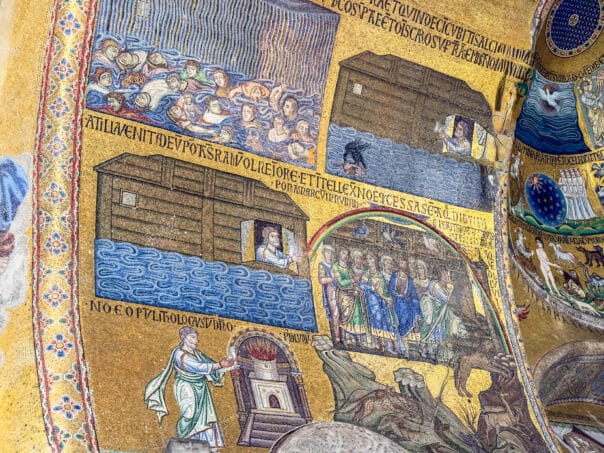
One of the most powerful narrative sequences is the story of Noah and the Flood, seen in my photo below and found in the atrium mosaics. These vivid panels show Noah building the ark, the gathering of the animals, and the deluge covering the earth—all in the basilica’s signature gold background. The scenes are not just artistic marvels, but reminders of human frailty, and the promise of salvation.
Mosaic of the Pentecost in the central dome
Look up at the central dome, where the Pentecost mosaic glows with spiritual energy. Each apostle is haloed in gold, and radiant lines descend from the heavens, symbolizing the arrival of the Holy Spirit. This breathtaking artwork was one of my favorites.

The Pala d’Oro
Behind the high altar lies the Pala d’Oro, or “Golden Cloth,” an altarpiece like no other. Made of gold, cloisonné enamel, and nearly 2,000 precious stones, it was created by Byzantine artisans and expanded by Venetian goldsmiths over the centuries. This jewel-encrusted masterpiece is one of the finest surviving examples of medieval religious art in Europe.

Photo Daperro, CC BY-SA 4.0 <https://creativecommons.org/licenses/by-sa/4.0>, via Wikimedia Commons
Relics of St. Mark
The basilica was built to enshrine the relics of St. Mark, Venice’s patron saint. According to tradition, two Venetian merchants smuggled his remains from Alexandria in 828, hiding them beneath layers of pork to outwit Muslim customs officers. St. Mark’s relics rest beneath the altar, making this artistic marvel a site of profound religious significance and pilgrimage.

The architectural blend—Byzantine domes and Gothic arches
St. Mark’s isn’t just a church—it’s a monument that’s stood the test of time. The basilica’s domes evoke the grandeur of the East, while its pointed arches and spires add Gothic elegance. This East-meets-West design mirrors Venice’s historical role as a trade and cultural crossroads between Europe, Asia, and the Byzantine Empire.
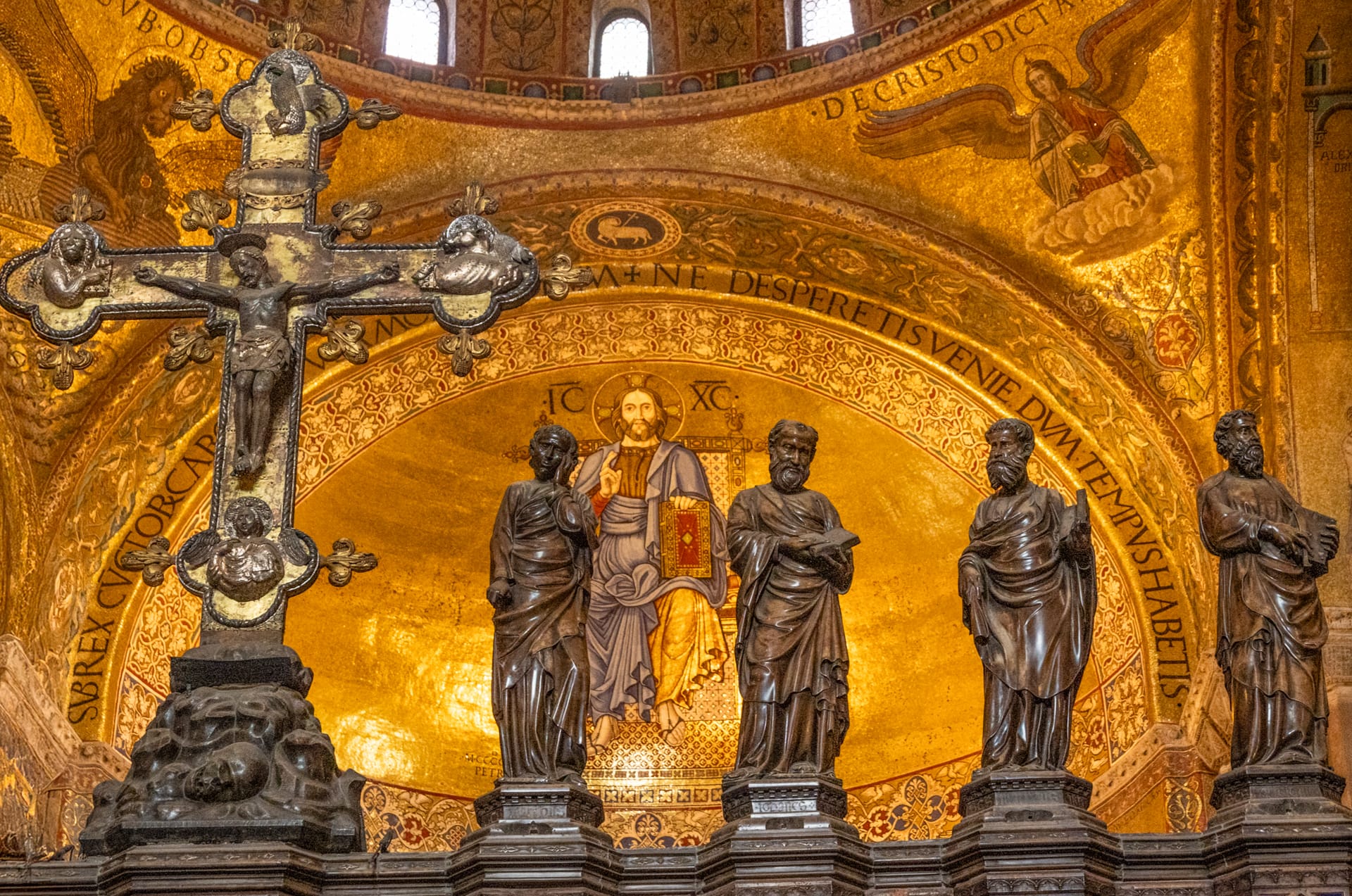

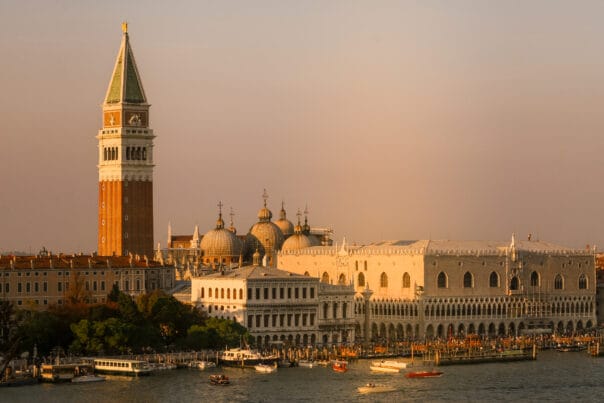
Sunset over the façade, golden light on mosaics
As the sun sets over Venice, St. Mark’s Basilica glows anew—its golden mosaics igniting in the last light of day. It’s timeless, mysterious, and radiant. The basilica continues to tell its stories—not just in stone and gold, but in spirit.
I recommend taking a skip-the-line tour; mine was a joint tour of the Doge’s Palace and St. Mark’s given by The Tour Guy. Without the guide, I would not have understood what I was seeing or the history behind it.