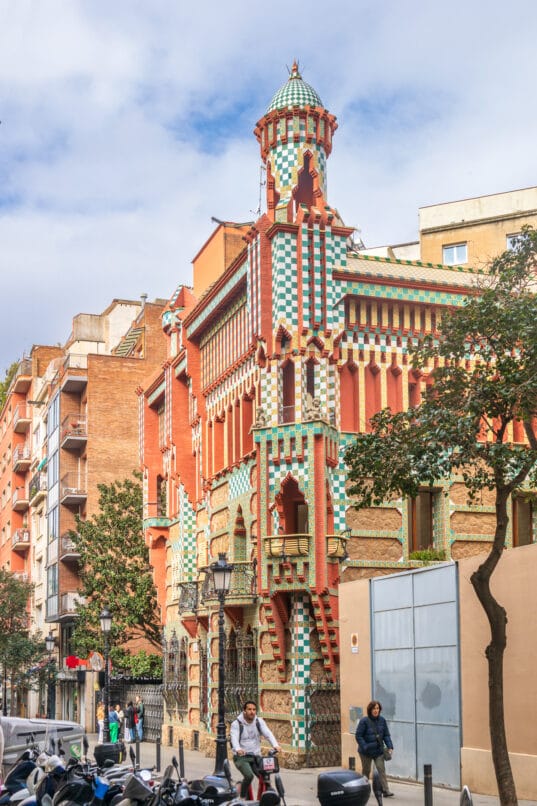
I heard rave reviews about Casa Vicens, Antoni Gaudí’s first significant architectural project, while touring his iconic Sagrada Família. So, my travel buddy Judy and I decided to visit. We took the subway from the Gothic Quarter and walked into the Gràcia neighborhood of Barcelona, Spain. Our excitement grew when a structure suddenly jumped out from the rest of the buildings along the street—a house completely unlike anything else. It appeared as a kaleidoscope of colors, textures, and unexpected shapes. We couldn’t wait to get a closer look.
Casa Vicens as seen from the street.
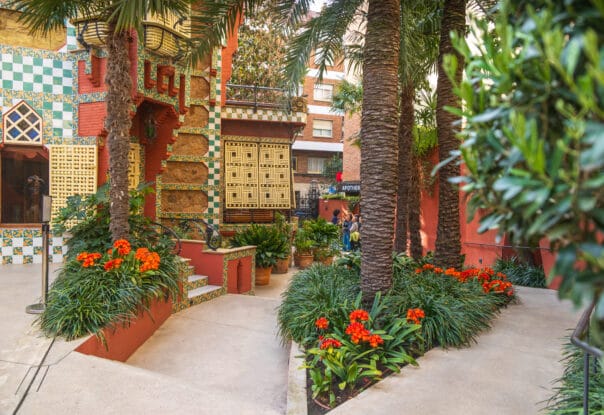
We followed a sign to the rear of the house, where we met a staff member who explained the use of the audio guide. We paused and listened outside, marveling at the imaginative details of the house and the blooming gardens.
Colorful gardens surround the house in the city.
Welcome to Casa Vicens
The house was commissioned by Manuel Vicens i Montaner, a wealthy stockbroker and tile manufacturer, as a summer home in the Gràcia district—then a separate village from Barcelona.
A side view of Casa Vicens full of color and life.
A House That Blooms
The façade bursts with green-and-white checkerboard tiles, lush floral motifs, and terracotta accents. Gaudí, deeply inspired by nature, even modeled some of the ceramic patterns after marigolds from the garden. The colorful tiles also give a nod to the ceramic factory that Mr. Vicens owned.
What a gorgeous entryway into the house.
Wrought Iron Wonders
Look closely: even the iron grilles and balconies are adorned with naturalistic details like palm fronds and climbing vines. Gaudí believed that every element mattered—from structure to ornamentation.
Ornate ironwork on the windows and balcony of Casa Vicens.
The Interior
When prompted by the audio guide, we stepped inside Casa Vicens and felt as if we had entered a child’s storybook and couldn’t wait to turn the pages. Completed in 1885, Gaudí’s first major work marked the beginning of his revolutionary architectural career. Its bold forms, eclectic textures, and vibrant colors set it apart from anything else in the city.
A Wall in the Living Room with built-in furniture.
Main Floor: Where Art and Architecture Meet
The main floor is a feast for the eyes. Hand-painted ceilings, wooden beams, and flamboyant wallpapers create a cozy yet theatrical atmosphere. Gaudí also designed the furniture, custom-made to blend seamlessly with the architecture.
Gaudi even designed furniture.
The Moorish Dream: The Smoking Room
Perhaps the most spectacular space is the oriental-inspired smoking lounge. Jewel-toned tiles, Arabic arches, and a muqarnas ceiling (a honeycomb-like structure of stacked forms) create a vivid tribute to Islamic art, which fascinated Gaudí. The room reflects the Orientalism popular in 19th-century Catalonia. (It reminded me of ceilings in the Alhambra in Granada and a room in Cardiff Castle in Wales.)
The Islamic inspired Smoking Room was my favorite.
Upper Floors: Geometry in Motion
Every inch of the house is a canvas. Light filters through intricately carved wood, casting shadows that shift throughout the day. The designs feel alive, never static. I loved the splash of color, the tilework, and the meticulous attention to detail. (The Gaudí-designed vase seen here originally stood at the front entrance.)
Gaudi-designed vase for the front entrance.
A Home in Harmony with Nature
The lush garden was essential to Gaudí’s vision. He believed in integrating architecture with the natural world. Casa Vicens was a summer retreat, and the green space offered both privacy and beauty. One bedroom balcony felt like a treehouse overlooking the garden.
Iron work and Tiles
Chimneys to the Sky
No Gaudí house is complete without its whimsical rooftop. The chimneys, wrapped in glazed tile mosaics, are functional sculptures. From the top, the views stretch across the Gràcia neighborhood—and hint at the architect’s future masterpieces.
The tiled chimney on the roof, a Gaudi signature.
The Birth of a Genius
Casa Vicens wasn’t just a house; it was Gaudí’s calling card—the moment when Barcelona, and the world, first glimpsed his genius. Every curve and color hints at what was to come, from Park Güell to the Sagrada Família.
The main entrance: look at the shadows of the almighty fronds accenting the (unseen) gate.
A Living Legacy
Casa Vicens remained a private residence until 2014, when it was purchased, restored, and eventually opened to the public in 2017. In 2005, it was included as part of the collective UNESCO World Heritage listing Works of Antoni Gaudí.
Today, Casa Vicens operates as a museum that celebrates Gaudí’s origins. It’s not just a monument—it’s a conversation between past and present, nature and architecture, tradition and innovation.
The bedroom balcony with cherub overlooking the garden.
Tips for Visitors
I booked a self-guided tour with an audio guide, which you install on your phone upon arrival. Be sure to bring your own earbuds! The narration was excellent—informative without being overly long.Wear comfortable walking shoes, as Barcelona’s streets are often cobblestone, and visiting the house involves climbing three flights of stairs. A small gift shop is located in the basement. By all means, don’t miss this less crowded but utterly charming Gaudí attraction in Barcelona.