My First View of the Grand Canyon at the South Rim
After years of yearning to see the Grand Canyon, I recently caught my first glimpse. The Canyon is way beyond grand– it’s indescribably magnificent, beyond glorious. It’s overwhelming. My heart started racing, the sight literally took my breadth away and almost brought tears to my eyes.
Majestic Red Rocks
Having built up a lifetime of dazzling expectations, I was afraid of being disappointed, but the reality was exactly the opposite –the view of twisted ravines, spectacular plateaus, and layers of terracotta, muted gold and brown rock were more stunning than I’d hoped; dramatic, scary and unfathomably deep.
Grand Views
I wanted to sit and just contemplate, however, my time was limited. Instead I quickly walked along trying to inhale every angle and vista possible. My photos do incredible injustice to the majestic two thousand million year-old gorge.
View from the Watchtower
I touched a mere smattering of the 280 mile-long natural wonder. I peeked thousands of feet below from the South Rim near the Visitor’s Center to the Bright Angel Lodge. I also traveled by car to the 70-foot tall Watchtower at Desert View, which provided more astounding vistas. And then a friend confided that the North Rim view is even more spectacular.
A closer look at the Canyon
Next time, and trust me, there will be a next time, I plan to hike all the way down to the bottom of Grand Canyon National Park, ride a donkey and savor a sunrise or sunset. But for now, I’m content with my tantalizingly short sojourn to this most sacred and humbling place.
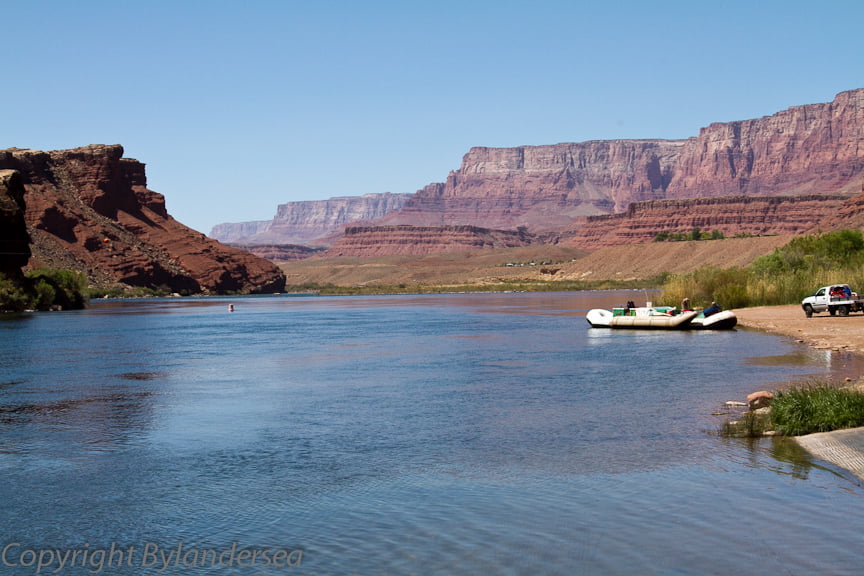
Rafters get started at Lees Ferry
For Visitor Information: http://www.arizonaguide.com/
Imagine stepping back in time and arriving at the Grand Canyon the same way travelers did more than 100 years ago- on the iron horse.
I recently experienced this journey starting in the heart of downtown Williams, Arizona, a frontier “Main Street” town along the legendary Route 66. Williams retains much original architecture and road-side appeal from the era when car travel was king and roadside cafes dotted the rural towns along fabled Route 66.
In Williams, every morning begins with a Wild West shootout. Of course, I expected a lot of cheesy humor from a scripted show, but the costumed actors were surprisingly good and the banter was honestly fun. The audience got into the moment.
Shoot-Out in Williams, AZ
Afterward, the crowd walks to the diesel-powered train as the conductor barks out, “All-aboard!” My first-class ticket provided entree to the “luxury” cars with sofas and tables, an attendant, food, drinks and even a strolling banjo player. What a relaxing and stress-free journey. During the two and half hour ride, I walked from car to car and stood on the rear platform to capture some incredibly exotic “Kodak” moments with my camera.
Before the railroad opened for business in 1901, visitors arrived at the magnificently chiseled Canyon via four-horse-team stagecoach. Tickets cost $20 for that arduous bumpy ride compared to $3.95 for the new-fangled choo-choo. No wonder steam powered trains instantly became the desired choice of public transport. However, as automobiles grew in popularity, rail travel slowly dwindled. In 1968, the tracks went quiet and lay dormant for twenty more years. Then, in 1989, the line was renovated, providing children and adults an opportunity to savor a most romantic mode of travel.
Grand Canyon Depot
Banjo player on the Grand Canyon Railroad
My sojourn ended in front of the massive, yet cozy Grand Canyon Depot, an incredibly picturesque log-framed station. Back in 1905, the Santa Fe Railway built the El Tovar Hotel across the tracks. The El Tovar reigned as one of the most luxurious hotels of its day featuring hot and cold running water, electric lights, art galleries and plush dining rooms. The original dark timbered structure still beckons and I walked in to take a peek. Moose, deer and buffalo heads adorn the lobby along with large paintings of the Canyon. Most US Presidents through the 20th Century have stayed there. Sadly, I did not.
My first look at the Grand Canyon truly overwhelmed me- it’s stunning, awesome, terrifying– yet glorious. My heart raced and tears formed in my eyes. Grand is not the right word; there simply are no apt words to capture this national treasure should be high on everyone’s bucket list. It does not disappoint.
Ample and safe parking for autos is available in Williams near the train station. Riding the rail relieves the Grand Canyon of some 50,000 cars annually. In addition, arrival by train bypasses tollbooth backups and eliminates the need to utilize shuttle bus transfers from remote parking to the Grand Canyon Village and South Rim.
In January I attended a photo workshop presented by John Reed in conjunction with the Okefenokee National Wildlife Refuge. The noted preserve was established in 1936 to protect the unique freshwater ecosystem and head waters of the Suwannee River. I’d never been through the Florida/Georgia swamp even though it sits just 75 miles away.
Okefenokee Wildlife Refuge
The park is vast, listed at 402,000 acres or roughly the size of 300,000 football fields. Whoa! The strange name comes from Native Americans who called it Okefenoka, meaning “Land of the Trembling Earth.” The name is still appropriate as peat continues to build up on the swamp floor and the deposits are so unstable that trees and bushes tremble when you stomp the ground.
During the workshop lunch break, I spotted an alligator sunning himself near the Visitor’s Center. His skin looked gray and dry and I suspected he’d been there quite a while. One of the rangers mentioned that gators move slowly during the winter. Since I’d seen frost on the morning drive and the temperature hovered around 38-40 degrees at noon, I wasn’t too worried. I got down on my belly atop a raised boardwalk and snapped this photo.
A Swamp Gator
Later in the afternoon, I returned and noticed a second, smaller gator. The larger one had only moved about a foot from his previous location and both barely opened their eyes. Guess most of the creatures were sleepy because my group had only seen these two reptiles and a slew of birds all day.
A sunrise shoot was planned for the next morning and the weather stayed cold. Sadly, the sunrise didn’t opt to make a dramatic entrance, so the group decided to move along. We headed in the direction of a fantastic winding boardwalk and three-story viewing platform.
But, as photographers are apt to do; we stopped after noticing some interesting tall grass. Instructor John walked along the road surveying the landscape. I was not far behind when we heard a hissing sound, like an amplified snake. John caught site of a gator’s head rising from a small mud-puddle. I wanted to photograph this wild critter, so I ran over. Sure enough, the small head was all I could see, surrounded in a thick mud bath. Was his body buried deep below?
Perhaps foolish thinking, but I stepped closer. That gator wouldn’t or better yet, couldn’t move quickly from his location, could he? Nah. Just as I was getting ready to click the camera, he hissed at me- VERY LOUDLY. That’s a sound I”ll never forget. I jumped back and my resulting shot is a bit blurry, but you can see his open mouth. Mr. Gator was mad and I was scared. As far as I was concerned everything was not okey-dockey in the Okefenokee.
I immediately departed the scene, leaving the fellow alone. Even if I didn’t get the photo, I at least left with a gator tale.
The Hissing Gator
For information contact: Okefenokee National Wildlife Refuge 2700 Suwannee Canal Road, Folkston GA 31537 912-496-7836 912-496-7836 E-Mail: okefenokee@fws.gov