Amelia Island Concours D’Elegance ranks high on the list of elite car shows worldwide. In 2013 some 300 vintage autos wowed the crowd, each a prime example of its class.
Special categories highlighted the fiftieth anniversary of the Porsche 911, the Corvette Singray and the Lamborghini.
No wonder thousands attended the multiday events strewn around Amelia’s Ritz Carlton and the fairways of the Golf Club of Amelia Island. Amelia Island itself is a gem, a skinny strip of land off Florida’s northeastern coast. The isle attracts beach goers with 13 miles of uninterrupted coastline and golfers to ten top courses within ten miles.
I drove from St. Augustine to Amelia Island to meet Richard Truesdell, Editorial Director of Automotive Traveler.com Magazine. Richard had flown in from California to attend three days of the auto festival: the auction, road rally and Sunday’s spectator viewing and awards ceremony.
A winning Porsche
While I’m certainly no authority on cars, hanging with Rich made the event more understandable and fascinating. He pointed out engine and design details and why each change was significant. I could best relate to the Porsche’s since I once attended Porsche Driving School sponsored by Brumos. In addition, working as a contributor at Automotive Traveler Magazine has provided me opportunities to tour auto assembly plants, get behind the scenes at Daytona Speedway and ride in a pace car on the Kansas Speedway.
But, I’ve never had a ride in a 1908 Mercedes Benz – I suspect not many have. This serendipitous experience occurred after the awards presentation at Amelia Concours, as the vintage autos were being loaded onto transporters to be shipped home or to another auto show.
It just so happened that the trailer for the Mercedes was parked in an area near a deserted section of the beach. Richard asked Hans Wurl, the manager, to drive the vehicle onto the sand for photos. Best of all, I got a ride!
Riding in a 1908 Mercedes-S
The bumpety-bump, jostling feel of the car was somewhat akin to riding a bike with firm tires down a cobblestone street. The horseless carriage engine made put-put sounds and the airy openness provided a totally outrageous view. The brief ride gave me a memory I’ll always cherish.
I have now learned that many car enthusiasts acknowledge this roadster as the world’s first sports car. How cool is that?
Like any journalist, I asked Hans about the prize-winning racer and its worth. He answered, as any good manager would, saying, “The auto, a 1908 Prinz Henrich owned by Bruce and Jolene McCaw, is not for sale.”
Yes, I said I understood, but then pitched the question in a different manner. “Suppose the car was listed in an auction, would the price start over a million dollars?”
“Absolutely,” was the answer.
So there you have it: my ride in a million dollar baby.
1908 Mercedes Benz at Amelia Island Beach
Please watch the video to see some of the vintage autos on display at Amelia Concours:
Florida’s documented cultural history dates back more than 12,000 years to Native Americans. The first inhabitants were hunters and gatherers whose diets consisted mainly of small animals, plants, nuts and shellfish. They learned to cultivate agriculture and began trade with other native groups in the Southeast. They developed a social organization and built large temple mounds and village complexes.
I recently visited the Florida Museum of History in Tallahassee to learn more about the state’s illustrious past. The Museum proudly presents its new permanent exhibition called Forever Changed: La Florida 1513-1821, in conjunction with Viva Florida 500. Phase 1 exhibits were opened March 3, 2013 and include three interactive galleries and artifacts showing 16th century European presence in Florida.
Wooly Mammoth at Florida Museum of History
In the Land of Many Cultures tourists learn about the native peoples shortly before the European arrival. They have a fabulous fossilized Wooly Mammoth, life size diorama, and a recreated Timucuan house. I was attracted by a rare (and gorgeous) ceramic bowl dating from 1350-1500, and a 1593 Astrolabe used for navigation.
The second section called Meeting of the Cultures showcases Spanish explorers such as Hernando de Soto and Tristan de Luna. Stop to hear these historical life size figures tell their stories. Note to parents — kids really like this area.
Life size model of Ana Menendez
The third new section, Spanish Exploration, boasts a portion of a 16th-century Spanish ship which everyone can board, plus investigate the dock area. The interactive exhibits, such as knot tying, allow guests to learn about life on the sea, navigation and what items the settlers needed to bring to the new world.
Spanish Ship within FL Museum of History
In addition to the Forever Changed exhibits, I found a fabulous collection of sunken treasures and gems discovered from Florida shipwrecks. Made me think of gold doubloons and pieces of eight! I also viewed displays on Florida’s involvement in the Civil War, WWI and WWII.
Sunken Treasures
Personally, my favorite exhibits were the array of kitschy Florida souvenirs spanning many years: an orange shaped tea set, mermaid memorabilia from Weeki-Wachee Springs, early Disney bric-a brac and the artwork on Florida orange crates.
Baby boomers grew up watching powerful rockets launch ‘right stuff’ astronauts into orbit. As the space program evolved, so did the size of the missiles from the Atlas to the Titan, and later the 360-foot Saturn V moon rocket. Sadly, the US manned space flight program is currently curtailed. Private companies are developing vehicles for future space exploration but none are available at this time.
Therefore, I was surprised to receive an invitation to watch a rocket launch on March 19, 2013, at Kennedy Space Center and even more pleased that it fit into my schedule. The drive from St. Augustine is a little under two hours and the launch window was scheduled from 5:21 pm to 6:01 pm. Perfect.
I parked in the Visitor Center lot ($10.00 fee per vehicle) then entered the complex through the suitably planted rocket garden. This area blossoms with numerous projectiles nurtured through NASA’s care and various flying machines like the tiny one-man Mercury capsule.
I meandered along, passing by the newly opened Angry Birds interactive encounter and found the bus queue for the Saturn V Center, a tour that’s included with visitor admission. The bus ride takes about 15 minutes and passes the VAB (Vehicle Assembly Building), the largest one story building in the world. Huge is an understatement. The building, complete with a painted American flag, greets like an old friend; it’s familiar to anyone who watched past NASA events. The bus driver said, “Each of the stars on the flag is 6 feet across, the blue field is the size of a regulation basketball court, and each of the stripes is 9 feet wide.”
Vehicle Assembly Bldg Kennedy Space Center
The Kennedy Space Center actually lies within the Merritt Island National Wildlife Refuge, home to more than 1,500 species of plants and animals. Some 600 alligators thrive in the roadside ravines and lakes. The bus passengers caught site of a few gators, an Eagle’s nest and a number of egrets and herons.
Upon arrival at the Saturn V building, I learned it houses the original Apollo mission control center. Visitors file into an amphitheater attached to the control room and watch a three-screened video display. I became the observer of a countdown and launch of the world’s most powerful rocket on its take-off for the moon. The seats vibrate during the launch. Very cool!
As I exited the control room I practically ran into the massive side lying Saturn V. The rocket is 58 feet taller than the Statue of Liberty from the ground to the torch. The fully fueled giant weighed 6.5 million pounds and had a payload capacity of 260,000 pounds.
Saturn V Rocket Kennedy Space Center
After perusing some astronaut spacesuits and other Apollo related displays, I went outside to set up my tripod. Although scheduled lift-off was still about an hour ahead, the grandstands were filling with spectators and kids were playing games on the grass. This was a slice of Americana, an apple pie moment.
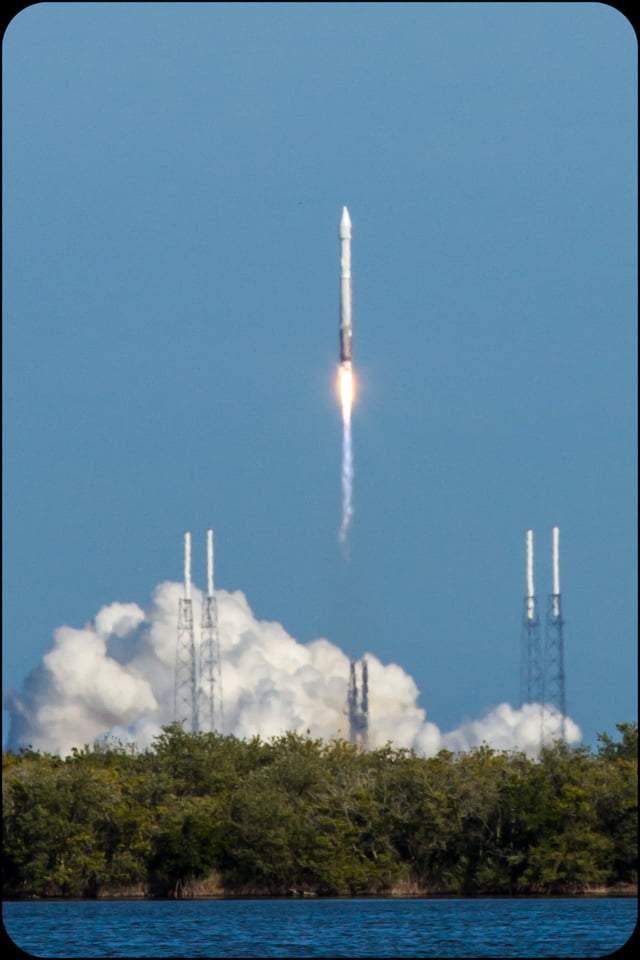
A NASA spokesman appeared about 30 minutes before launch time and explained what would happen. We would see the launch of an Atlas V rocket carrying missile warning satellites for national security purposes. The Atlas V is a small rocket and its heaviest payload lifted into orbit was 15,000-pounds.
The spokesman said we would hear mission control requesting systems approval and the specialists responding with a “GO” signal — if all was right. Assuming it was, the mission controller would give permission for the countdown to proceed.
Ignition Atlas V Kennedy Space Center
At about ‘T’ minus 3 minutes, a hush came over the crowd; people anxiously looked in the direction of the rocket. I could feel excitement mounting as the minutes ticked away. When the countdown got to 15 seconds, everyone was on alert. Then, the number 10 was spoken and the crowd spontaneously joined in the reverse count 3…2…1…zero. We heard the word “ignition” and saw lots of white smoke blast around the base of the rocket. Soon flames appeared and a gradual lift-off commenced. The adults began to clap and cheer.
As the rocket rose higher, the cheers grew wilder and the sight was honestly awe inspiring. Much more captivating and thrilling than seen on television.
After another ten seconds the rumble and roar grew louder; then a rocket separation occurred leaving a trail of billowing ghostly smoke high in the sky. I hate to say this, but the trail reminded me of the ill-fated Challenger’s. In a matter of ten more seconds, the rocket’s red glare was out of sight and headed into orbit.
I could scarcely contain my joy! Honestly, a launch is something to view and a moment you will not forget. I strongly encourage everyone to witness a live event, if possible. Had the rocket been larger and manned, I am sure it would have elicited goose bumps or tears. But, don’t let a smaller rocket stop you; the thrill is still magnificent.
I am so grateful I availed myself of this opportunity. Thank you Kennedy Space Center.
Atlas V Smoke Trail Kennedy Space Center
By the way, should your summer plans include a visit to the Orlando area, consider a stop to see the new $100 million Shuttle Atlantis facility being unveiled at KSC on June 29th. The addition is currently being constructed around Atlantis, the last shuttle to fly in 2011.
Also KSC behind the scenes tours continue- you can read about them in my earlier post.
The VAB tour has been extended through 2013 and the LCC and Launch Pad tours are confirmed through June 30. All Up-Close Tours are $25 per adult and $19 per child (ages 3-11) plus tax, in addition to admission.
For more information on Kennedy Space Center Complex, please visit www.KennedySpaceCenter.com.
Here’s a video of the Atlantis Shuttle launch as seen on a Behind the Scenes Tour: