Tag Archives: recipe

Colonial Cooking: Indian Pudding and the Roots of American Cuisine

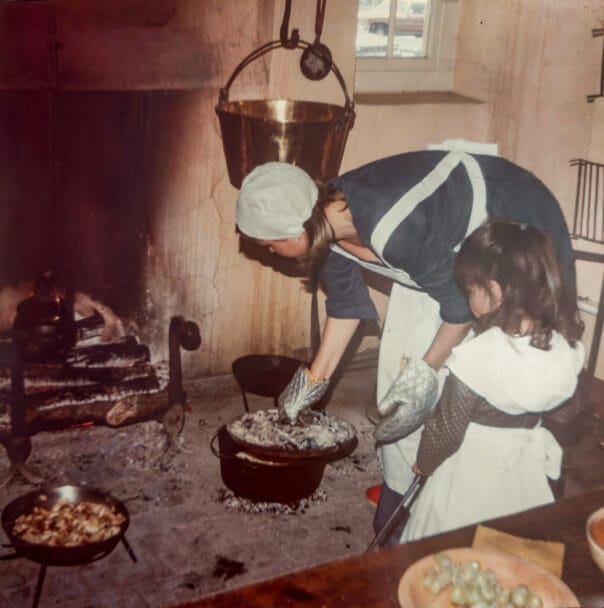
That’s me — Demonstrating Open Hearth Cooking many years ago. ©Bylandersea

As part of my BylanderseaAmerica250 blog series, I plan to share historic recipes from time to time. Many years ago, I volunteered as an open-hearth cooking docent for the Camden County, NJ Historical Society. That experience sparked my love of colonial-period recipes—some of which I still prepare today.

Food in colonial America wasn’t simply about taste; it was about survival. Early settlers arrived to an unfamiliar climate and landscape, often with limited supplies. They had to learn quickly what would grow, what game could be hunted, and how to preserve food through long winters.

Lessons from the Land and Its People
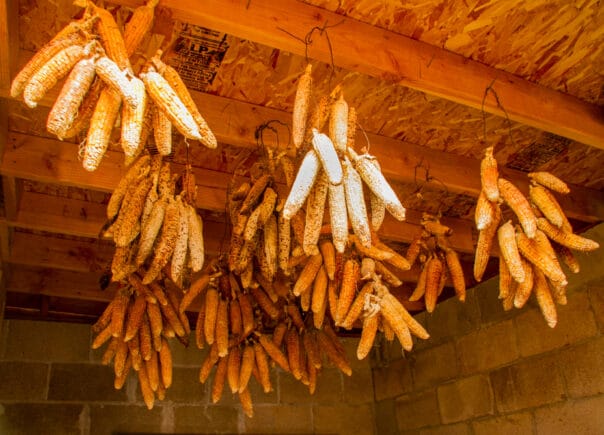
Drying corn for the winter. ©Bylandersea

Native Americans played a vital role in shaping colonial diets. They introduced the newcomers to a variety of foods that became staples in the colonies. Chief among these was corn, or maize, a crop unknown in Europe but already the backbone of many Indigenous diets. Native peoples taught colonists how to plant corn in mounds with beans and squash—the “Three Sisters” method—which replenished soil nutrients and produced a balanced harvest. They also showed the colonists how to grind dried corn into meal for breads, mush, and porridge. Recipes evolved into staples such as johnnycakes and hoe cakes.

Beyond corn, Indigenous communities shared knowledge about beans, pumpkins, wild rice, cranberries, and local herbs. They passed on methods of smoking and drying meat and fish, enabling colonists to preserve protein through the lean months. Without these lessons, many early settlers might not have survived.
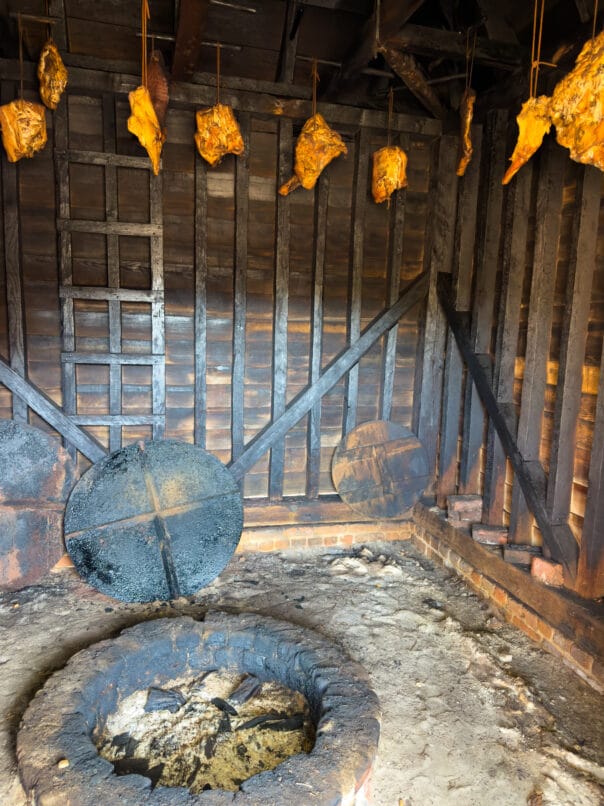
Hanging and Drying Meat the old-fashioned way. ©Bylandersea

Settlers adapted English recipes to the ingredients at hand. Stews, chowders, and corn-based breads became daily fare. A typical colonial meal might feature a pot of vegetables and salt pork, corn mush with milk, or roasted game accompanied by whatever seasonal produce was available.

Indian Pudding
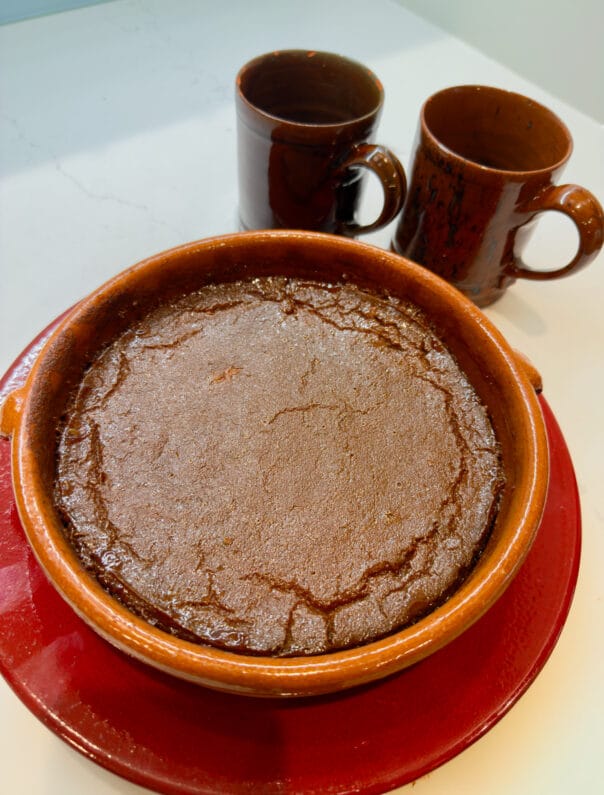
Indian Pudding – ready to eat. ©Bylandersea

In this post, I’m sharing a classic: Indian Pudding. Its name reflects the influence of Indigenous people who introduced corn to the early settlers and taught them to eat it in countless forms—roasted, boiled in soups and stews, mashed, dried, ground into cornmeal, or baked. Indian Pudding uses cornmeal and molasses, making it both hearty and lightly sweet. The custard like concoction can be served as a side dish or dessert, and it makes a wonderful addition to a Thanksgiving table as a conversation starter about our shared food heritage.

Today, preparation is easy: you simply bake it in the oven. But in colonial times, the pudding might be cooked in a Dutch oven or a heavy pot nestled into hot coals by the hearth.

Recipe for Indian Pudding

  • 3 cups milk
  • ½ cup molasses
  • 1/3 cup cornmeal
  • ½ teaspoon ground ginger
  • ½ teaspoon ground cinnamon
  • ¼ teaspoon salt
  • 1 tablespoon butter

In a saucepan, mix the milk and molasses; stir in the cornmeal and spices. Cook and stir until thickened, about 10 minutes. Pour into a 1-quart casserole. Bake uncovered at 300°F for about one hour (or longer if the middle seems uncooked). Serves 6–8, hot or cold.

Colonial Cooking: Why It Matters Today
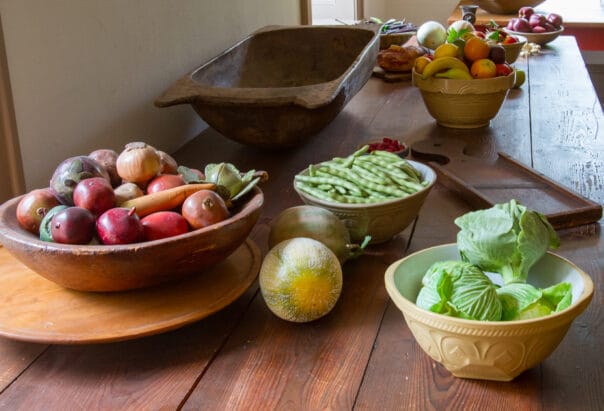
A colonial kitchen table.©Bylandersea

Colonial cooking tells a story not only of hardship but of cultural exchange and adaptation. The blending of Indigenous and European foodways laid the foundation for American cuisine as we know it. When you bite into cornbread, enjoy a Thanksgiving pumpkin pie, or spoon up a chowder, you’re tasting history that began in those earliest kitchens.

A Juicy Mango Cake for Mango Season

As I take my morning walk in Sarasota, Florida, I pass mango trees ripe with fruit. At the end of July and  beginning of August, the mangos are in season –so mature they drop from the tree and litter the sidewalk. I picked one up, only slightly bruised, and decided to take it home. That got me inspired to bake.  

Unripened mangoes growing on a tree.
Unripe Mangoes on a Tree

If you’ve never tasted the golden- peachy stone fruit that bursts with sweet delicious pulp, buy one. Mangoes are high in Vitamin C and A. Mangos are so moist you’ll find juice dripping down your hands. I have heard the best way to eat a mango is naked!

A mango cut open showing the juicy mango flesh.
The golden orange inside of a ripe mango. (Photos Wikimedia Commons: Ivar Leidus)

My grocery stores generally sells two types of mangos. While the exact number of mango varieties  worldwide is uncertain, there are at least 500 and perhaps as many as 1,000.  Many of those grow in India. The mango is the national fruit of Pakistan, India and the Philippines. It is also the national tree of Bangladesh.

Champagne mangoes in a red bowl.
A Bowl of Champagne Mangoes

My favorite is the thin-skinned, more oblong variety I call a champagne mango (sometimes called honey mangos). They are yellow when ripened and the pit in the center is small compared to other type. The best part is that the flesh is very smooth, without fibers.

In the past, I’ve made mango pie and mango cobbler but never tried to bake a mango cake—until now. The Southern Living website published the following recipe, which I followed, baking the cake for my house guests. This recipe is a Bundt cake, but the texture resembles a moist carrot cake with golden raisins and walnuts, however without cream cheese frosting. My guests declared the dessert a winner, topping it with vanilla ice cream. Why not try it for yourself and see?  

A baked Mango Bundt Cake
My Mango Bundt Cake (Photo by Debi Lander)

***

If you don’t know how to cut a mango, here is a YouTube video that explains the process in great detail.

How to Cut and Dice a Mango: 

And if you are interested, here’s a link to 13 Juicy Facts about Mangoes:

Recipe for Mary’s Mango Cake from Southern Living

Mango Cake is full of fruit and nuts.
Looking inside the Mango Cake.

Ingredients:

Cake

•       4 large eggs

•       1 cup granulated sugar

•       1/2 cup vegetable oil

•       1/2 cup honey

•       2 cups all-purpose flour

•       2 teaspoons baking powder

•       2 teaspoons ground cinnamon

•       1 teaspoon ground nutmeg

•       1/2 teaspoon baking soda

•       2 cups diced fresh mango (from 1 mango)

•       1 cup chopped walnuts or pecans

•       1/2 cup golden raisins

•       1 tablespoon orange zest (from 1 orange)

•       2 teaspoons lime zest (from 2 limes)

Topping

•       1/2 cup sifted powdered sugar

•       1 teaspoon orange zest plus 1⁄4 cup fresh juice (from 1 orange)

•       1/2 teaspoon lime zest plus 2 tsp. fresh juice (from 1 lime)

Directions

1.      Prepare the cake: Preheat oven to 325°F. Lightly oil and flour a 14-cup Bundt pan. Beat eggs in bowl of a stand mixer on medium speed until fluffy, 4 to 5 minutes. Beat in sugar until combined; then beat in oil until combined. Gradually beat in honey.

2.      Whisk together flour, baking powder, cinnamon, nutmeg, and baking soda in a separate bowl. Add flour mixture, ½ cup at a time, to egg mixture, beating just until blended after each addition. Stir in mango, nuts, raisins, orange zest, and lime zest. Pour batter into prepared pan.

3.      Bake in preheated oven until a wooden pick inserted in center comes out clean, 50 to 55 minutes. Remove to a wire rack, and let stand in pan 10 minutes.

4.      Prepare the Topping: While the cake stands in the pan, stir together powdered sugar, orange and lime zest, and orange and lime juice until combined. Invert cake onto a plate. Drizzle Topping evenly over warm inverted cake. (Or make a glaze, stirring together about 1 cup sifted powdered sugar and 1 tablespoon fresh orange juice; pour over cooled cake.) I think I used too much juice in my glaze because it was runny. Tasted good, however. 

5.      Serve with or without ice cream. 

Turning the Mostly Apples Cake into the Mostly Apple Hurricane Cake

I was in a hurry as we in Florida were expecting a hurricane, and that likely means a power outages.  I wanted a quick and easy bake, something without a lot of bowls and pans to clean-up. But, I needed a recipe with ingredients that were already in the house. That meant I couldn’t make my Easy Blackberry Cobbler.

 I had recently seen the recipe for a Mostly Apples Apple Cake from King Arthur Baking site and it caught my eye. The cake looked like a cross between an apple pie and apple cake, more like a cobbler but not as fruity.

A slice of Mostly Apple Hurricane Cake closeup.
A slice of Mostly Apple Hurricane Cake

Continue reading Turning the Mostly Apples Cake into the Mostly Apple Hurricane Cake