I am not an artist; the closest I come is through photography. However, I recently found myself in Key Largo and was offered a painting class with Pasta. Hmm. My thoughts ran to my grandkids and those colorful necklaces and bracelets they make with painted pasta shapes.
No noodles here. I entered a fabulous artist’s studio and gallery where I met Roberto Pantaleo, a.k.a. Pasta, my instructor. Pasta is an artist who paints vibrant scenes of the Keys, mostly fish and marine life. I adored his lines and design in the above fish and was drawn to the peacefulness of this mangrove tree with criss-crossed roots.
Pasta Pantaleo and the Mangrove Tree
I was to paint a Leatherback turtle–okay! First, I sketched oval egg shapes on a piece of paper and Pasta showed me how to blend those into the turtle’s head, body and limbs. Next, I drew a similar animal on canvas. So far so good.
Painting the water
Now it was time to pick up the brush- a daunting task. “Just mix blue and green together and drab them onto the canvas like Monet,” said Pasta. Sure, I thought.
“Lovely colors,” he said. “Do the same thing with beige and browns to create the beach.”
Amazingly, my little turtle was coming to life better than I expected and the thing was — I was having a blast. I forgot about time and felt like I was floating in the water with my tortoise. I was literally living in the moment.
When I tried painting my turtle’s shell, my efforts didn’t achieve much depth. But, a few strokes from the master greatly helped the cause. I ended up with a painting I’m rather proud of. Sure, I know it’s a primitive work but I had fun. Wish I could take another class.
Turtle by Debi
Pasta Pantaleo is the ideal teacher; he’s encouraging and helpful, never demeaning and an all-around happy person. Might be the island’s aura, but the Keys seem to bring out art in everyone.
Brides historically chose June as the most desirable month for their ceremony, but destination weddings have throw out the calendar. Exchanging vows somewhere other than a hometown church is the growing trend. Resorts and exotic locations temp couples with gorgeous settings, warm winter weather – if desired, and assistance with planning. Plus, family and friends can enjoy a getaway, too.
Hotels embrace the concept because lavish functions and even those more low-key produce big income. Host facilities maintain a list of reliable vendors like florists, bakeries, photographers and transportation options to help coordinate nuptials. They essentially become “the wedding planner.”
Destination weddings do not necessarily mean an international venue. Some brides choose a place where the family has vacationed for years, a place that holds memories.
In the Southeast region, the Casa Marina Hotel on Jacksonville Beach, Florida, reigns as one of the most popular choices. Rebekah Blakely, the hotel’s Director of Catering says, “We have an intimate facility and only hold one wedding per day. We assure exclusivity and our entire staff is committed to delivering dedicated service.”
The historic hotel must be doing things right because the Casa Marina earned a Best of Weddings listing from The Knot, a premier wedding website. General Manager Mark Vanderloo said, “Back in 2004, the hotel hosted about 30 weddings but the number grew to approximately one hundred by 2011.”
Wedding Photos on the Beach
Brides are choosing the ease of holding their wedding and reception in the same locale. Beach weddings have tremendous appeal and Casa Marina brides can choose between an oceanside ceremony or the hotel’s courtyard which lies just steps off the shore. When brides realize they can eliminate the complications of sand and rent a tent in case of bad weather, they often choose the courtyard. This also negates the need for a beach permit.
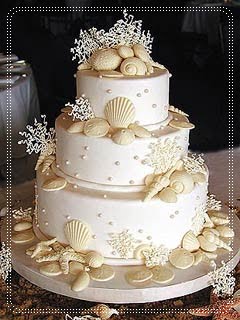
To match the non-traditional setting, many couples want flower arrangements or favors that feature a beach theme. They often incorporate shells, driftwood, starfish, floating candles and sand. Some couples select a seafood menu and specialized wedding cake featuring nautical designs. For example, Classic Cakes of Jacksonville Beach offers wedding cakes with white chocolate sea shells and brown sugar sand.
Beach Themed Wedding Cake
Wedding photographer Emily Martin suggests working the beach as a romantic backdrop. She frequently whisks the couple onto the sandy shores for a quick sunset photo shoot. Sunrise is the best, she adds, ” but few brides select early morning ceremonies. ”
Today’s saavy brides know what they want and they want a memorable day that runs flawlessly. We can’t guarantee the weather, say Blakely at the Casa Marina, but we can take the worry out. Weddings are our specialty. We pride ourselves in excellent management of every detail. No wonder brides and mother-of-the-brides are choosing the Casa Marina.
The Spanish built and manned Fort Matanzas (1740-42) to ward off British attacks on St. Augustine. Visitors need to understand that the fort is located 14 miles south of St. Augustine (along A1A). The area, now Fort Matanzas National Monument, is run by the National Park Service and located on Anastasia Island. The park is situated near the site of the killing of nearly 250 French Huguenots in 1565 by the Spanish, an act that gave the river and inlet the name Matanzas, Spanish for “slaughters.” Upon arrival (free parking) watch the eight-minute film to learn about the fort and the area’s history. Then, take a Park Service boat over to Rattlesnake Island, a less than 5-minute boat ride. Rattlesnake Island, a barrier island is left to wildlife, except for official trips by the Park Rangers. The public may boat and fish the waterway, but are not permitted to use the fort’s dock.
Costumed Soldiers at Fort Matanzas
Fort Matanzas measures only 50 feet on each side with a 30-foot tower; so a visit becomes a quick exploration. If possible go on a day when the soldiers are in costume.
Here is a soldier near the Garita or sentry box.
.This is the soldier’s quarters.The officer’s quarters are a level above.Officer’s Quarters
A Spanish flag flies from the observation deck. You’ll also find a chimney for the hearth below.The powder magazine was build into the land-based side of the fort’s walls.
A cistern for water storage lies below the canon deck, but is not open to tourists.
When the soldiers fire the canon, all visitors must evacuate the structure. Park Rangers gather them outside, and then explain the procedure and answers questions. The location allows only a side view of the canon from below, so you can’t see much of the soldiers’ participation in the activity. As one of the reenactors said, “If you really want to watch a canon firing, go to the big fort- Castillo de San Marcos.”
History The Spanish landed in St. Augustine in 1565, claimed it and built a settlement. Francis Drake raided the town in 1586. Afterward, the Spanish erected Castillo de San Marcos for their protection, a massive coquina fort still standing in the city (completed in 1695). In 1740, Governor James Oglethorpe and his British troops from Georgia blockaded the St. Augustine inlet or harbor. The Spanish held Castillo de San Marco during the 39-day siege, which was halted when hurricane season arrived and Oglethorpe withdrew. To prevent the British from attacking via the Matanzas River (a weak point in the city’s defense at the rear) the Spaniards constructed an outpost –Fort Matanzas. Oglethorpe returned in 1742 with 12 ships, but the soldiers drove off the attack with the little fort’s canon. Fort Matanzas was never attacked again.
Like Castillo de San Marco, Fort Matanzas was built of coquina stone and covered inside and out with white lime plaster. Usually, only one officer, four privates of the infantry and two gunners manned the fort. Soldiers were assigned there as a part of their regular rotation among the outposts and missions near St. Augustine. The tour of duty at Fort Matanzas was one month.
What happened to the fort? As part of the Treaty of Paris in 1763, signed to end the French and Indian War, all property in Florida was transferred to Britain. After the American Revolution, a second Treaty of Paris returned Florida to Spain. Fort Matanzas continued to be staffed but was not maintained. When Florida became a state in 1819, Spain transferred the land to the US. The fort had become so badly deteriorated that soldiers could no longer live inside. All that remained were two eight-pounder Spanish cannons originally mounted in 1793. They remain to this day. The US took possession in 1821 but never occupied the site. Military personnel were later sent to examine the ruins. They determined that Fort Matanzas had only historical value as the exterior surfaces were overrun with vegetation and its walls had cracked.
History lovers gained Fort Matanzas on July 18, 1916, when $1025 was granted by Congress for the repair of the historical structure. On October 15, 1924, using the power granted in the Antiquities Act, President Calvin Coolidge named five sites, including Fort Matanzas and the Castillo de San Marcos, as national monuments. On August 19, 1927, he issued another order, assigning all the lands around the fort, not included in the national monument to the Department of Agriculture, as a bird refuge.