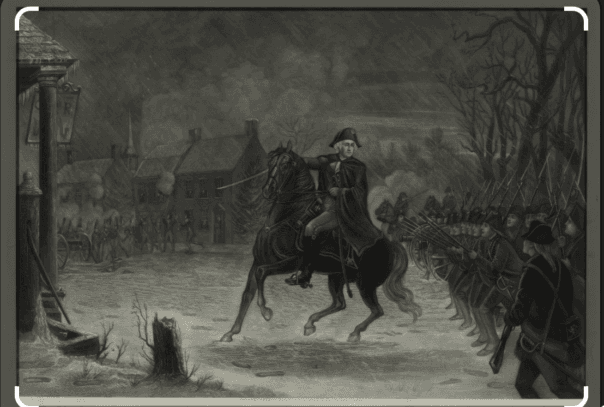
Washington leading the way to Valley Forge, Pennsylvania.
After the stunning victory at Saratoga in October 1777, the American cause finally gained international credibility. France would soon become an ally. Yet victory did not bring relief.
In December, General George Washington led nearly 12,000 weary soldiers into winter quarters at Valley Forge, only eighteen miles from British-occupied Philadelphia. The camp would test not only the army, but Washington himself.
He faced shortages, desertion, political rivals in Congress, and whispers that he should be replaced. Letters from the time reveal a leader weighed down by doubt yet anchored by resolve. Valley Forge became Washington’s greatest test.
By the summer of 1777, the American Revolution remained a fragile experiment. George Washington had saved the Continental Army at Trenton and Princeton, (be sure to read about the famous crossing of the Delaware if you missed it: here), but survival alone would not secure independence. The army was still poorly supplied, unevenly trained, and constantly short of men. Enlistments expired. Desertions continued. Victory had proven possible, but the outcome of the war was far from certain.
A Vintage print of George Washington at the Battle of Trenton.
British leaders believed time was on their side. If the colonies could be isolated and divided, the rebellion would collapse under its own weight. Military defeat was only one option. Political exhaustion and geographic separation might accomplish the same goal.
To that end, British commanders devised a sweeping plan to regain control of the Hudson River corridor, the natural spine of the colonies. Control the Hudson, and New England would be cut off from the middle and southern colonies. The heart of the rebellion would be isolated.
The task fell to John Burgoyne, a confident and ambitious British general. Burgoyne would march south from Canada with a large army, supported by artillery, German mercenaries, and Native allies. He expected to meet up with British forces advancing north from New York City. Together, they would crush American resistance in the region.
On paper, the plan appeared decisive.
In reality, it depended on flawless coordination, reliable supply lines, and terrain that proved anything but cooperative.
By the spring of 1776, the rebellion that had begun in the fields of Lexington and Concord finally forced the British out of Boston. For eleven months, the city had been trapped in a slow, grinding standoff known as the Siege of Boston, while George Washington’s newly formed Continental Army surrounded it from the hills beyond.
The turning point came in the dead of winter when Henry Knox, a young bookseller turned artillery officer, accomplished what many believed impossible. He hauled fifty-nine heavy cannons and mortars from Fort Ticonderoga across frozen rivers, mountains, and snow-covered wilderness. When the guns arrived outside Boston, Washington wasted no time.
On the night of March 4, 1776, American troops silently dragged Knox’s cannon up Dorchester Heights, overlooking the city and the British fleet. At dawn, General William Howe looked out and saw the heights bristling with artillery. The position was so strong that an assault would have been catastrophic. On March 17, 1776, the British evacuated Boston.
The Revolution had its first great victory.
But victory did not mean security.
The War Moves to New York
With Boston lost, British commanders shifted their focus. They would take New York City, whose deep harbor and strategic position made it the most important military prize in North America.
By summer, the largest British armada ever assembled filled New York Harbor. Washington rushed his army south, but his forces were untested and inexperienced. The result was disaster.
In August 1776, the Battle of Long Island ended in crushing defeat. Washington’s army barely escaped annihilation, slipping away under cover of darkness and fog. What followed was a long, exhausting retreat across Manhattan and New Jersey.
Men deserted. Supplies vanished. Morale collapsed.
By December, the Continental Army was on the brink of extinction.
A Desperate Gamble
Washington knew he had one last chance.
Washington Crossing the Delaware by Emanuel Leutze
Across the icy Delaware River, in the small town of Trenton, a force of Hessian soldiers slept in their winter quarters. Washington decided to strike on Christmas night.
Snow fell. The wind howled. Ice floes smashed against the boats as soldiers ferried cannon, horses, and men across the freezing river. Many marched barefoot, leaving blood on the snow. Muskets jammed. Powder grew wet. Some men collapsed before they reached the far shore.
Still, they marched.
In the early hours of December 26, 1776, Washington’s army descended on Trenton. The attack was swift and overwhelming. In less than an hour, nearly the entire Hessian garrison was captured.
It was not a major victory in size. It was a victory in belief.
A week later, Washington struck again at Princeton, forcing the British to retreat from much of New Jersey. The Revolution was alive.
Why This Moment Changed Everything
The evacuation of Boston proved the British could be beaten. The crossing of the Delaware proved the Americans would not surrender.
From the frozen trails of Henry Knox to the storm-tossed river at Trenton, the Revolution became something larger than rebellion. It became a test of endurance, sacrifice, and faith in an idea that had never before existed.
The war would grow darker still before it reached the light of independence. But on that frozen Christmas night, the American cause was saved.
Travel Guide
I sadly admit that I have not visited the New York City and New Jersey Revolutionary Sites and Museums, but I’d love to! Here’s my recommendations:
Fraunces Tavern Museum in Lower Manhattan
A must-visit for Revolutionary history in NYC. This museum preserves artifacts and tells the story of the Revolution in New York, including Washington’s farewell to his officers in 1783. For more information: frauncestavernmuseum.org
Revolutionary era exhibits
Hands-on programs and special America 250 events
Located in the historic Fraunces Tavern building
The New York Historical — Manhattan
While not exclusively Revolutionary, this museum houses strong collections and exhibitions related to New York’s colonial and Revolutionary history. Visit: New-York Historical Society
Bonus Revolutionary Sites While in NYC
Even in a modern city, history survives in places and tours:
Historic Revolutionary Tours NYC to explore sites tied to the 1776 campaign. Check out: American Battlefield Trust
Brooklyn War Memorial (tribute to military service) and historical markers around the city commemorating Revolution-era events.
Trenton, New Jersey Revolutionary History
Old Barracks Museum — Trenton
One of the finest Revolutionary War museums in New Jersey, housed in a restored 1758 military barracks used during the war. It interprets the Battle of Trenton and life during the era. Reopening March 2026.
British soldiers were stationed here
Museum tours explain the war’s impact on soldiers and civilians
Trenton Battle Monument & New Jersey State House
Nearby historic landmarks connected to Revolutionary New Jersey and its role in the fight for independence. Click Trenton Historical Society for a Self-Guided Tours of Trenton’s Revolutionary War Battlefields.
Princeton Battlefield State Park
A preserved battlefield where Washington scored a key victory shortly after Trenton. Visitors can walk the grounds where Continental soldiers advanced and British forces retreated.
Princeton Battle Monument
Princeton Battlefield Monument in Princeton, NJ depicting George Washington and his troops. Douglas Ullman, Jr.
A towering monument commemorating the decisive Revolutionary battle in Princeton.