Whether I’m traveling abroad or exploring my home state, I find something comforting about revisiting a place. Familiar landmarks, like Cinderella’s Castle at Disney World, the Eiffel Tower or the Colosseum in Rome can evoke a wave of nostalgia. They bring back vivid memories of past visits. Of course, changes are inevitable—sometimes enhancing the experience, other times altering it in unexpected ways. Regardless, returning always offers the opportunity for new memories, especially when revisiting an international destination.
Istanbul as seen when cruising the Bosporus.
In 2016, I had my first encounter with Istanbul, a city rich in history and culture. Now officially spelled “Türkiye” instead of “Turkey,” the country continues to evolve. Recently, I returned to Istanbul and revisited three historical monuments, each offering a fresh perspective. Among them, the Hagia Sophia stood out with its profound transformation.
I’m known as a big fan of Colonial Williamsburg, but I’d never had the chance to see the Grand Illumination until last December. It’s a tradition that marks the beginning of the holiday season, dating back to 1935, but based on the colonial custom of celebrating significant events by firing guns and lighting fireworks. Initially, Williamsburg’s Grand Illumination took place on the first Sunday of December. However, the event has expanded to multiple weekends in recent years, allowing more visitors to enjoy the festivities. It’s become very popular, so make your plans and reservations now.
Fireworks over Williamsburg’s Governors Palace.
As twilight beckons, crowds start to gather on Duke of Gloucester Street. Performances from actors, handbell ringers, and a roving men’s choir from the College of William and Mary entertain.
The crowd begins to gather in front of the Courthouse.
The gala evening festivities begin with the Fife and Drum Corps performance before the Courthouse. A proclamation is read, inviting all to the season of goodwill and peace. Then, the corps marches in a torch-lite parade to the Palace Green, stopping in front of the George Wythe House. Mr. Wythe was a leader of the patriot movement in Virginia, delegate to the Continental Congress and Virginia’s first signer of the Declaration of Independence. The house, an original structure, also served as General George Washington’s headquarters just before the British siege of Yorktown.
The Fife and Drum Corps play.
A George Wythe reenactor in period costume welcomes the crowd and proceeds to read various quotes as a candle is lit in each window of the mansion—inspired by the colonial practice of placing candles in windows to celebrate life events. The crowd responds with loud “huzzahs,” a 17th-century word of praise shouted at the end of speeches.
George Wythe greets the crowd in front of his home in Colonial Williamsburg.
The Fife and Drum Corps then proceed to a stage before the Governor’s Mansion. The waiting crowd listens to additional holiday music until the highlight of the Grand Illumination at 7 pm, a spectacular fireworks display. Fireworks illuminate the sky over three key locations in the Historic Area: the Governor’s Palace, the Magazine, and the Capitol. A nod to modern technology, all are centrally controlled by a computer, with synchronized timing and choreography of launches.
The Fife and Drum Corps advance toward the Palace .
I have seen many outstanding pyrotechnic productions like those over Cinderella’s Castle in Disney World, but the Williamsburg Grand Illumination is even better. I was blown away!! The dazzling streams of color and the breathtaking explosions, often in red, white, and blue, left me gasping. When I thought they were over, another round of stars and lights shot skyward. Heavenly!
The Grand Illumination lights up the night.
After the celebration, I proceeded down Duke of Gloucester Street, where burning braziers (firewood baskets) led the way. The warmly glowing road felt alive and joyful as residents and visitors meandered up and down past colonial homes and taverns. (Food trucks are brought into Nicolson Street for the evening to help keep the crowds fed.) I had reservations for dinner in Christina Campbell’s Tavern, a favorite.
Burning braziers line the Duke of Gloucester Street.
While in the historic area, I especially enjoyed the holiday decorations made from live, natural products. An annual contest picks a winner, but every building in town displays a unique entry. Colonial Williamsburg also offers special programs during the holiday season: candlelit tours of historic homes, holiday-themed interpretations at various trade shops, and special exhibits showcasing colonial holiday traditions. I saw many trees decorated with old-fashioned ornaments. I also did my shopping for holiday items in the craft shops, markets, and gift stores. The world-class museums offer an alternative activity.
Holiday wreaths and decorations made from natural products.
You can choose to attend three Grand Illumination weekends, December 7, 14, and 21, 2024. For more information: ColonialWilliamsburg.org
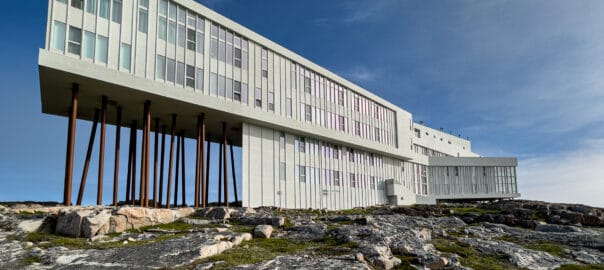
If you’re going to Newfoundland, Canada, one of the most-sought after destinations is remote Fogo Island. The dreamy lodging choice is the superb Fogo Island Inn. Between the islands mystical appeal, often shrouded in fog, and its timeless sense of place, a journey to Fogo and a stay at the Inn become one of life’s fondest memories.