A while back, I hung a magazine ad in my office that read: "Travel is the only thing you buy that makes you richer."
I believe it's true, and the advertisement would still be posted had it not faded and crumpled off the wall.
Whether you choose to go to a local museum or take an international tour, travel opens our eyes, our hearts and minds. You gain an understanding of the past and an appreciation for different cultures. Perhaps you will connect with someone and create a lasting friendship or take on a new cause because you realize the urgent need.
The US dollar has strengthened and gas prices are at their lowest levels in four years. Yet, the Travel Industry Association predicts a 1.3 percent drop in 2009 leisure travel. If you can afford a vacation, 2009 will likely be a year of travel deals. Take advantage of this opportunity.
Last April, when I traveled in Italy, a euro cost about $1.60-$1.75. Currently a euro is valued at $1.36, meaning the dollar goes farther. (Universal Currency Converter: http://www.xe.com/ucc)
According to the U.S. Bureau of Transportation Statistics, travel to Europe by Americans was down 4.8 percent in the first eight months of 2008 compared to the same period in 2007. If prices fall and the dollar continues to gain, this may be the right time to plan a European trip.
The dollar is also doing better elsewhere. An Australian dollar costs just 67 cents in U.S. currency, down from nearly $1 this past summer, and Canadian dollars are worth just 80 (U.S.) cents now. Earlier in 2008, the Canadian dollar was worth more than a U.S. dollar.
If the recession is hitting you and your travel budget, look for free offerings. Most museums and some zoos open their doors a few hours every week. Visit the library to borrow guidebooks instead of buying them. Ask at the tourist information center for free walking tours; some are provided as printed handouts and others are guided.
Consider home exchange programs (www.homeexchange.com). If you are staying a few days or longer, investigate the possibility of renting an apartment. I almost did this in Rome (www.realrome.com) but decided too late. You must plan far ahead to snag the best locations and rates.
Vacation home rentals usually save over hotels or look for lodging with a kitchen or kitchenette because cooking in costs less. Use consumer reviewed websites like www.travelocity.com to get the honest scoop on what other travelers thought of their stays in bargain hotels.
In the past few years something called couch surfing has taken off. The website www.couchsurfing.com defines themselves as volunteer-based worldwide network connecting travelers with members of local communities, who offer free accommodation and/or advice. I worry about the safety issues, so have not participated and don't know anyone who has, but feel free to comment.
Drop down a notch, skip the taxi and try local restaurants or street food, i.e., the hot dog vendor. While I'm no longer up for youth hostels, my 2-star hotel in Rome was quite adequate for 5 days. Arthur Frommer (remember his book Europe on $5 a Day) recalled his best travel experiences happened when he spent the least. I recommend his current magazine: www.budgettravel.com.
A new slogan hanging on my wall reads: "There are places you leave. And places that never leave you." Get out there and travel in 2009.
ASSISI is the beloved city of God; birthplace of St. Francis and St. Clare. The location radiates an atmosphere that touches the mind, body and spirit in heavenly ways.
Kathy, Cory and I arrive at the Umbrian train station and view an oatmeal-colored medieval town, sprawled over Mount Subasio.
We take the taxi up the hill and check into our room at San Crispino Historic Mansion, divine lodging nearly hidden from the road. The Sister Moon and Stars Suite is, in fact, below street level. Our two rooms feature stone floors, a wooden table and chairs, a fresco of St. Francis, and blue vaulted ceilings adorned with a starry skies. I find the snack filled armoire–including a cappuccino machine and best of all- we walk out into our own private walled garden. As I said- heavenly.
Standing in the garden I’m in awe gazing out on the expansive valley. What a sight–we can see the facade of the Basilica of St.Clare on our left, the apse of St. Maria Maggiore on your right, and the domes of Chiesa Nuova and San Rufino Cathedral in front.
Kathy basks in the sunlight.
The afternoon is fading so we step up pebble-lined stairways, along crooked paths, to the mid-town square. Italian men cluster around benches discussing world problems or is it their grandchildren? Local women carry groceries in open-weave bags.
Tourists sit in cafe’s and restaurants, browse the shops and visit numerous religious buildings. There are two basilicas and countless monasteries, convents, chapels and holy shrines in this tiny town of 25,000.
Spring blossoms everywhere: bright geraniums in pots, cascading greenery drips from balconies, red poppies bloom in the grassy valley below. You sense that residents care about beauty and nature.
Wandering around we lose our way in the labyrinth of tiny alleys. No problem. Life-long resident, Grandma Pat comes to the rescue. She wears the standard outfit of older Italian women — a black dress.
The dear lady speaks nothing but Italian as she hobbles along with her cane. She escorts us back to our hotel and says, “Statci Uniti–Papi?” Yes, the Pope is visiting the US.
Dinner turns into a bountiful party — wine, antipasti, wine with pasta, and a seafood entree. Coffee please, but we must split dessert.
Falling into bed, I gaze at the celestial ceiling reciting prayers of gratitude. I am most fortunate to be here with my daughter-in-law and her mother. Sleep comes easy, exhausted from our flight and less than 24 hour blitz through Florence.
Sunrise and birdsong awaken us and we sip coffee in our garden, munching pastries fresh from the bakery. Am I really here? A little pigeon makes his home in a hole in the wall. What sublime tranquility. I envy the lady who tells us she is staying a month.
Our guide arrives to lead a tour of the famous monuments and help us understand their history. We hear of cloistered nuns, called Poor Clares, visit the pink limestone Basilica of St Clare and gaze into the original crucifix of San Damiano- the one which inspired St. Francis to convert in 1205.
Roman ruins are found at Minerva’s ancient temple, now converted to a church. I’m stunned at the altar Madonna, crowned with an electrified halo.
A funeral leaves the Church of St. Rufino, and then we enter, finding St Francis’ baptismal font, over 800 years old. We learn Francis was the son of a cloth merchant and is known to have been a party boy in his early years.
Time for a stop at the cafe. I find it hard to refuse tempting confections, oozing a buttery mix of nuts, sugar and cinnamon. Instead, I take a photo and then taste perfection in a frothy latte.
Together we climb steep walkways to the upper town, arriving at Via Santa Maria delle Rose. This building holds a permanent sculpture exhibit by artist Guido Dettoni della Grazi. He created the most extraordinary Virgin Mary. In fact there are 33 Marias, each made from a different wood, one for each year of Christ’s life.
Viewed from different angles, the piece gently morphs into the kneeling Virgin receiving the Annunciation, a woman carrying the pitcher to the well, an expectant mother, and the Blessed Mother holding the Child (my favorite). If turned horizontally, she becomes the Dove of Peace.
We purchase a small copy, grasping it within our fist and thumb. It fits snugly, feels sleek and soothing, like a polished stone. But a sensation of security extends beyond my hand, as if I am being held.
Finally, we descend into the immense Basilica of St. Francis. The structure is really two churches constructed over the Saint’s tomb. Pope Gregory IX laid the foundation stone in 1228 and consecration occurred in 1253. What a short time to build such an enormous shrine.
Highlights are the colorful frescoes by Giotto, simple, quaint and expressive. They depict the life of St. Francis in pictorial art, bringing the Middle ages to life. Many artists worked over 130 years creating the masterpieces for these hallowed halls; the most famous: Martini, Cimabue and Giotto.
I feel comfortable here and could sit in the sacred setting for hours and meditate. But we must hurry, another relaxing option waits. We get a ride downhill through the green fields of Assisi. The added bonus–a chance to photograph the town from afar.
An afternoon of pampering at San Crispino Spa includes a steam bath, Jacuzzi, and an olive oil massage. Aaah. We are rejuvenated at the idyllic retreat, and the only non-Italians on the property.
Back up the road and an evening stroll. We indulge in another fantastic repast- glad we had reservations. Meandering back, a full moon rises over St. Clare’s Basilica. What could possibly top the natural phenomenon?
Mass the next morning; an intimate moving experience in a big Basilica. One just seems closer to God here. The air is pure, no Byzantine gold or Renaissance glam. A mood of simplicity, piety and peace prevails, yet the village is alive. Little boys kick big rubber balls on the church steps. Men gather at the fountain. Tour buses start to roll up the hill.
I could stay here, learn Italian, and study art. Kathy puts it this way, “This is a place to let go, let God.” I like that.
But it is time to leave, take the train to Bella Roma. I hesitate, wanting to linger. Instead, I leave my heart and lug my suitcase full of heavenly memories.
A dignified hawk soars over an emerald green meadow, and then rips through the air, plunging downward, deftly making a kill for his owner. Falconry, hunting with trained raptors, is an ancient art. In recent times it has again become popular, and now Irish falcons are in high demand. Small wonder: the native Peregrine is the fastest bird of prey, estimated to dive or “stoop” at over 200 mph.
The sport arrived in Ireland by the seventh century, with nobles flying prized hawks and falcons in contests; hence it became known as the sport of kings. For common folk, birding provided a means of survival. And now my family, instead of larking around on vacation, would fling ourselves into a highly anticipated adventure, at an ancient Irish site.
Falconry was well established in 1228 when the Normans laid the first stone of their tower, which later became Ashford Castle. Hidden in the wilds of County Mayo, Southwest Ireland, the fortress kisses Lough Corrib’s shores, said to have an island for every day of the year. Acquired and restored by the Guinness family, the huge chateau-style building is fit for a king, including Rapunzelesque turrets and towers amid formal gardens. Indeed the Prince of Wales, later King George V, visited for a shooting holiday in 1905. More recently actor Pierce Brosnan rented the entire estate for his three-day wedding.
“It is inconceivable that throughout Ashford’s history, falcons and hawks were not kept within the castle grounds,” said Deborah Knight, owner of Ireland’s School of Falconry.
Today Peregrines nest only 15 minutes away from land once belonging to the estate.
Upon entering the stately hotel, we receive directions to our scheduled Hawk Walk. Off we traipse down walkways lined with gnarly old trees, hung low with lichen-laden branches. Ferns and spongy moss cover the ground, while shafts of sunshine peek through gently swaying foliage. Soft swirls of mist add to the mysterious aura in this fairy-tale-like enchanted forest.
Ashford Castle at dawn
We arrive at the School’s high walled fence, carefully guarding the valuable animals. Rod Hare–our aptly named instructor –welcomes us to the aviary, introducing the birds of prey. “Harris Hawks have keen eye-sight, approximately eight times better than a human’s and are naturally inclined to co-operate,” he explains. Rod, an Australian with a subdued Crocodile Dundee persona, charms us with his vast knowledge and stories of raptors’ deadly conquests.
We enter the mews, a quiet, dark enclosure for the birds’ overnight protection against predators and poachers. Untrained Harris Hawk chicks sell for $700 and a Peregrine for $5,000 or more. Falconers carefully record every bird’s weight, keeping each under the fed-up level, so they want to work for food.
Laura and a hawk
With our wee bit of knowledge, we don heavy leather gloves called gauntlets on our left arms. Rod picks up Liffey, a chocolate-brown and black-feathered Harris Hawk, and perches him on my fist. Liffey calmly peers at me with his russet eyes over his curved blue tipped, yellow beak. I timidly grasp hold of leather strips or jesses, attached to his ankle bands. All the birds wear falconry bells to help locate them in the wild. My daughter Laura receives an equally majestic bird, named Skellig. Our hawks will fly as a pair, a social trait unique to this species.
I feel privileged, like Mary Queen of Scots, an avid falconer, who often flew merlins. Tis an honor to carry this living creature, I think, strolling to an open glen to “cast off”. Like a Mama Bird nudging babies from the nest, I pray them to spread their wings and fly. Up they rise, fluttering onto the lower tree branches, watching us carefully. ” No problems so far, ” I say, but have to wonder, will Liffey and Skellig return?
Rod pulls a gob of meat from his pouch and hides it between my gloved fingers. When I extend my arm, quick as a flash, Liffey plummets for it and my heart rate accelerates to hummingbird-speed. Whoa–what a thrill. I forget to be frightened, watching the hawk greedily snatch the lure with his sharp talons, feeling the pressure through my glove. I am Mother Nature with a haughty grin; I feel powerful. Yet Liffey is in control, trained to follow his instinct for food; he merely permits me to enter his world.
Then I look over and sense Laura’s trepidation as she braces for Skellig, who swoops to fetch his prize. Instantly she laughs with glee. “That’s brilliant,” she exclaims, an expression picked up in the UK. She turns to us, looking smug.
Together we hide in the twisted tangle of bushes, playing hide and seek, which is all too easy for out feathered friends. We develop a partnership, a rhapsody with the raptors. They don’t even have to sing for their supper, as we provide them with fast food— if they come and get it.
To better understand how raptors hunt in the wild, we exchange the birds for a female hawk, named Balina. We carry her into the overgrowth, where a rope and pulley hide. Rod attaches a lure to the rope–a meat-garnished pretend rabbit and we fire-off the mechanism. The little lady dive bombs with such force, she almost crashes and bounces off the ground. What an awe-inspiring simulation. Being amid the action is far superior to mere sightseeing.
Rod quickly steps in, making a meal trade with Balina, while she “mantles” or surrounds her food with her wings. My husband Jay humorously mimics her loud squawking. In a true hunt, the falconer wants to keep the catch and not permit his bird to feast.
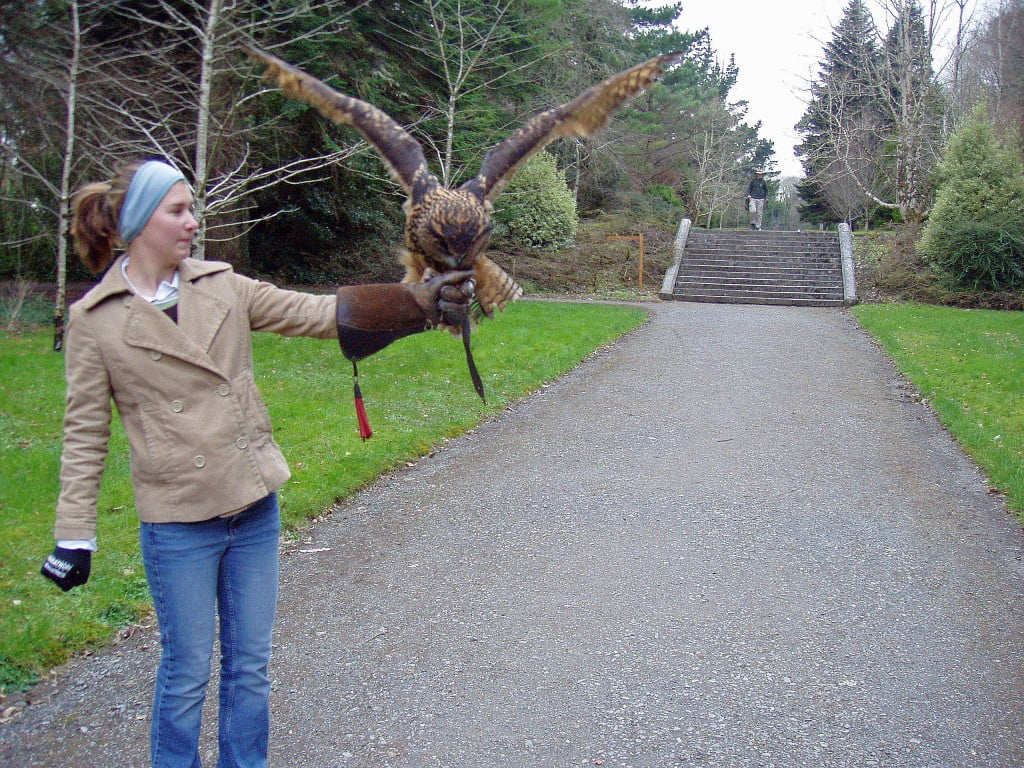
Then my group returns to get Dingle, a European Eagle owl weighing four pounds, much heavier than the hawks. Rod explains how his unique serrated edged feathers permit silent flight.
Dingle swoops low
“The owl is a stealth assassin,” he says. “They catch their prey with 100% deadly accuracy,” he continues. “They have eyes equipped with telescopic lenses and their hearing is exceptional. These fellows can detect a mouse 100 meters away and they absolutely rule the night.”
Rod attaches a tracking device to Dingle as Laura inspects the owl’s surprisingly scrawny body, camouflaged by downy fluff. We exchange our gloves for thicker ones, to protect against razor sharp talons. Owls are not good falconry birds, often undecided about chasing quarry. Should he not cooperate, Rod could locate him using the monitor.
To entice Dingle to work, our instructor scoops an owl’s version of a tempting morsel onto my gauntlet, shows it to him–then the proud falconer, and his trained- but- temperamental bird, strut away. The path is straightforward and we all are ready. The hooter swoops low, almost touching the ground with his enormous wingspan and, at the last moment, pounces onto my wrist.
“Saints preserve us,” I cry –something my Irish Mother-in-law often says. What a regal creature; I am euphoric and can hardly resist petting him, like my golden retriever, as a reward for a trick well done. Touching is not allowed, as birds of prey do not understand that type of behavior. Falconers get deeply attached to their birds, but the raptors aren’t emotionally attached. They work solely from appetite.
Afterward, Jay and Laura have a turn experiencing the difference of landing an owl versus a hawk. My trio photographs each other, attempting to capture the moment of the strike.
Completely unaware of the time, the cold and dampness, we regrettably end our exploits. This twilight performance includes all the scenes an Irishman would spin into a spirited story. And it doesn’t take long …together we march right to the hotel bar for hot mulled wine- or hot chocolate- and begin bragging about our extraordinary escapade.
The word “raptor” comes from the Latin word meaning “to seize,” and taking a hawk walk was more than seizing the day. The Ashford afternoon humbled us: we were delighted by Dingle who gave us new admiration and understanding of owls. Liffey and Skellig, the Harris Hawks, touched our hearts, not just our gloved hands, accepting our entrance into nature’s food chain. Throughout the world, birds of prey symbolize power, and our encounter in Ireland left us with a powerful raison d’etre: to roam again with raptors.
Liffey and Skelling on a tree limb
*********
If you go:
A car is needed to drive to rural Ashford Castle, approximately 30 miles from Galway in County Mayo. Pass by farm fields, crumbling stonewalls and flocks of wooly sheep before reaching the tiny hamlet of Cong. The town is famous as the location where The Quiet Man was filmed, a 1951 movie, starring John Wayne and Maureen O’Hara.
Ashford, a five-star castle hotel, resembles a country manor house with paneled lounges, carved ceilings and blazing fireplaces scattered amidst suits of armor and objects d’art. Don’t miss the hall of fame-a room filled with hundreds of signed photos from notables who have stayed at the castle.
Lough Corrib is renown for spectacular fishing, and the Castle grounds for shooting, riding, golf and the Falconry School.