Category Archives: Family Life

Chattanooga: Much More than a Choo-Choo

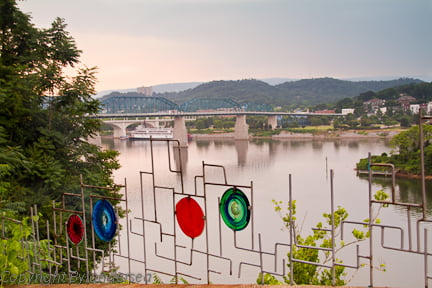
Scenic Chattanooga

If you are looking for an exciting adventure, a family friendly escape or a romantic getaway, set your sites on Chattanooga, Tennessee.  The city once known for its choo-choo, now volunteers a bounty of activities.

Scenic views and nostalgic barn signs lead visitors to “See Rock City.” The Rock City Gardens opened in 1932 at the top of Lookout Mountain. You can walk among natural stone formations, across swinging bridges, and revel in the panoramic view of “7 States.” The fairyland gnomes entice adults who visited as children to return with their own. I was truly surprised and delighted with the updated venue.

Rock City’s Lookout

Ruby Falls endures as another vintage roadside attraction. While the caverns themselves are not the most spectacular, the lighted 145-foot waterfall is worth the underground journey. Every October the staff turn the caverns into a haunted cave.  This event rates are one of the top 10 haunted Halloween houses in the country.  Screams and spine tingling fear guaranteed. Naturally, teens love it!

Ruby Falls

Those that seek sheer exhilaration head to Lookout Mountain Flight Park,  the nation’s premier hang gliding school. No prior experience is necessary. Participants and their instructor hook into a glider that’s tethered to an ultralite plane. The plane pulls them to an altitude of 2,000 feet, then releases the daring duo. Take my word on this –you’ll feel like a bird and gain a never to be forgotten perspective on the glorious mountains and valley below. Read about my fantastic aerial expereince here.


World-class whitewater rafting on the Ocoee River offers Olympic-caliber thrills and spills just 45-minutes from Chattanooga. Outfitters supply a professional guide to accompany and assist rafters as they traverse class 3 and 4 rapids. Whoo-eee! What a blast. Should you be looking for tamer exercise, think kayaking on the Tennessee River or bicycling a 10-mile pathway through city parks.

The Tennessee Aquarium is Chattanooga’s jewel, the world’s largest freshwater aquarium. The facility expanded to a second building: one featuring river ecology and creatures while the other explores the ocean habitat. Your ticket entitles you to come and go at this awe-inspiring aqua world, so visitors can break up the day with dining or other activities. An educational  treat for all ages.

Many adults desire a more relaxing vacation and should consider riding in air-conditioned comfort on the Aquarium’s high-speed catamaran. Guests are transported into the Tennessee River Gorge surrounded by a colorful seasonal landscape. While the boat is speedy, the ride is not at all dangerous or scary. Tourists and locals also find dinner cruises aboard the Southern Belle Riverboat  to be laid back escapes.

Romantic couples head for the charming Bluff View Art District and find elegant lodging plus refined dining, bakeries, coffee shops and art galleries. The Hunter Museum of American Art along with a hilltop sculpture garden are mere steps away.  The Back Inn Cafe features exceptional cuisine.


Don’t leave the diverse city without a peek into the historic Chattanooga Choo-Choo Hotel, or better yet, stay overnight in one of their railroad cars. The former terminal was converted into a grand lobby with fine lodging–a train buff’s heaven.

Chattanooga is quite the opposite of a sleepy Southern city. Her mindset is fun, the streets buzz,  restaurants are hopping and scenic beauty surrounds.  You honestly need more than a weekend to uncover all of the diverse treasures.


For further information: www.chattanoogafun.com.

Art Installations along San Antonio’s River Walk


Fiberglass Fish along the River Walk

San Antonio‘s most sacred and historic site will always remain the Alamo, but the popular River Walk flows an economic lifeline through the heart of the city. Restaurants, cantinas, shops, business and museums thrive from tourist and residential traffic rolling along the five-mile Paseo del Rio.

A little known and surprising story that saved the Texas waterway goes to none other than a few simple puppets. When a devastating flood hit the city in 1921, a disaster control plan was devised to prevent future damage and loss to the business district. . The goal was to drain the river and divert it through a storm sewer — then pave over paradise.

Thank heavens the clever minded Conservation Society came up with a brilliant idea. The organization performed a captivating puppet show which pulled the heartstrings of city hall commissioners and focused attention on San Antonio’s natural wonder. Afterward, Society members took the civic leaders on canoe rides designed to convince them to rescue the river. It worked.

The massive construction project commenced in 1939 and was completed by the WPA in 1941. The meandering oasis provided San Antonio with green parks and two parallel sidewalks. The water depth of the Venice-like canal ranges from just two to four feet, so there isn’t much danger if anyone falls in. However, about 2,000 partying patrons or klutzes per year take a plunge, likely begging mercy to avoid the $200 fine.

San Antonio’s River Walk

A 35-40 minute cruise on the River Walk remains a must for any tourist. Riders board either an open air water taxi or sightseeing barge while tour guides retell history and interesting trivia along the two and a half mile course.

A recent $74 million Museum Reach extension was completed in May, 2009,  including a new lock and dam. The additional mile and a half from Lexington to Grayson Street included $11 million dedicated to privately funded art-projects. The San Antonio River Foundation commissioned eight artists to create site-specific art installations spaced around eight bridges.

At the Lexington Street Bridge, British artist Martin Richman installed reflective, suspended elements that dance in the breeze, scattering flashes of color like glittering prisms. I’ve seen similar dangles made into earrings, but must admit, the reflections were pleasing.

Dangling artwork reflects the light along the River Walk.

As visitors pass beneath two bridges at McCullough and Brooklyn, groups of shimmering steel-mesh panels on either side come to life and change colors. Our tour guide claimed that nearby pedestrian traffic creates even more stimulating effects.

Sequenced speakers under the Jones Avenue Bridge pitch “sound sculptures” from artist Bill Fontana’s blend of recorded and live broadcasts. I heard what sounded like nothing more than typical morning birdsong. Perhaps I don’t have an artist’s ear.

Colorful Fish

My favorite section of river art was the school of larger-than-life fiberglass fish suspended above the water and below the Interstate 35 overpass. Philadelphia artist Donald Lipski was the brainchild behind these whimsical creatures which reflect onto the river below. Very cool!

The tour guide also said that a sunset water taxi provides a memorable way to see the new River Walk art installations. The magic hour of twilight — a photographer’s preference — brings out the artworks’ full charisma and beauty. And then after darkness falls, indulge in libations and dinner from the varied culinary establishments along the banks as the art installations glow luminously in the background.

My hometown, Jacksonville, Florida is divided by a river, but the immense width of the St. Johns River dwarfs the petite San Antonio. In this case, however, the compact is superior because much of San Antonio’s charm and tourist traffic are indebted to the secluded ambiance of River Walk–and the legendary puppet show.

Rolling on the River Walk

Things I Didn’t Know About the Alamo

The Alamo in San Antonio, Texas

As best I can recall, my early U.S. history lessons focused on Jamestown, the Revolutionary War and our Founding Fathers; perhaps due to my growing up in Arlington, Virginia. As the end of school year approached, the teacher hurriedly moved on to Lewis and Clark, the Civil War, and the California gold rush. I can’t remember ever studying the Spanish-American War, causes of WWI or a mention of Japanese sent to internment camps during WWII.

My eyes were opened last fall when I visited New Mexico for the first time. There, I became acquainted with the Pueblo Revolt of 1680, a Civil War Battle of Glorieta Pass, and the Texas Camel Corps.

Recently, I made a trip to San Antonio, Texas, and sad to say, I didn’t remember much about the Alamo.  Sure, I’d heard of bloodshed and bravery, Davy Crockett, Jim Bowie and William Travis. But, I didn’t understand the background of the battle.  Fortunately, I had an excellent tour guide who provided me with details concerning the events and left me with a desire to learn more.


So, here’s what I’ve since discovered:

Battle of The Alamo


The original Mission San Antonio de Valero (now the Alamo) was constructed in 1718, and for 70 years served as a home to missionaries and Native Americans who converted to the faith.

In 1793, Spanish officials took over San Antonio’s five missions and distributed their lands. In the early 1800’s the site became a Spanish military station and in 1814 the Mexican’s took over.

In December 1835, during the Texas Revolution, a Mexican contingent was forced to surrender to Texans and Tejano volunteers (Texans of Spanish descent) fighting in San Antonio. The Texas group then used the Alamo as their base.

In January 1836, Sam Houston requested permission to “blow up the Alamo” as he didn’t think that group had enough men to defend it. He wanted the supplies and canyons moved  to Gonzales for his use, but Texas Governor Henry Smith denied the request.

A group of only 200 defended the Alamo for 13 days against General Santa Anna and his 5,000 strong Mexican army.  On March 6, 1836, the final battle erupted before daybreak when the Mexicans scaled the walls, rushed into the compound and seized the property.

Visitors to the Alamo!

Twenty six women and children survived including the widow of Gregorio Esparza and his four children. While Gregorio fought for freedom inside the Alamo, his brother Enrique had joined the Mexican army.  Enrique survived and claimed his brothers’ body for burial, the only Christian burial Santa Anna permitted. All the other defenders were cremated.  The manager of La Cantera Resort, where I stayed, showed me the Esparza Library in the hotel, honoring the family.

In 1884, the Alamo was sold to a grocery firm who wanted, in turn, to sell it to a hotel developer. Many people were opposed, especially Clara Driscoll who gave thousands of dollars to prevent the hotel construction. Driscoll eventually worked out a plan to purchase the property for the state.

In 1905, the Daughters of the Republic of Texas (DRT) became custodians of the Alamo and remain so today. However, they are being investigated by the state of Texas for neglecting to properly maintain and preserve the site.

The Alamo receives no taxpayer funding and offers free admission to an estimated 2.5 million visitors each year. This year they are celebrating the Alamo’s 175th anniversary.

And, UK’s music legend, Phil Collins, has the largest private collection of Alamo memorabilia in the world.


So, there you have it, lessons learned from travel: I better understand the sacred piece of Texas history and promise to Remember the Alamo.


Debi at The Alamo- No photos allowed inside, so everyone takes a shot of the exterior.

The Alamo Gardens