Category Archives: Destinations

St. John, Virgin Islands – Following Caribbean Coordinates

Checking coordinates
Geocaching

Following Caribbean Coordinates with a Hi-Tech Teen

By Debi Lander

The path closes in, narrowing at each turn. Dampness collects on my skin as I plod through sultry, humid air. Above, huge termite nests hang from bay leaf trees while dozens of hermit crabs claw at the pebbly route. The constant need to scratch and swat at mosquitoes annoys me, yet I wind round and around this seldom-traveled trail on the island of St. John.

“What’s your reading?” I yell to my daughter.

She answers: “North 18° 21.038, West 63° 30.078.”

“Not too far now, we must reach West 64°,” I shout back, hoping I’m right.

We’re geocaching, a pirate-like outdoor treasure hunting game pronounced “geo-cashing”. Players use a Global Positioning System (GPS) receiver to locate hidden containers in 222 countries. The hi-tech device grabs a satellite signal and reports precise longitude and latitude coordinates. GPS units, accurate to a 20-foot radius, cost $100 and up.

In this pastime, participants place caches wherever permitted, and then publish coordinates at sites like http://www.geocaching.com/ or http://www.terracaching.com/. Some insert Travel Bugs, special objects that players move from location to location, tracking their route online. Owners establish a separate website, requesting photos to show off globetrotting.

Many resorts, state parks, and convention and visitors bureaus are sponsoring geocaches as a way to lure and entertain guests. “It’s really a fantastic family activity,” says Kurt Johnson, a naturalist from Wyoming. “Kids are exceptionally good at this because they’re good with new technology, and they like scavenger hunts. And it brings out the kid in adults, too.”

Fun and family time is just what my husband Jay, Laura and I plan. We’re spending two days at St. John’s Caneel Bay Resort, originally part of a Danish West India Company sugar plantation. The upscale retreat, described as a haven for the newly wed or nearly dead, encourages family-friendly summer activities.

Fifty years ago, Laurance Rockefeller donated 6,000 acres on St. John, diva of the Virgin Islands, to the National Park Service. I’m sure he never imagined visitors navigating via satellite messages. Most tourists come to kick off their shoes on the talc-soft beaches, dip into water so clear it tempts drinking, or snorkel and scuba in the natural deep-sea aquarium. Now the eco-friendly sport of geocaching has arrived in this laid- back Caribbean corner.

Like most teenagers, my 15-year-old daughter Laura is comforted by gadgetry. Travel essentials include her DVD player, a supply of rental movies, her cell phone and iPod, even for short distances. I’ve learned the chances of keeping a solo teen happy grow exponentially when microchips are involved.

Room check-in provokes the question, “where’s the TV and phone?” from my shocked adolescent. Then she eyes the hotel brochure offering geocaching and is anxious to try. I agree to act as a Sherpa, toting bug spray, water, camera and whatever.

The GPS directs us much like a compass. “Arghhh, matey,” I cry-as we both fumble with geographical challenges. My husband commandeers the unit, captaining us toward hidden loot on the property. Written coordinates hint the box lies near secluded Honeymoon Beach.

I pray we don’t uncover lovers as my group tramples through squishy sand. We pass bougainvillea, full of papery iridescent orange blossoms, sharply contrasting the turquoise water. Laura unearths a Tupperware container tucked into a water-eroded tree. She withdraws a logbook and pen, and a tube of small plastic sea creatures, which her niece and nephew will love.

I expected a coupon from the resort, but now understand the rules. Get a gift, give a gift. Fortunately Jay has a few doubloons in his pocket.

Heading in search of our next prize, we fortuitously pass the hotel bar, where hubby and his gin and tonic abandon us. After swigging down a fruit punch (though I considered grog), we divert to the gift shop to purchase trinkets, booty for future hunters.

Scavenging this cache proves more difficult. The GPS reading indicates we’re close, but a dense tropical forest traps us. We’re forced to retrace our steps, circumventing all 11 tennis courts protected by the trees, and approach from a different angle.

Scores of lizards leap across this scrubby terrain, distracting us from the surreptitious attack of a large cactus, overgrowing the walkway. Removing a few needles, I carefully limp along, cursing my footwear choice–flip-flops.

Eventually Laura spies the waterproof bin. She unlatches it–but finds it muggled, a geocaching term borrowed from Harry Potter, meaning “empty.”

“Plundered, ” I cry, “those rakish rouges!” We feel truly disappointed by the cold cache.

Although the final navigational points appear nearby, without a map, I’m lost -I must follow my teen’s lead. We trek for miles, crossing a beach, looking like … out of place geeks: Dumb and Dumber, following a nerdy compass. But I don’t care.

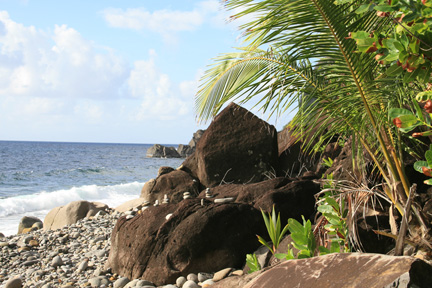
The route again ascends through thorny undergrowth. We eye an iguana, basking in the sun, and pass immense boulders, created from volcanic eruptions that formed the island, millions of years ago.

In the rough
In the Rough

Pausing in the heat, I photograph flowering succulents. The frowns, blood red in the center, run full spectrum to a pinkish hue at the tip. Lovely, except my face color matches. I’m cranky and tired. I could be floating on a raft at one of Caneel’s seven beaches, for heaven’s sake.

We are playing a game of cache me if you can–and losing. After another ten minutes, we swagger toward a wooden bench at an overlook and rest. A thought occurs as if a coconut hit me on the head: I’m spending the afternoon with my daughter, on a languorous isle. Don’t worry, Mom–be happy.

The Bench
The Bench

We reminisce, recalling a snorkel sighting of a Hawksbill turtle, his shell a disguise, like a giraffe’s coat. Together we peer through variegated shades of the teal blue tide, even identifying a few colorful fish.

With fortified spirit and no more whining, we’re determined to finish. At long last the GPS declares the desired “waypoint.” Laura peeks between huge moss-encrusted rocks, big enough to dwarf an NBA player, and discovers the buried treasure.

“Dad will love these,” she says, displaying two new golf balls and tennis ball which, our ever faithful but loopy, golden retriever can chase.

Caneel Bay Resort sprawls over 170 acres, scattered with guest cottages and meandering footpaths. I believe we covered 150, the ones most guests miss. This escapade rewarded us with secret views of tiny islands and cays off the Sir Francis Drake Channel, intimate wildlife detail, and most importantly– time together.

Now, disgustingly hot and bedraggled, we’re about to cache-out. A cleaning staffer stops a motorized cart and we ride back to the bar. This time I order a hearty rum punch, followed by a “Painkiller”–a powerful Caribbean cocktail.

My daughter is often outspoken on her likes and dislikes, but to my amazement, she didn’t complain about wandering in the heat. “We did it Mom,” she proclaims, slapping a high five. I see a hint of pride and affection bubbling within. It’s not a champagne moment by any means– just one that soothes the psyche of a mother enduring the turbulent teen years.

When her dad asks, Laura rates the activity “good” meaning she truly enjoyed the experience.

Be it the lore of a pirate’s chest or wishful dreaming about hidden fortune, searching for “X marks the spot” is a swashbuckling good time. Grab your buccaneer and go geocaching.

If you go:

St. John ranks as the smallest of the three US Virgin Islands. Measuring nine miles long and five miles wide, the territory is largely unpopulated, mountainous and reaches a peak of 1,300 feet. The US National Park Service owns and maintains approximately two-thirds of the land.

Most tourists fly to St. Thomas and hop a ferry for a short ride to Cruz Bay. Cars are driven on the left hand side with challenging steep, sharp turns, but never a stoplight.

St. John boasts numerous white sand beaches running along the shores and some of the finest snorkeling in the Caribbean.

Lodging choices are limited: Caneel Bay and the Westin resorts, privately rented villas and condominiums or Maho Bay and Cinnamon Bay Campgrounds.

Virgin Island National Park; Phone 340 776-6201
Caneel Bay Resort; Phone 340 776-6111
St. John Westin Resort; Phone 340 693-8000
Maho Bay Campgrounds ; Phone 800 392-9004
Cinnamon Bay Campgrounds; Phone 340 776-6330

Ireland – Gone Hawking

Dingle, the owl

Gone Hawking-Falconry Lessons at Ashford Castle

By Debi Lander

A dignified hawk soars over an emerald green meadow, and then rips through the air, plunging downward, deftly making a kill for his owner. Falconry, hunting with trained raptors, is an ancient art. In recent times it has again become popular, and now Irish falcons are in high demand. Small wonder: the native Peregrine is the fastest bird of prey, estimated to dive or “stoop” at over 200 mph.

The sport arrived in Ireland by the seventh century, with nobles flying prized hawks and falcons in contests; hence it became known as the sport of kings. For common folk, birding provided a means of survival. And now my family, instead of larking around on vacation, would fling ourselves into a highly anticipated adventure, at an ancient Irish site.

Falconry was well established in 1228 when the Normans laid the first stone of their tower, which later became Ashford Castle. Hidden in the wilds of County Mayo, Southwest Ireland, the fortress kisses Lough Corrib’s shores, said to have an island for every day of the year. Acquired and restored by the Guinness family, the huge chateau-style building is fit for a king, including Rapunzelesque turrets and towers amid formal gardens. Indeed the Prince of Wales, later King George V, visited for a shooting holiday in 1905. More recently actor Pierce Brosnan rented the entire estate for his three-day wedding.

“It is inconceivable that throughout Ashford’s history, falcons and hawks were not kept within the castle grounds,” said Deborah Knight, owner of Ireland’s School of Falconry.

Today Peregrines nest only 15 minutes away from land once belonging to the estate.

Upon entering the stately hotel, we receive directions to our scheduled Hawk Walk. Off we traipse down walkways lined with gnarly old trees, hung low with lichen-laden branches. Ferns and spongy moss cover the ground, while shafts of sunshine peek through gently swaying foliage. Soft swirls of mist add to the mysterious aura in this fairy-tale-like enchanted forest.

Ashford Castle at dawn

We arrive at the School’s high walled fence, carefully guarding the valuable animals. Rod Hare–our aptly named instructor –welcomes us to the aviary, introducing the birds of prey. “Harris Hawks have keen eye-sight, approximately eight times better than a human’s and are naturally inclined to co-operate,” he explains. Rod, an Australian with a subdued Crocodile Dundee persona, charms us with his vast knowledge and stories of raptors’ deadly conquests.

We enter the mews, a quiet, dark enclosure for the birds’ overnight protection against predators and poachers. Untrained Harris Hawk chicks sell for $700 and a Peregrine for $5,000 or more. Falconers carefully record every bird’s weight, keeping each under the fed-up level, so they want to work for food.

Laura and a hawk

With our wee bit of knowledge, we don heavy leather gloves called gauntlets on our left arms. Rod picks up Liffey, a chocolate-brown and black-feathered Harris Hawk, and perches him on my fist. Liffey calmly peers at me with his russet eyes over his curved blue tipped, yellow beak. I timidly grasp hold of leather strips or jesses, attached to his ankle bands. All the birds wear falconry bells to help locate them in the wild. My daughter Laura receives an equally majestic bird, named Skellig. Our hawks will fly as a pair, a social trait unique to this species.

I feel privileged, like Mary Queen of Scots, an avid falconer, who often flew merlins. Tis an honor to carry this living creature, I think, strolling to an open glen to “cast off”. Like a Mama Bird nudging babies from the nest, I pray them to spread their wings and fly. Up they rise, fluttering onto the lower tree branches, watching us carefully. ” No problems so far, ” I say, but have to wonder, will Liffey and Skellig return?

Rod pulls a gob of meat from his pouch and hides it between my gloved fingers. When I extend my arm, quick as a flash, Liffey plummets for it and my heart rate accelerates to hummingbird-speed. Whoa–what a thrill. I forget to be frightened, watching the hawk greedily snatch the lure with his sharp talons, feeling the pressure through my glove. I am Mother Nature with a haughty grin; I feel powerful. Yet Liffey is in control, trained to follow his instinct for food; he merely permits me to enter his world.

Then I look over and sense Laura’s trepidation as she braces for Skellig, who swoops to fetch his prize. Instantly she laughs with glee. “That’s brilliant,” she exclaims, an expression picked up in the UK. She turns to us, looking smug.

Together we hide in the twisted tangle of bushes, playing hide and seek, which is all too easy for out feathered friends. We develop a partnership, a rhapsody with the raptors. They don’t even have to sing for their supper, as we provide them with fast food— if they come and get it.

To better understand how raptors hunt in the wild, we exchange the birds for a female hawk, named Balina. We carry her into the overgrowth, where a rope and pulley hide. Rod attaches a lure to the rope–a meat-garnished pretend rabbit and we fire-off the mechanism. The little lady dive bombs with such force, she almost crashes and bounces off the ground. What an awe-inspiring simulation. Being amid the action is far superior to mere sightseeing.

Rod quickly steps in, making a meal trade with Balina, while she “mantles” or surrounds her food with her wings. My husband Jay humorously mimics her loud squawking. In a true hunt, the falconer wants to keep the catch and not permit his bird to feast.

Then my group returns to get Dingle, a European Eagle owl weighing four pounds, much heavier than the hawks. Rod explains how his unique serrated edged feathers permit silent flight.

Dingle swoops low

“The owl is a stealth assassin,” he says. “They catch their prey with 100% deadly accuracy,” he continues. “They have eyes equipped with telescopic lenses and their hearing is exceptional. These fellows can detect a mouse 100 meters away and they absolutely rule the night.”

Rod attaches a tracking device to Dingle as Laura inspects the owl’s surprisingly scrawny body, camouflaged by downy fluff. We exchange our gloves for thicker ones, to protect against razor sharp talons. Owls are not good falconry birds, often undecided about chasing quarry. Should he not cooperate, Rod could locate him using the monitor.

To entice Dingle to work, our instructor scoops an owl’s version of a tempting morsel onto my gauntlet, shows it to him–then the proud falconer, and his trained- but- temperamental bird, strut away. The path is straightforward and we all are ready. The hooter swoops low, almost touching the ground with his enormous wingspan and, at the last moment, pounces onto my wrist.

“Saints preserve us,” I cry –something my Irish Mother-in-law often says. What a regal creature; I am euphoric and can hardly resist petting him, like my golden retriever, as a reward for a trick well done. Touching is not allowed, as birds of prey do not understand that type of behavior. Falconers get deeply attached to their birds, but the raptors aren’t emotionally attached. They work solely from appetite.

Afterward, Jay and Laura have a turn experiencing the difference of landing an owl versus a hawk. My trio photographs each other, attempting to capture the moment of the strike.

Completely unaware of the time, the cold and dampness, we regrettably end our exploits. This twilight performance includes all the scenes an Irishman would spin into a spirited story. And it doesn’t take long …together we march right to the hotel bar for hot mulled wine- or hot chocolate- and begin bragging about our extraordinary escapade.

The word “raptor” comes from the Latin word meaning “to seize,” and taking a hawk walk was more than seizing the day. The Ashford afternoon humbled us: we were delighted by Dingle who gave us new admiration and understanding of owls. Liffey and Skellig, the Harris Hawks, touched our hearts, not just our gloved hands, accepting our entrance into nature’s food chain. Throughout the world, birds of prey symbolize power, and our encounter in Ireland left us with a powerful raison d’etre: to roam again with raptors.

Liffey and Skelling on a tree limb

*********

If you go:

A car is needed to drive to rural Ashford Castle, approximately 30 miles from Galway in County Mayo. Pass by farm fields, crumbling stonewalls and flocks of wooly sheep before reaching the tiny hamlet of Cong. The town is famous as the location where The Quiet Man was filmed, a 1951 movie, starring John Wayne and Maureen O’Hara.

Ashford, a five-star castle hotel, resembles a country manor house with paneled lounges, carved ceilings and blazing fireplaces scattered amidst suits of armor and objects d’art. Don’t miss the hall of fame-a room filled with hundreds of signed photos from notables who have stayed at the castle.

Lough Corrib is renown for spectacular fishing, and the Castle grounds for shooting, riding, golf and the Falconry School.

Ashford Castle in Cong, Country Mayo–http://www.ashford.ie/.

Ireland’s School of Falconry–http://www.falconry.ie/

Telephone 094 954 6820