Roman Emperor Justinian was a busy man. He directed the building of Hagia Sofia, hiring two renowned architects, 1000 master craftsman and 10,000 workers to get the job done. He ordered the renovations to the Chora Church (see upcoming blog post), the hippodrome and had the underground cistern built in 532 AD. The Istanbul facility has the capacity of 100,000 tons of water storage.
The Stone of Million, starting point for all roads leading to Constantinople.
Istanbul, formerly Constantinople, was the hub of the civilized world for centuries, and the city’s treasures remain a powerful draw. On this day, we toured four of the major sites within the historic area with a private guide thanks to Turkey Tourismand Barefoot Plus Travel. Mehmet arrived at 9 and presented an informative orientation. We soon realized he has an incredible wealth of knowledge and felt lucky to be in his presence.
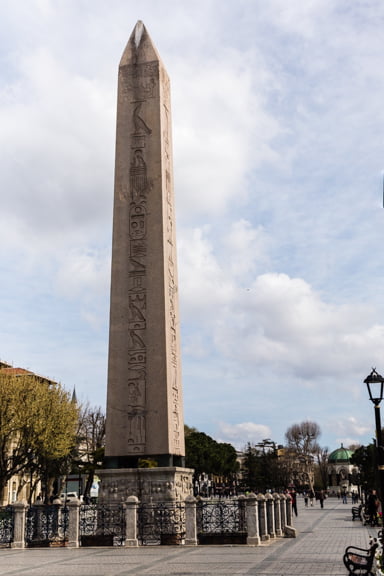
Egyptian Obelisk
Mehmet led the way as we climbed the hill to the Hippodrome of Constantine, the former chariot-racing grounds of the Romans and gathering place of the Ottomans. We stopped at the 400-ton Egyptian obelisk, originally carved with hieroglyphics around 1500 BC. We, and I suspect anyone without a guide, would miss reading the stone carvings below the monolith. They tell the story of how the massive column was raised into place using human power and ingenuity. Mehmet claimed it took 32 days.
The base of the obelisk tells the story of how it was raised.
Many months ago Judy and I decided to start our six-month adventure in Turkey and developed an itinerary to work our way across Europe. So, we flew from Philadelphia to New York, New York to Paris and then Paris to Istanbul.
We discussed the recent bombings and unrest in the world but decided that fear was not going to stop us. We’d be mindful and hope for the best. Besides, who can predict when or where the next violent rampage might happen in the United States.