When in Orlando, take a break from Mickey, Minnie and the other Disney characters and head out to a tropical oasis at Disney’s Polynesian Resort. Dining at the Spirit of Aloha Show includes bounteous portions of fine food, island dancing, humorous entertainment and a daring fire-knife dance.
“The charm of fishing is that it is the pursuit of what is elusive but attainable, a perpetual series of occasions for hope,” said John Buchan, a Scottish politician and I suspect, an avid fisherman. Although I had never devoted a day to fishing, I was about to let a chance opportunity become the occasion.
Sure, I’d dropped a line off a dock as a child and helped my own kids do the same, but a dedicated outing on a fishing boat – nope; never happened for me until a trip to Branson, Missouri. Little did I know the Ozark lakes ranked as some of the best fishing grounds in the United States or that Lake Taneycomo was known as the “Trout Capital of America.”
Fishing on Lake Taneycomo
I’m told true fishermen start at sunrise but my group finagled a late start- around 9:30 on a sunny morning. Not the optimal conditions to make things happen, but I was excited about angling.
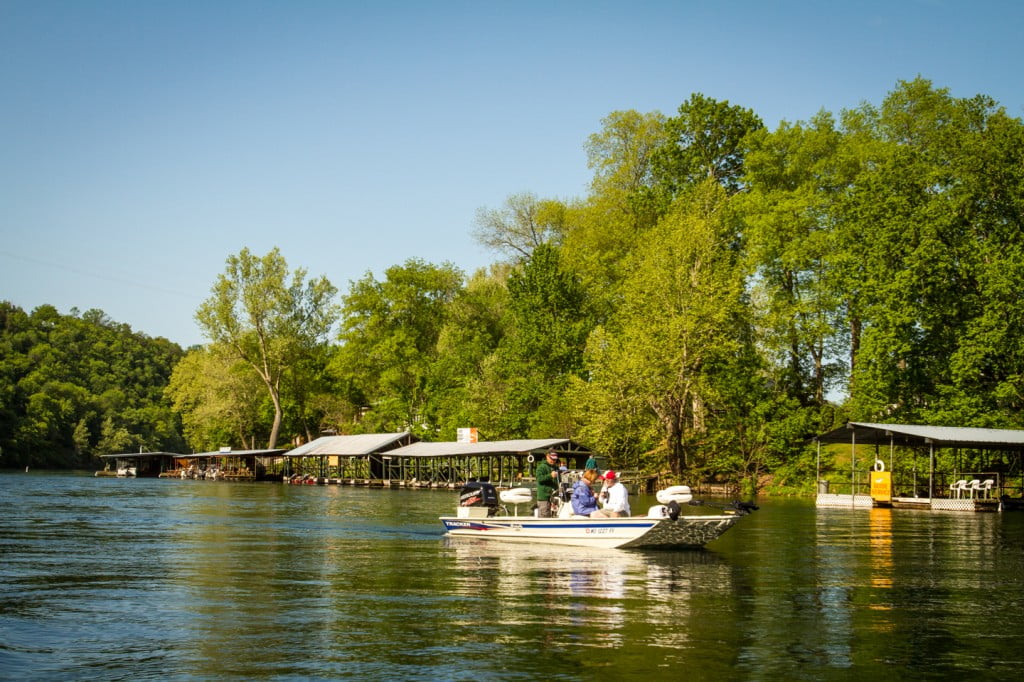
We arrived lakeside at Lilley’s Landing, a cozy little resort and outfitter that offers lodging as well as a store, docks and restrooms. After obtaining a license, Steve Dickey, a professional guide, took me and another colleague out in his Tracker Grizzly, commonly referred to as a bay boat.
Steve maneuvered downstream to an area near Branson Landing, a $300 million addition of trendy shops and restaurants to Branson’s downtown. Steve felt the fish were hiding near the buildings overhanging the water.
I should add that Lake Taneycomo is stocked with 750,000 trout each year, so the odds run favorable. About 15 minutes later I got a bite and screamed with excitement (perhaps a little too loud) as I began to reel in my catch. Alas, I lost the fish as it neared the boat.
Evan’s catch near Branson Landing
We continued to cast lines for another hour with no luck, and then moved on to an area that was very shallow. I said “we” although must admit Steve did the casting which is a thing of beauty the way he performs. He flexes the rod and the line releases, gently arcing through the air before entering the water. Evan, the other fisherman on my boat put me to shame. Evan cast on his own and caught and released three, but I got no nibbles. Our boat returned to Lilley’s for lunch with my sorrowful negative score.
Steve assured me all his guests catch at least one fish and promised I would be successful and have a photo to prove it. In fact, Steve is sure so he will guide his clients to the fish, he offers a money back guarantee. So far…he has never had to return a customer’s money. Pretty impressive, I’d say.
Steve displays my catch
We employed a different tactic after lunch- bumping along the bottom near Table Rock Dam. Steve said that trout are five times more likely to die if caught and released on natural bait, so we used his artificial flies. The massive Table Rock Lake was created in 1958 by construction of a 252 foot high dam. The view from below reminded me of a scene in the movie The Fugitive; the one where Harrison Ford is being chased and makes a reckless leap from a dauntingly tall dam. The water that flows over Table Rock dam into Lake Taneycomo is cold because it comes from the bottom of the 160-foot deep lake. Trout prefer cold water, so this makes Lake Taneycomo fertile grounds.
Within a minute (no kidding) I had my first catch- an approximate two and a half pound rainbow trout. Steve unhooked the lure and took my picture. Then, he placed the fish back in the water and got my line ready again. Soon — I had another!
Debi catches rainbow trout in Lake Taneycomo.
How fun was this? Number two rainbow trout turned up to be about the same size as the first. Over and over again the scenario repeated itself. I let the line hit the bottom and bounce along briefly and then nabbed another. I began to feel the difference between a bite and a line snag. However, I regret the loss of two flies to those snags.
By quitting time I had caught 13 rainbow trout and that’s no fishy tale. The elusive had been attained.
Christmas in July?Clement Moore’s famous poem describes St. Nick as having a droll little mouth drawn up like a bow, and a beard as white as snow. The piece continues, “He had a broad face and a little round belly, that shook when he laughed, like a bowlful of jelly!”
Moore’s poetry inadvertently describes the requirements for contestants in the “Papa” Hemingway Look-Alike Contest. The competition highlights the annual Hemingway Days festival in Key West, Florida, along with a marlin tournament boasting a $250,000 purse and literary short story competition drawing over 1300 entries.
Contestant Michael Groover
From July 16-21, 2013, stocky middle-aged men with whiskers will flock to the isle to compete in a pageant akin to Miss America. Some return on an annual pilgrimage with the understanding that newbies score little chance of securing the coveted title. They line up on stage for preliminary rounds showing off their beards and bellies. Hopefuls also receive a generous minute to display a personal talent- frequently a song, poem, literary reading or comic routine.
Last summer I watched as many paraded in khaki sportswear but at least two men wore fisherman knit sweaters resembling a famous portrait of Ernest. That’s diehard dedication in 90 degree heat and humidity! Another dressed as Hurricane Hemingway donning red boxing robes and gloves, but making it difficult for him to grab the microphone.
Hemingway Look Alike
Semi-finalists go on to compete in the finals held Saturday night before a beer-drinking crowd overflowing the doors of Sloppy Joe’s Bar. The Key West watering hole ranks a favorite haunt of Old Hem himself and owner Joe Russell became one of his closest friends.
The judge’s panel of past winners also scrutinize the contestants’ congeniality during activities like the whimsical “Running of the Bulls.” This quirky event satirizes Ernest Hemingway’s love of Spain and the bullfight. Look-alikes pull wooden hobbyhorse bulls through the streets of downtown Key West instead of Pamplona.
Running of the Bulls – Key West Style
No one mentions the fact that the Nobel Prize winning writer was actually a young man when he lived in Key West during the 1930’s. Seems that older contestants fare better than those in their 50’s and no aspiring youths enter. This contest indulges big boys and the Hemingway manly-man lifestyle of hunting, fishing and love of cocktails.
During the festival, participants, known as Papa’s, meld into a fraternity of sorts; likewise for their wives called Mama’s. The 2012 semi-finalists included Michael Groover of Savannah, Georgia, who was cheered by his wife, Food Network personality Paula Deen. Deen praised her husband’s Hemingway looks but said he had other equally important qualities in common with the author.
“He’s all man, he’s truthful and honest and (has) really got the spirit,” Deen said.
Greg Fawcett, 2012 Hemingway Look Alike Winner
The 2012 winner, Greg Fawcett, a64-year-old North Carolina investment banker, won after his 10th attempt besting the 139 other Hemingway look-alikes. He credited his victory to establishing camaraderie with the judges, timing his haircuts carefully and paying attention to the length of his beard. Upon hearing the announcement, Fawcett looked to the heavens mouthing a thank you. Like a pageant crowning, he was met with rousing cheers and hugs from fellow contestant. Why, I might have even seen a few tears.