By Debi Lander, www.bylandersea.com
Snow fell relentlessly at Valley Forge in the winter of 1777–78.
Men wrapped bleeding feet in rags. Smoke drifted from crude log huts. Hunger and disease spread faster than hope.
It would have been easy to assume the Continental Army would not survive.
But in June 1778, something remarkable happened.
They marched out stronger than they had marched in. And just weeks later, they proved it.

Forged in Hardship
Valley Forge was not a battlefield victory. No triumphant charge. No surrendering British general.
Instead, it was a transformation.
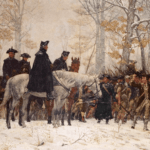
Under the watchful leadership of George Washington, and the relentless drilling of Baron Friedrich von Steuben, the army became disciplined and unified.
Von Steuben , whom I introduced in the previous post, was a former Prussian officer with limited English but boundless intensity. He introduced standardized drills, battlefield formations, and proper camp sanitation. He trained officers to train their men. He insisted on order where chaos once ruled.
By spring, the ragged collection of state militias had become something new:
A national army.
Women like Martha Washington and other camp followers helped maintain morale, sew clothing, nurse the sick, and remind the men what they were fighting for. French nobleman Marquis de Lafayette, still in his early twenties, remained loyal to Washington and to the cause.
Valley Forge did not break them.
It forged them.
A Strategic Shift
While the army trained in the Pennsylvania cold, the British occupied Philadelphia.
But global politics were shifting. In early 1778, France formally allied with the American colonies. Suddenly, Britain faced a far more complicated war. Naval vulnerability forced a decision.
The British abandoned Philadelphia. They began marching across New Jersey toward New York.
Washington followed.
The Test: The Battle of Monmouth

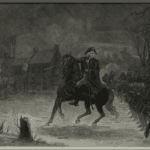
Emanuel Leutze, Public domain, via Wikimedia Commons
On June 28, 1778, under brutal summer heat, the two armies clashed at the Battle of Monmouth.
It was the first major test of the newly trained Continental Army.
Early confusion nearly unraveled American lines. But Washington rode forward personally, rallying retreating troops and restoring order. This moment became one of the most dramatic scenes of his military career.
Then, something extraordinary happened.
The Americans held.
They maneuvered in coordinated formations. They fired disciplined volleys. They stood against seasoned British regulars in open field combat and did not collapse.
In this battle, the fighting raged through oppressive heat. Soldiers on both sides fell to exhaustion. The battle ended as a draw, without a decisive victor, but strategically, the British continued their retreat to New York.
Psychologically, however, it was a triumph. Monmouth proved that Valley Forge had worked.
The army that had shivered in frostbite now fought in fiery heat, and stood its ground.
Why Monmouth Matters in the America 250 Story
If Saratoga brought France into the war, and Valley Forge strengthened the army’s spine, Monmouth demonstrated its muscle.
After Monmouth, the war shifted southward. The British would attempt to rally Loyalist support in Georgia and the Carolinas. New campaigns would unfold. New hardships would test American resolve.
But after June 1778, one truth was undeniable:
The Continental Army was no longer an experiment. It was a force.
Visiting Valley Forge Today
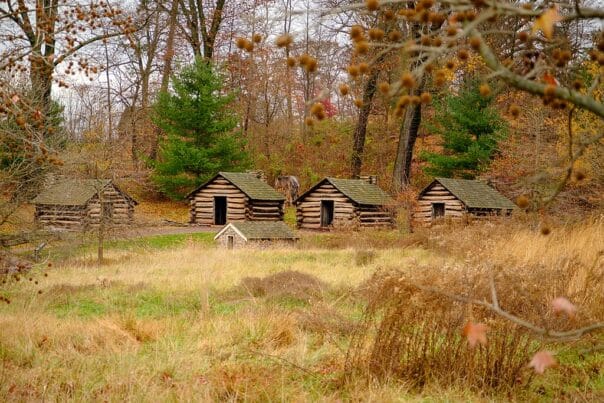
Valley Forge National Historical Park
1400 N. Outer Line Drive
King of Prussia, Pennsylvania
Website: https://www.nps.gov/vafo
- Distance from Philadelphia: ~25 miles (45 minutes by car)
- Admission: Free
- Suggested visit time: 3–4 hours (longer if biking the 10-mile encampment loop)
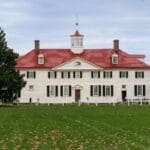
- Highlights: Washington’s Headquarters, reconstructed soldiers’ huts, the National Memorial Arch
Walking the grounds, it is hard to reconcile the peaceful rolling hills with the suffering once endured here.
Visiting Monmouth Battlefield
Monmouth Battlefield State Park
16 Highway 33
Manalapan Township, New Jersey
Website: https://www.nj.gov/dep/parksandforests/parks/monmouthbattlefieldstatepark.html
- Admission: Free
- Visitor center exhibits and battlefield walking trails
- Approximately 1 hour from Philadelphia; 1.5 hours from New York City
Stand in the open fields and imagine June heat rising from the grass. Imagine Washington riding forward. Imagine the moment Americans realized they could stand firm.
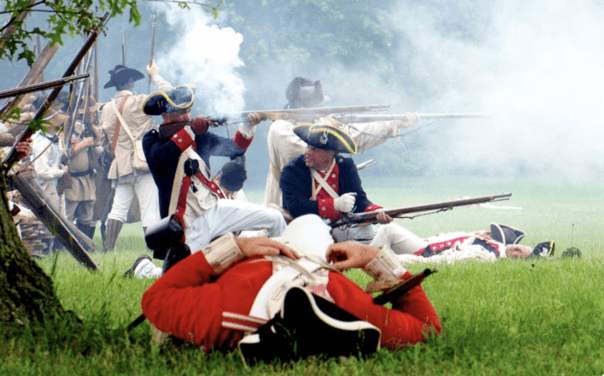
A reenactment of the June 1778 battle is held annually with volunteers that portray both armies. The two armies camp in the park with their camps open to the public, and battle in the fields for all to see.
The Visitor Center features an orientation video, exhibits and interactive media that reveal the American and British strategies of battle, the heroism and horror of combat, the impact of war on the homefront and the political outcome of George Washington’s victory.