Category Archives: Family Life

Kennedy Space Center, Florida Rocket Launch

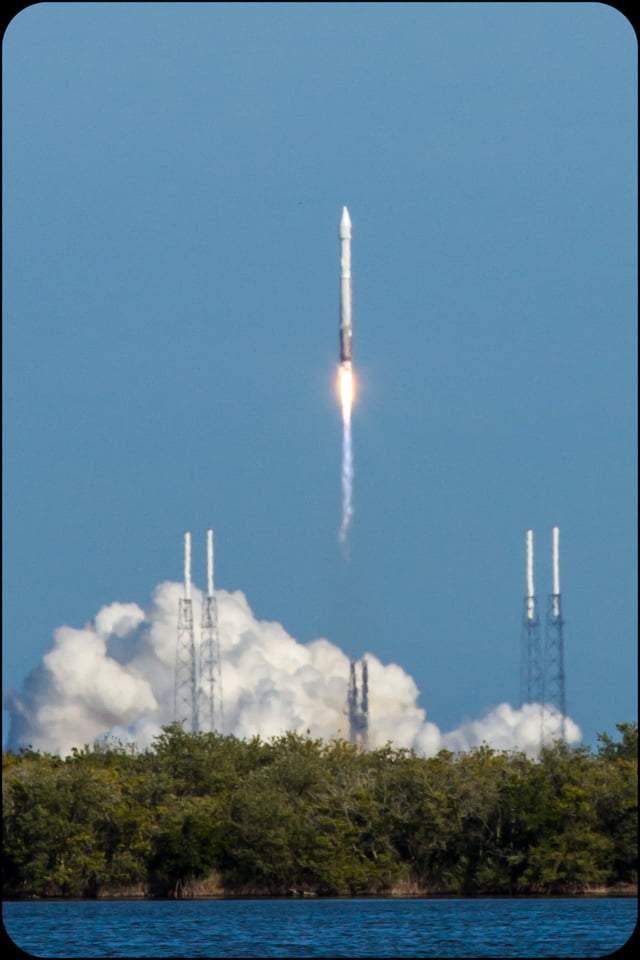
Atlas V Launch Kennedy Space Center

Baby boomers grew up watching powerful rockets launch ‘right stuff’ astronauts into orbit. As the space program evolved, so did the size of the missiles from the Atlas to the Titan, and later the 360-foot Saturn V moon rocket. Sadly, the US manned space flight program is currently curtailed. Private companies are developing vehicles for future space exploration but none are available at this time.

Therefore, I was surprised to receive an invitation to watch a rocket launch on March 19, 2013, at Kennedy Space Center and even more pleased that it fit into my schedule. The drive from St. Augustine is a little under two hours and the launch window was scheduled from 5:21 pm to 6:01 pm. Perfect.

I parked in the Visitor Center lot ($10.00 fee per vehicle) then entered the complex through the suitably planted rocket garden. This area blossoms with numerous projectiles nurtured through NASA’s care and various flying machines like the tiny one-man Mercury capsule.

I meandered along, passing by the newly opened Angry Birds interactive encounter and found the bus queue for the Saturn V Center, a tour that’s included with visitor admission. The bus ride takes about 15 minutes and passes the VAB (Vehicle Assembly Building), the largest one story building in the world. Huge is an understatement. The building, complete with a painted American flag, greets like an old friend; it’s familiar to anyone who watched past NASA events. The bus driver said, “Each of the stars on the flag is 6 feet across, the blue field is the size of a regulation basketball court, and each of the stripes is 9 feet wide.”

Vehicle Assembly Bldg Kennedy Space Center

The Kennedy Space Center actually lies within the Merritt Island National Wildlife Refuge, home to more than 1,500 species of plants and animals. Some 600 alligators thrive in the roadside ravines and lakes. The bus passengers caught site of a few gators, an Eagle’s nest and a number of egrets and herons.


Upon arrival at the Saturn V building, I learned it houses the original Apollo mission control center. Visitors file into an amphitheater attached to the control room and watch a three-screened video display. I became the observer of a countdown and launch of the world’s most powerful rocket on its take-off for the moon. The seats vibrate during the launch. Very cool!

As I exited the control room I practically ran into the massive side lying Saturn V. The rocket is 58 feet taller than the Statue of Liberty from the ground to the torch. The fully fueled giant weighed 6.5 million pounds and had a payload capacity of 260,000 pounds.

Saturn V Rocket Kennedy Space Center

After perusing some astronaut spacesuits and other Apollo related displays, I went outside to set up my tripod. Although scheduled lift-off was still about an hour ahead, the grandstands were filling with spectators and kids were playing games on the grass. This was a slice of Americana, an apple pie moment.

A NASA spokesman appeared about 30 minutes before launch time and explained what would happen. We would see the launch of an Atlas V rocket carrying missile warning satellites for national security purposes. The Atlas V is a small rocket and its heaviest payload lifted into orbit was 15,000-pounds.

The spokesman said we would hear mission control requesting systems approval and the specialists responding with a “GO” signal — if all was right. Assuming it was, the mission controller would give permission for the countdown to proceed.

Ignition Atlas V Kennedy Space Center

At about ‘T’ minus 3 minutes, a hush came over the crowd; people anxiously looked in the direction of the rocket. I could feel excitement mounting as the minutes ticked away. When the countdown got to 15 seconds, everyone was on alert. Then, the number 10 was spoken and the crowd spontaneously joined in the reverse count 3…2…1…zero. We heard the word “ignition” and saw lots of white smoke blast around the base of the rocket. Soon flames appeared and a gradual lift-off commenced. The adults began to clap and cheer.

As the rocket rose higher, the cheers grew wilder and the sight was honestly awe inspiring. Much more captivating and thrilling than seen on television.

After another ten seconds the rumble and roar grew louder; then a rocket separation occurred leaving a trail of billowing ghostly smoke high in the sky. I hate to say this, but the trail reminded me of the ill-fated Challenger’s. In a matter of ten more seconds, the rocket’s red glare was out of sight and headed into orbit.

I could scarcely contain my joy! Honestly, a launch is something to view and a moment you will not forget. I strongly encourage everyone to witness a live event, if possible. Had the rocket been larger and manned, I am sure it would have elicited goose bumps or tears. But, don’t let a smaller rocket stop you; the thrill is still magnificent.

I am so grateful I availed myself of this opportunity. Thank you Kennedy Space Center.

Atlas V Smoke Trail Kennedy Space Center

By the way, should your summer plans include a visit to the Orlando area, consider a stop to see the new $100 million Shuttle Atlantis facility being unveiled at KSC on June 29th. The addition is currently being constructed around Atlantis, the last shuttle to fly in 2011.

Also KSC behind the scenes tours continue- you can read about them in my earlier post.
The VAB tour has been extended through 2013 and the LCC and Launch Pad tours are confirmed through June 30. All Up-Close Tours are $25 per adult and $19 per child (ages 3-11) plus tax, in addition to admission.
For more information on Kennedy Space Center Complex, please visit www.KennedySpaceCenter.com.

Here’s a video of the Atlantis Shuttle launch as seen on a Behind the Scenes Tour:

Visit Three Centuries of History in St. Augustine’s Colonial Quarter

Costumed Performers in St. Augustine's Colonial Quarter
Costumed Performers in St. Augustine’s Colonial Quarter

The state of Florida owns the land, the University of Florida manages the property, but entrepreneur Pat Croce anted up to $3 million to fund the reconstruction of the two-acre Colonial Quarter in downtown St. Augustine.

Instead of focusing only on the Spanish period, (as did the formerly named Spanish Quarter), St. Augustine’s Colonial Quarter now encompasses three centuries of Florida history. To do so, the area is broken into four quadrants. The Spanish area includes the 16th century First City, 17th century Fortified Town and 18th century Spanish Garrison Town. The 18th century British area is called The 14th Colony and features a print shop, candle maker and Public House, a pub like restaurant.

Climb the watchtower in St. Augustine's Colonial Quarter
Climb the watchtower in St. Augustine’s Colonial Quarter

The watchtower, one of the Quarter’s highlights,  allows visitors to climb the 35-foot high structure earning themselves a fabulous view over the Castillo de San Marcos (fort) and waterfront. The tower is similar to one the earliest settlers would have built for defensive purposes.

View of Castillo de San Marcos

During my tour, the blacksmith bantered with guests as he forged away on a “J” hook, forming it from red-hot iron. The gunsmith caught attention by firing a musket, but the boatwright proved to be the most interesting. Craftsman Gary Kennedy is actually building a 55-foot ship, called a caravel, just like the ship Don Pedro Menendez used to sail into St. Augustine. It’s a long process; in fact, one he feels could take several years.

Blacksmith in the Colonial Quarter
Blacksmith

Pat Croce said the area was designed as “Epcot meets Williamsburg; the difference being instead of countries it’s centuries.” He also said the goal was to allow visitors an opportunity to make memories.

Also memorable are the influx of costumed employees I see walking to work and overall adding to the ambiance of the city.

However, I was dismayed at the plastic plates, forks and knives offered diners in the two restaurants. When I questioned Mr. Croce, he informed me there was no room or nor permission for dishwashers. Sad fact. I regret this situation (and I certainly hope the problem gets solved soon), but the use of plastic is just wrong.

Dishes and utensils aside, I equally questioned the menu selections. The British Bull & Crown Public House offers paninis and kettle chips layered with bleu cheese dressing topped with a balsamic glaze.  They taste fantastic, but I can’t imagine them as a dish in colonial days. Hats off for offering Gato’ d’ Ametlla or Minorcan almond cake.

Bull & Crown Public House

Yes, I am being harsh but with the University of Florida involved, I expected more.

Now, just so you don’t think I am overly critical of Pat Croce, I adore his Pirate Museum which sits adjacent to the Colonial Quarter. The attraction offers Smithsonian quality artifacts in an entertaining atmosphere.

Okay, I’ll give Croce and St. Augustine’s Colonial Quarter a little more time to get up to grade. And, I’ll return when they add a Colonial Revue this summer and hope to give it grand reviews.

Meal preparation in a soldier's home.
Meal preparation in a soldier’s home.

For information: www.ColonialQuarter.com.

Take the Iron Mountain Road to Mt. Rushmore

“There they are!” we both shouted simultaneously.

Mt. Rushmore
Faces on Mt. Rushmore

Chills and adrenaline ran through our bodies as we spotted our first glimpse of the presidents heads atop Mt. Rushmore.

The images of four Presidential faces carved in granite are among the most famous in the world. But, the icon stands in the Black Hills of South Dakota, sacred North American Indian lands, which are pretty much in the middle of nowhere.

Badlands National Park, SD

My friend Judy and I made a trip to Sioux Falls and decided it was the perfect opportunity to visit the state’s awe-inspiring Badlands and Mt. Rushmore. Teddy Roosevelt described the Badlands saying, “Nothing could be more lonely and nothing more beautiful than the view at nightfall across the prairies to these huge hill masses, when the lengthening shadows had at last merged into one and the faint after-glow of the red sunset filled the west.”

Sun begins to set in the Badlands, SD

We spent one afternoon and evening among the deep desolate canyons, towering spires and rugged buttes. Sadly, that amount of time is not nearly enough.

The next day we drove the Needles Highway in Custer State Park seeing spiky mountain peaks and bison walking down the road. Rangers encouraged us to drive north on the Iron Mountain Road for the best approach to Mt. Rushmore. Little did we know the next 17 miles would turn into one of the most thrilling road trips.

First glimpse of Mt. Rushmore from Iron Mountain Road

Unlike its heavy, rigid sounding name, the Iron Mountain Road snakes around itself with a series of bridges, known as pigtail bridges, and through tunnels barely wide enough for one car. The term pigtail should not be confused with the hairstyle—think of a tightly twisted pig’s tail or a 720 degree spiral. The road’s construction, in the 1930’s,  ranks as a marvel of engineering and has been termed “the by-way that couldn’t be built.”

Closer view of Mt. Rushmore from Iron Mountain Road

Since Judy and I made a point of pulling over at each scenic overlook, we naturally stopped at the first one. Our car was the only vehicle in the lot and the landscape seemed non-descript, like an ordinary field.  But then….way off in the distance we spied a tiny white outcropping on the side of a mountain. It included four heads!  Woo-hoo, our first glance at Mt. Rushmore in person.

I leap out of the car as if pushed by an ejection button.  I was truly eyeing a place I thought I’d never see. As we proceeded, the road continued to flirt with seduction,  offering a sneak peek here and there. The views got better and better as we drove along.  At one stop we caught site of George Washington through an opening in the trees.  Further along, we squeezed our car through a one-lane tunnel which acted like a dramatic portal.  Iron Mountain’s  summit offered a stunning but still distant vista of the 60-foot tall carvings.

Tunnel on the Iron Mountain Road

Eventually we arrived at the National Memorial and strolled down the Avenue of the Americas lined with each of the 50 state flags. We stared up at the immense work of Gutzon Borglum, his son and 400 other workers. The project took 14 years to complete from 1927-41 and cost less than a million dollars. We ogled and pinched ourselves; when an icon looks like this, nowhere becomes somewhere.

Take my word:  Mt. Rushmore is one of those places you should see up close and in person. If possible, arrive via the Iron Mountain Road for an experience that will not disappoint.

The Magnificent Mt. Rushmore National Park