Category Archives: Sea Adventures

The Curious Incident of the Sand in the Night*

When you drive down US 1 heading toward Key West, you know you have arrived when you come to a city: a downtown with stop lights, shops and homes. That may seem like an obvious statement, but when you motor by the other islands or Keys (there are actually 1,700, thought most are tiny and uninhabited) you feel rather betwixt and between.  The landscape is a tad monotonous; a small strip of land surrounded by shimmering blue water, or patches of development with 1950’s style buildings.  I was feeling neither here nor there, more in a twilight zone of locations known simply by their numbered mile markers.

It was in just such a spot that my husband Jay and I stopped to photograph a at sunset.  So, it happened that we approached Islamorada near dark, when the sunset afterglow had disappeared into the waves. 

The original name, Isles Moradas, pronounced- eye-la-mor-rah-da, translates to purple isles. Pick the name derivation as no one knows if it’s from the purple-shelled snail or the colors in the orchid trees and bougainvillea. I found the place enigmatic, full of mystery and intrigue.

Night descended quickly and we drove past our lodging.  Realizing our mistake, we made a U-turn, then ventured in and registered. I would never have stayed at La Siesta Resort had I just driven by–not much in the way of street or curb appeal. But I’d been told, “Try it. You will like it, you will be surprised.” I was. 

We located our unit, a small single story building, more than accommodating.  I could have lived there for a week– or longer, a king-sized bed, full kitchenette, dining table and den with sleeper/sofa and wall-mounted flat screen TV.   

But, we were hungry.  We dropped out bags and left for dinner, choosing the Islamorada Fish Company, attached to the Bass Pro Shop. Arriving around 8:30pm, I thought we’d get a table, but found the sprawling restaurant full.  Our names were added to a list and we were given one of those vibrating light-up disks, so off we went for a drink. We waited; we enjoyed our margaritas; we were the last ones at the bar.  Finally the hostess came over, said she had tried to contact us, but our communicator wasn’t communicating. Gee, the margaritas had been refreshing and the view lovely, guess I was getting into “island time,” that kick-backed nature of The Keys.  Nonetheless, my stomach was starting to growl, I was ready for food. We soon ended up with lovely yellowtail snapper and grouper for dinner.  

Morning Sand at La Siesta
Afterward, we fell asleep early; the sea air must have tuckered us out. On the other hand, when the mornings’ ochre rays filtered into the room, I immediately awoke.  I crept to the double security sliding glass door, opened the drape and found, well….an amazing site. A hammock rested on the patio and a huge swirl of sand like a labyrinth garden lay beyond.

I wanted to enter and follow the path, but hesitated- my foot steps would desecrate the pattern, like making tracks through freshly fallen snow.  But, I couldn’t resist; I paced round to the middle and realized it wasn’t the middle. No, this was the beginning.  Of course, whoever created it started in the center. Hmm. I felt the need to sit and meditate or try a yoga pose. However, like being knocked on the head with a coconut (which could have actually happened), I realized I was barefoot, standing in the open hotel complex in my pajamas– with a camera strung around my neck.

I returned to my room to dress and discovered Jay slowly coming to life.  He doesn’t do mornings very well, at least not before his coffee.  I left him in his post-dawn stupor and went back outside.  Some fisherman had arrived on the scene. I watched as they loaded their boat with about twenty fishing lines and then took off. However, they shared a secret– coffee and Danish were being served by the pool.  This was indeed good news, especially to Jay. 

A little later in the morning, I drove a few miles to the kayak rental shop at Robbie’s Mariana.  I was expecting to be expected, as travel writers frequently are, but I wasn’t.  Nonetheless, I arranged for a kayak and went in search of a crocodile, one I was told would make a great photo.  Alas, he wasn’t there. Now I admit, I don’t have the best sense of direction, and the map handed me looked somewhat like a drawing of my first-grade grandson, but it led me astray. Perhaps my car’s GPS has spoiled me—I needed a voice to tell me, turn here—NOW. I was lost in the lush mangroves.

Then, I ran into three other kayakers who were, shall we say, off-course. Mind you, two of them were college professors, and we all four attempted to get to a point on the map; and we all got lost together.  I thought it rather funny and decided it was time to retrace my outing and return my boat.

So, I ate some lunch and returned to La Siesta Resort and took an afternoon nap, a siesta, in the hammock at La Siesta! That evening, Jay and I went to dinner at The Hungry Tarpon.  The outside looked like a breakfast diner and it was, but it also had an outdoor patio strung with Christmas lights, which was actually an awesome gourmet restaurant (if you can call an “old Keys-style marina and fish shack”a gourmet restaurant). The chef, Joseph Sassine, came out to talk to us, but couldn’t stay long because he said his assistant needed supervising.  The assistant was rather new on the job, he added, just been working at it for five years. 

After another restful night, I awoke to find the same curious pattern created in the sand during the night.  I rather enjoyed the mystery and never inquired. Somethings are best left alone. 

Nonetheless, I convinced Jay to go back to the Hungry Tarpon Restaurant in the morning, even though we weren’t hungry.  I wanted to feed the famous jumping fish that I’d learned about the night before. Tarpon usually like deep water but these tarpon were different.  The tarpon at Robbie’s Marina like to swim near the surface and be fed by human hand.  Wouldn’t you know, on this morning, the hungry tarpon were neither hungry nor jumpy. The prehistoric-looking denizens must have felt the cold air, as a recent spell of artic air had chilled Florida. And so the curious happenings continued. 

Hungry Tarpon Chef & Manager
Betsy

“Enough,” said Jay, “time to drive home.” One last time I insisted on stopping.  “I must photograph Betsy, the lobster,” I begged.  Betsy is a huge roadside attraction, the type of thing that was popular back in the 60’s when drivers traveled Route 66. So, for the record, here she is, a real beauty.        

What more could one wish for on a trip to the quirky Keys and an interlude on Islamorada? 

If You Go:

La Siesta Resort, Mile Marker 80.5, Islamorada, FL offers 1,2 and 3 bedrooms suites, a 3 bedroom vacation house and 5 bedroom executive house. Marina slips are also available. www.lasiestaresort.com

The Hungry Tarpon Restaurant at Mile Marker 77.5, 305 664 0535, www.hungrytarpon.com, is open for breakfast, lunch and dinner. Dinner reservations suggested. 

Florida Keys Kayak, 305 664 4878, Kayak Shack at Robbies Marina. www.robbies.com

Islamorada Seafood Company, Mile Marker 81.5, 305-664-9271, www.fishcompany.com

* Article title with apologies to novelist Mark Haddon, author of The Curious Incident of the Dog in the Night.

Cumberland Island: Grandeur and Green

Just off Georgia’s coast, this historic isle offers elegant lodging and an escape from modern civilization

Plum Orchard on Cumberland Island, Currently Undergoing Restoration
Plum Orchard

Indians, soldiers and ghosts of Camelot docked upon her marshy shores. Turn-of-the-century multi-millionaires built castles, and commanding women protected their estates.

The history of Cumberland Island reads like steamy, romantic fiction. Its mansions now stand in ruin–wild horses as their guests. Former slaves haunt Stonehenge-like chimneys, aristocratic families’ feud (often with the government) and visitors spin their own tales.

The pristine preserve belongs to Georgia’s Golden Isles, a string of small barrier islands that dollop the Atlantic border. Cumberland, the group’s largest, rests between Savannah and Jacksonville, Florida, flaunting diversity among three different ecosystems: saltwater marsh, maritime forest and beach. The island, a National Seashore, limits visitors to 300 each day.

“Don’t tell anybody about this place,” whispered the visitor. “It’s total relaxation.”

The elegant Carnegie-built Greyfield Inn offers the only lodging (other than primitive camping) on an isle larger than Manhattan. Overnighters experience 19th century ambiance in a wilderness setting–just seven miles from the mainland, but remote from hustle and bustle. John Kennedy, Jr. chose Cumberland Island as the romantic spot to take his bride and the press never discovered or invaded their privacy.

Greyfield Inn

Visitors to the Southeast are attracted to former blue-blood enclaves–Colonial Coast vacation resorts including Jekyll, Amelia, Sea and St. Simons Islands–to golf, swim, boat and laze. But Cumberland stands apart–her natural splendor remains untouched by modern development. No convenience stores, beach homes, high rises or condominiums; in fact, nothing rests in between; first class or the floor, grandeur or green.

Her first chapter began with the Timucuan tribe, then the Spaniards, followed by Britain’s James Oglethorpe (Savannah’s founder) who built forts and a hunting lodge and re-named the area Cumberland.

Wild Horse on Cumberland Island

After the American Revolution plantations prospered. Stafford Plantation, an 8,000-acre tract, reputed as the most productive–and exploitive with over 350 slaves. The owner William Stafford kindled a clandestine affair with a mulatto, who birthed four daughters and two sons. Today, the only remnants are the chimneys of their rustic cabins- and some say their ghosts.

In 1783, Revolutionary War hero Nathanael Greene and wife Caty moved near Oglethorpe’s lodge. Greene, however, died before they could build on the chosen site– an Indian burial mound. Caty remarried and constructed a four-story, 16-fireplace tabby (coquina) mansion. Her home, Dungeness, and twelve acres of formal gardens became renowned as a luxurious retreat among colonial patricians.

A Trail on Cumberland IslandThe Civil War brought plantation lifestyle to a halt. Freed slaves moved to nearby Amelia Island, but some returned to their birthplace and established The Settlement, on Cumberland’s northern tip. Dungeness deteriorated and was destroyed by fire.

The 1880’s brought a new infatuation. Thomas Carnegie, brother and business partner of millionaire steel magnate Andrew Carnegie, purchased the old Dungeness property and constructed a far grander mansion. Unfortunately he, like Oglethorpe and Greene, suffered a similar fate. Carnegie died soon after the house was finished, further connecting legends of the plagued site to the Indian burial ground.

Nevertheless, Thomas’ wife Lucy and their nine children stayed on in the 59-room Scottish castle with turrets, an indoor pool, squash court, beauty salon, golf course and 40 out buildings.

Guests–including the Astors, Vanderbilts and Rockefellers–stayed for a month at a time. Thomas Carnegie’s widow employed 200 servants to take care of any whim.

Guests, like the Astors, Vanderbilts and Rockefellers, stayed at her retreat for a month at a time. They threw lavish soirees, picnicked on the lawn with crystal and fine china, and entertained with shooting, fishing, and beachcombing parties. Lucy employed two hundred servants to take care of any whims. Dungeness danced with merriment and carefree abandon through the Gilded Age.

When the matriarch died in 1916, her trust funds provided enough for upkeep- until inflation struck after WWII- pushing even the wealthy to cut back. Additional property taxes forced the family to close Dungeness. Thirty years later, a fire, apparently started by arson, burned the mansion. Now a highlight of a trip to Cumberland includes viewing the ruins.

The Great Depression and higher taxes further dwindled the Carnegie inheritance. The family held onto acreage and the Greyfield home, eventually opening it in 1962 as an inn. Today, Inn guests find casual elegance—dress for dinner and follow the rules of etiquette, but no phone, TV or WiFi.

In 1968, Hilton Head developer, Charles Fraser, wanted to purchase and develop Cumberland. Landowners–the Carnegies and Candlers (Coco-Cola heirs)–battled to halt commercialization. They met with the National Park Service (NPS) and, in 1972; the government declared Cumberland a National Seashore.

Front Porch Swing at Greyfield Inn

Heated debates over park usage followed. Ten years later, the central tract of forest and beach were designated as “official wilderness–a conservation class that outlaws mechanical devices like cars, bicycles and chains saws.”

The Park Service now controls ninety percent of Cumberland with just 2,000 acres remaining in private hands. Political struggles continue over management and development, historic preservation and driving privileges.

Lucy Carnegie built white-columned Greyfield in 1901 for daughter Retta. The three-story stucco mansion, with a raised basement and 11 bedrooms, sits on 200 acres. A graceful staircase descends from the first floor porch to the lawn.

Retta’s child, Lucy R. Ferguson, opened the house as an inn. Today, Mary Ferguson, wife of Mitty- who is the great-great-grandson of Thomas Carnegie, manages Greyfield, listed among the Historic Hotels in America.

Sitting Room of a Master Suite at Greyfield Inn

A stay affords uncommon privacy ands tranquility. Upon arrival– via Greyfield’s own ferry–the staff escort guests through a cathedral high canopy of magnolias and immense southern oaks. A genteel, unhurried lifestyle immediately descends. Greyfield guests may also fly in and land prop planes on a grass strip runway with permission. However, no airport facilities exist.

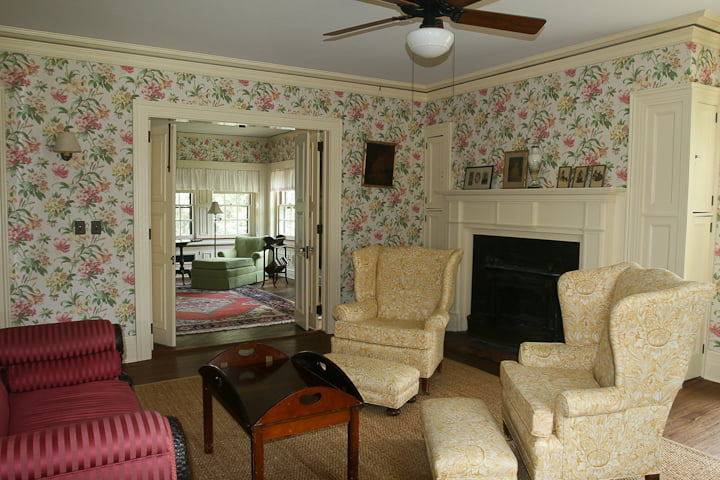
House tours mention personal touches; staying in the gracious manor feels like a visit to a wealthy aunt, old family photographs line the walls. Look for Uncle Richard’s collection of shark teeth and Margaret’s favorite conch shell. All rooms are decorated with Carnegie originals or antique furnishings. The library contains hundreds of first editions; the old gun room became the bar. Guests pour for themselves on the honor system.

The one-hundred-foot front porch vies as favorite for its sweeping veranda and bookend bed-like swings. Rocking chairs line the front rail and creak on the wooden floorboards. Hummingbird feeders attract a bevy of those tiny, twittering creatures.

Hors d’oeuvres, graciously served in the living room, are typically enjoyed with cocktails on the porch. Jane Walsh, a guest from Palm Beach, calls Cumberland, “a slice of heaven.” She and her husband Michael celebrated their 40th wedding anniversary with a return visit and hope to come back every year.

Michael whispers, “Don’t tell anybody about this place. It’s total relaxation.”

A Parlor at Greyfield Inn

Dinner at 7:30 PM is an elegant affair.  Men must wear jackets. The dining room features one long board, beautifully set with flowers and heirloom silver candlesticks, and two side tables. Honeymooners often sit by themselves, but most prefer chatting with others and discussing the day’s activities.

Blessedly cool, air-conditioned guest rooms on the second or third floor include private baths or shared amenities. Guests may also take advantage of the state-of-the-art bath house behind the Inn. The master suite includes a spacious 15 x 20-foot sitting room, a pineapple-post king bed and views out the front, side and back of the house. A claw foot tub dominates the bath, with shower accommodations.

Complimentary fat-tired bicycles, good on the sand, become a real bonus. A ten-minute pedal to the beach at sunrise makes an ideal start to the day. Cyclists often ride to the Dungeness ruins, via Grand Avenue, a dirt road beneath overhanging trees. Old photos show the gutted frame engulfed in vines. But, the NPS removed the foliage- and some of the mystique, to reinforce the crumbling bricks.

Don’t miss another highlight, an outing with a naturalist. By special permission, Greyfielders ride in open air seating for an exhilarating three-hour adventure. Stops include the salt marsh; the bluff- highest point on the island at 80 feet; the shallow, 83-acre Whitney Lake (home to gators); The Settlement and First African Baptist Church.

Interior of the First African Baptist Church

The teensy old slave church with red doors rose to Notre Dame fame following the 1996 Kennedy wedding. Venturing inside uncovers stark, whitewashed walls and windows and rough-hewn pews. Visitors must stretch their imagination to envision candlelight and flashlights used during the hush-hush Kennedy service arranged by Carnegie granddaughter, GoGo Ferguson.

The island tour stops for a peek at Plum Orchard, the Greek revival home of George Carnegie. The NPS recently spent $5.3 million on renovation to the decaying shell and interior. The extravagance of the era crystallizes with the realization that this grandiose home and indoor pool–built in 1898- sits in the enchanting wild, 45 minutes from Georgia’s mainland.

The exotic forest surrounding Plum Orchard feels like a gnome’s sanctuary. Cool, dark, shadowy branches are home to mosses, lichens and emerald green resurrection ferns. The outside world seems shut out except for sounds like yellow-throated warblers or pileated woodpeckers. An afternoon shower presents a squawking chorus, compliments of green tree frogs.

From the dim jungle, you emerge to the blinding flat, sandy beach that stretches as far as the eye can see. There’s not a person, beach towel, umbrella or chair on a shoreline that’s almost 1,000-feet wide at low tide. What can compare?

Thousands of sandpipers, sanderlings and other shorebirds dodge waves. During raptor migration, enthusiasts may see hawks and peregrine falcons. Soaring above the dunes lurk vultures and bald eagles. The entire island is on the Colonial Coast Birding Trail, with more than 277 identified species.

Nesting Loggerhead Turtle

Loggerhead turtles return from May to September creeping just over the dunes’ high-water mark to lay eggs. The NPS attempts to police feral pigs that forage the nests. Non-native wild horses and hogs disrupt and endanger the sea oats and sand dunes.

According to naturalist Fred Whitefield, “sea oats are the most important plant on the island because their deep roots slow dune erosion.” But…the tourists love the beauty of the ponies.

Dusk brings raccoons and armadillos, and a variety of critters whose beady eyes and acute sense of smell make them nocturnal scavengers. Night falls and the place has the magnificent feel of solitude on a remote private island.

A weekend at Greyfield lets you flip back the pages of history and return to the privileged days of Jay Gatsby, or camp like early settlers who slept under the stars. Just slow down like the turtles on her shore, roll with the tides or escape in the thick of her forests. Retreat like the former elite or use your own feet. No matter which adventure you choose, Cumberland is an open book waiting for you to write a chapter.

This article also appears in the February 1, 2010 issue of Business Jet Traveler. View it now on Business Jet Traveler Online.