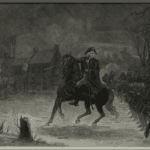
Washington leading the way to Valley Forge, Pennsylvania.
After the stunning victory at Saratoga in October 1777, the American cause finally gained international credibility. France would soon become an ally. Yet victory did not bring relief.
In December, General George Washington led nearly 12,000 weary soldiers into winter quarters at Valley Forge, only eighteen miles from British-occupied Philadelphia. The camp would test not only the army, but Washington himself.
He faced shortages, desertion, political rivals in Congress, and whispers that he should be replaced. Letters from the time reveal a leader weighed down by doubt yet anchored by resolve. Valley Forge became Washington’s greatest test.
A Cabin at Valley Forge National Historical Park
A Battlefield Without Bullets
More than 1,000 log huts rose from frozen ground. Smoke stung eyes. Cold cut through thin blankets. Shoes disintegrated. Some men wrapped their feet in rags, leaving bloody trails in the snow.
Disease swept through camp—typhus, dysentery, pneumonia, and smallpox. By spring, over 2,000 soldiers had died. Not from enemy fire, but from hunger and illness.
Yet the army did not disband.
The Turning Point: Baron von Steuben
Statue at Valley Forge By Abhiram Juvvadi – https://commons.wikimedia.org/w/index.php?curid=145511059
In February 1778, a Prussian officer arrived carrying the discipline of Europe and the hope of change—Baron von Steuben.
Though not truly a baron, he had trained with the army of Frederick the Great. At Valley Forge, he became Inspector General and drilled the troops personally, shouting commands in French and German while aides translated.
Von Steuben introduced standardized formations, sanitation rules, and bayonet training. He wrote the army’s first official training manual. Under his guidance, the Continental Army transformed from a struggling militia into a unified fighting force.
Lafayette: Loyalty in the Cold
Washington and Lafayette at Valley Forge, Painting by Dunsmore.
The young French nobleman Marquis de Lafayette arrived in America in June 1777. He fought bravely at Brandywine and Germantown and spent the brutal winter at Valley Forge alongside the soldiers.
Washington came to trust him deeply. Lafayette’s presence strengthened Franco-American ties and symbolized international hope for independence.
The Women of Valley Forge
The army did not survive alone.
Hundreds of women—wives, widows, daughters, and camp followers—cooked, washed, mended, nursed, hauled water, and buried the dead.
Martha Washington
This miniature portrait, painted in 1772 by Charles Willson Peale, is the earliest depiction of Martha after her marriage to George Washington and is a rare depiction painted before Washington’s presidential years. She is 41 years old at the time (image courtesy of Mount Vernon Ladies’ Association).
In February 1778, Martha Washington arrived to join her husband. She visited the sick, organized clothing drives, hosted officers’ wives, and provided emotional strength for the camp.
Lucy Flucker Knox
Lucy Knox, from the American Battlefield collection.
Lucy Flucker Knox, married to Henry Knox, was pregnant when she arrived, Lucy lived among the soldiers and helped nurse the sick, sharing the same harsh conditions.
Catharine Littlefield Greene
Catharine Greene: Photo from Portsmouth History Notes.
A political confidante and unifier, Catharine, wife of Nathanael Greene, hosted gatherings that lifted morale and strengthened bonds among officers.
Polly Cooper (Oneida Nation)
Statue in King of Prussia, Pennsylvania.
Polly helped deliver corn and food from the Oneida people when the army was near starvation—an act of lifesaving diplomacy.
Margaret Corbin
Margaret Corbin was wounded while fighting at Fort Washington, Margaret later became one of the first American women to receive a military pension. She was not background figure. She was a fighter and lifeline.
Spring: A Nation Takes Shape
When the army marched out of Valley Forge in June 1778, they were no longer a desperate rebellion.. They had become a nation in formation.
Visiting Valley Forge Today
Valley Forge National Historical Park is located in King of Prussia, Pennsylvania—just 18 miles (about 30 minutes) from downtown Philadelphia. Valley Forge is the place where George Washington and the Continental Army took refuge during the winter of 1777-1778. Today the park protects 3,500 acres of meadows, woodlands, historic landscapes, and monuments commemorating the resolve of the Revolutionary War generation and honoring the power of people to pull together, overcome adversity, and find renewal through transformation.
Plan to spend 2–4 hours exploring the park’s Encampment Loop, Washington’s Headquarters, and reconstructed soldier huts.