Baby boomers grew up watching powerful rockets launch ‘right stuff’ astronauts into orbit. As the space program evolved, so did the size of the missiles from the Atlas to the Titan, and later the 360-foot Saturn V moon rocket. Sadly, the US manned space flight program is currently curtailed. Private companies are developing vehicles for future space exploration but none are available at this time.
Therefore, I was surprised to receive an invitation to watch a rocket launch on March 19, 2013, at Kennedy Space Center and even more pleased that it fit into my schedule. The drive from St. Augustine is a little under two hours and the launch window was scheduled from 5:21 pm to 6:01 pm. Perfect.
I parked in the Visitor Center lot ($10.00 fee per vehicle) then entered the complex through the suitably planted rocket garden. This area blossoms with numerous projectiles nurtured through NASA’s care and various flying machines like the tiny one-man Mercury capsule.
I meandered along, passing by the newly opened Angry Birds interactive encounter and found the bus queue for the Saturn V Center, a tour that’s included with visitor admission. The bus ride takes about 15 minutes and passes the VAB (Vehicle Assembly Building), the largest one story building in the world. Huge is an understatement. The building, complete with a painted American flag, greets like an old friend; it’s familiar to anyone who watched past NASA events. The bus driver said, “Each of the stars on the flag is 6 feet across, the blue field is the size of a regulation basketball court, and each of the stripes is 9 feet wide.”

The Kennedy Space Center actually lies within the Merritt Island National Wildlife Refuge, home to more than 1,500 species of plants and animals. Some 600 alligators thrive in the roadside ravines and lakes. The bus passengers caught site of a few gators, an Eagle’s nest and a number of egrets and herons.
Upon arrival at the Saturn V building, I learned it houses the original Apollo mission control center. Visitors file into an amphitheater attached to the control room and watch a three-screened video display. I became the observer of a countdown and launch of the world’s most powerful rocket on its take-off for the moon. The seats vibrate during the launch. Very cool!
As I exited the control room I practically ran into the massive side lying Saturn V. The rocket is 58 feet taller than the Statue of Liberty from the ground to the torch. The fully fueled giant weighed 6.5 million pounds and had a payload capacity of 260,000 pounds.

After perusing some astronaut spacesuits and other Apollo related displays, I went outside to set up my tripod. Although scheduled lift-off was still about an hour ahead, the grandstands were filling with spectators and kids were playing games on the grass. This was a slice of Americana, an apple pie moment.
A NASA spokesman appeared about 30 minutes before launch time and explained what would happen. We would see the launch of an Atlas V rocket carrying missile warning satellites for national security purposes. The Atlas V is a small rocket and its heaviest payload lifted into orbit was 15,000-pounds.
The spokesman said we would hear mission control requesting systems approval and the specialists responding with a “GO” signal — if all was right. Assuming it was, the mission controller would give permission for the countdown to proceed.

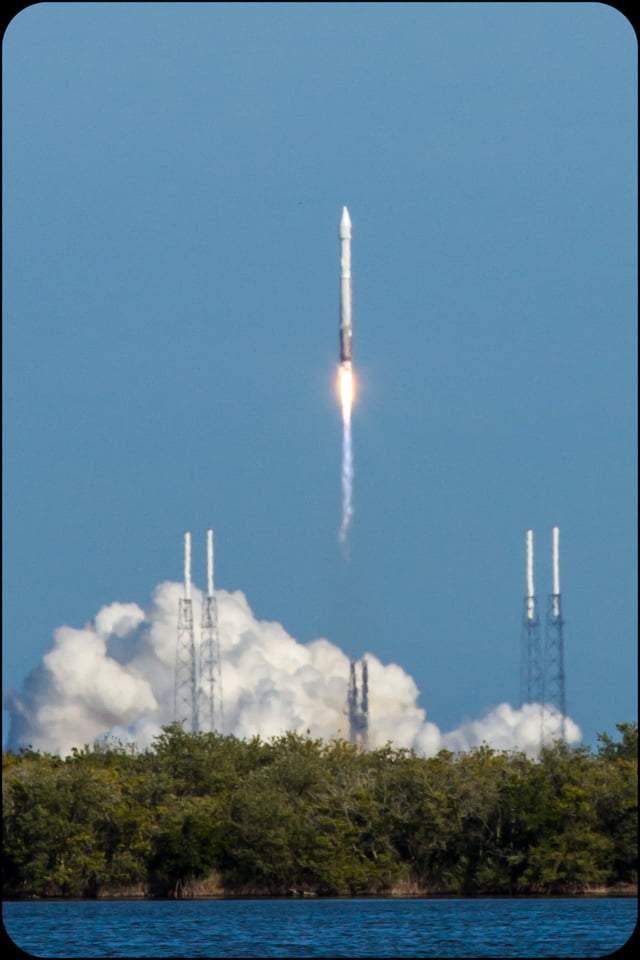
At about ‘T’ minus 3 minutes, a hush came over the crowd; people anxiously looked in the direction of the rocket. I could feel excitement mounting as the minutes ticked away. When the countdown got to 15 seconds, everyone was on alert. Then, the number 10 was spoken and the crowd spontaneously joined in the reverse count 3…2…1…zero. We heard the word “ignition” and saw lots of white smoke blast around the base of the rocket. Soon flames appeared and a gradual lift-off commenced. The adults began to clap and cheer.
As the rocket rose higher, the cheers grew wilder and the sight was honestly awe inspiring. Much more captivating and thrilling than seen on television.
After another ten seconds the rumble and roar grew louder; then a rocket separation occurred leaving a trail of billowing ghostly smoke high in the sky. I hate to say this, but the trail reminded me of the ill-fated Challenger’s. In a matter of ten more seconds, the rocket’s red glare was out of sight and headed into orbit.
I could scarcely contain my joy! Honestly, a launch is something to view and a moment you will not forget. I strongly encourage everyone to witness a live event, if possible. Had the rocket been larger and manned, I am sure it would have elicited goose bumps or tears. But, don’t let a smaller rocket stop you; the thrill is still magnificent.
I am so grateful I availed myself of this opportunity. Thank you Kennedy Space Center.

By the way, should your summer plans include a visit to the Orlando area, consider a stop to see the new $100 million Shuttle Atlantis facility being unveiled at KSC on June 29th. The addition is currently being constructed around Atlantis, the last shuttle to fly in 2011.
Also KSC behind the scenes tours continue- you can read about them in my earlier post.
The VAB tour has been extended through 2013 and the LCC and Launch Pad tours are confirmed through June 30. All Up-Close Tours are $25 per adult and $19 per child (ages 3-11) plus tax, in addition to admission.
For more information on Kennedy Space Center Complex, please visit www.KennedySpaceCenter.com.
Here’s a video of the Atlantis Shuttle launch as seen on a Behind the Scenes Tour: